Posted on — 2 Comments

How does pollination work? A step-by-step guide to pollination and the plant life cycle

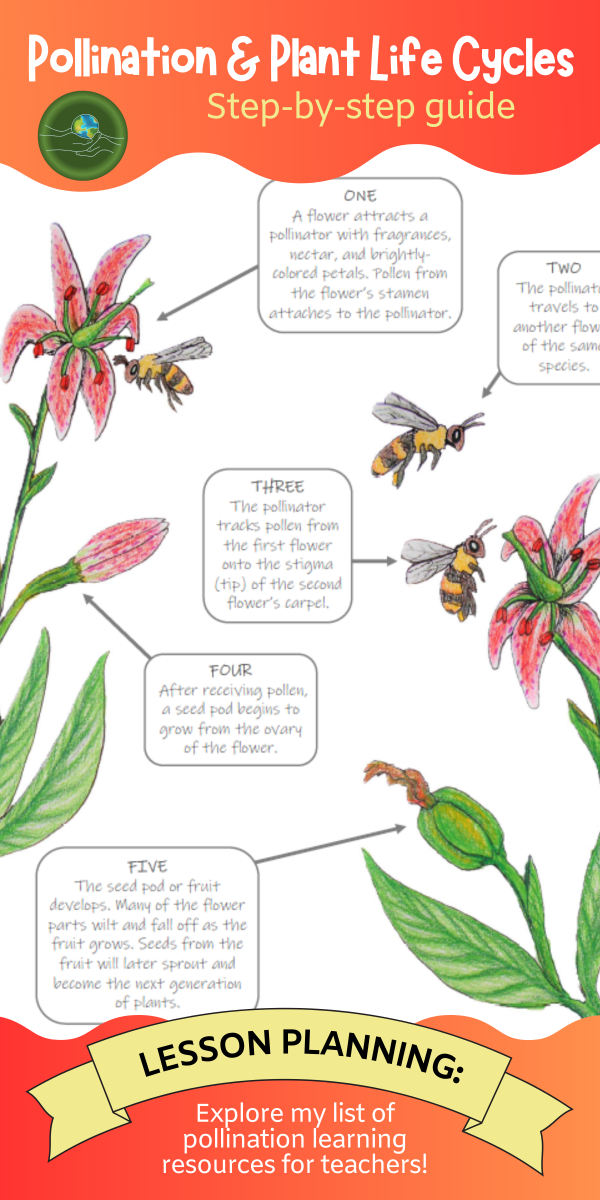
banner advertising a blog post about pollination and plant life cycles with a diagram of bees pollinating flowers
text that says share this post

In this post, we will take a closer look at the steps of animal pollination and the plant life cycle. You might already know that pollination is the transfer of pollen from the stamen to the carpel of a flowering plant (psst – brush up on your plant anatomy by reading my flower anatomy post or checking out my Flowers Unit!). Once pollinated, the plant forms a fruit. Fruits contain seeds, which will grow into the next generation of plants.

A variety of animals can be pollinators, such as bees, butterflies, and many others that may surprise you. The relationship between a pollinator and a plant is key to the survival of both species. This relationship is so important to both the plant and the pollinator that it influences how they evolve. In other words, plants and pollinators coevolved. Plant species developed traits to help them attract pollinators, such as brightly colored petals, sweet nectars, and strong scents. As pollinator species grew reliant on nectar as a food source, they developed body parts and habits for collecting flower nectar more efficiently.

Before we dive in: If you’re an educator planning to teach pollination in your classroom, great activities are key to deepening understanding! I think you and your students will love my Pollination Unit, which is also found within my Botany Collection (plus you’ll support my blog with your purchase! ❤️)

Recommended products

Now, let’s take a look at the steps of pollination and the plant life cycle!

Step 1: Attracting pollinators

A flower attracts a pollinator with fragrances, nectar, and brightly-colored petals. Pollen from the flower’s stamen attaches to the pollinator.

A pollinator visiting a flower.

Step 2: Pollen transfer

The pollinator travels to another flower of the same species.

A pollinator traveling between flowers of the same species.

Step 3: Pollination

The pollinator tracks pollen from the first flower onto the stigma (tip) of the second flower’s carpel. Pollen travels via the style to the flower’s ovary.

The pollinator transfers the pollen to a second flower.

Step 4: Fruit growth

 After receiving pollen, a fruit or seed pod begins to grow from the ovary of the flower. Many of the flower parts wilt and fall off as the fruit/seed pod grows.

A fruit starts to form from the flower’s ovary.

Step 5: Seed dispersal

The seed pod or fruit develops. Once the fruit is ripe, the plant must disperse its seeds. At this point, some plants rely on another animal (separate from the pollinator) to help with seed dispersal. After the animal eats the fruit, it travels away from the parent plant and deposits the seeds in its scat. However, many plants do not rely on animals for seed dispersal. Alternative methods for seed dispersal utilize forces such as wind, water, and gravity.

Almost ready for seed dispersal.

Step 6: Germination and growth

After seed dispersal, seeds will germinate (or sprout) into tiny plants. The luckiest of the tiny plants will grow and reach maturity. Once mature, the plants make flowers of their own to attract pollinators, and the cycle begins again!

Germination process.

Teaching Pollination and Plant Life Cycles

Are you teaching pollination in your classroom? Here are some additional activity ideas and resources!

1. Try my free pollinator guessing game in your classroom:

Directions and cards for a pollinator guessing game are available on the free resources page of my website. My email subscribers gain access to the free resources page (plus receive my newsletters with new activity ideas, project guides, and science teaching inspiration!).

2. Read my post about weird and wild pollinators!

3. Check out my list of pollinator activity ideas for classrooms!

4. Try the flower anatomy activity in this blog post:

5. Study pollination with Wild Earth Lab!

Your students will love my Pollination Unit and other science units! I created this set of printable pollination learning materials and it is packed with activities and information, as well as my pollination artwork!

Recommended products

Here are some more units that I think you’ll love:


Are you interested in reading more posts about environmental science topics? Subscribe or follow Wild Earth Lab using the links below!


Sharing options and discussion for this post:

Posted on — 4 Comments

Which animals pollinate? Common pollinators plus a few that will surprise you!

banner with pictures of pollinators and the text "weird and wild: animal pollinators!" and "+ free classroom activity! Learn about the diversity of pollinators!"

Pollinators are animals that transfer pollen between flowers. Many pollinators are insects, such as bees. However, birds, mammals, and a variety of other animals can also be pollinators! Pollinators are key members of most terrestrial (on-land) ecosystems. Pollinated plants produce food that feeds other members of the ecosystem. Pollinators also help humans because they pollinate many of our food crops. For example, a tomato could not form from a tomato plant’s flower without being pollinated by a bee.

Plants and pollinators have symbiotic relationships – long-lasting, close relationships between two living beings. A pollinator and a plant have a specific type of symbiotic relationship called mutualism, in which the relationship benefits everyone involved. The pollinator gets a tasty meal of nectar. The plant gets pollinated so it can make seeds. It’s a win-win!

In this post, we’ll take a look at the different types of animals that pollinate plants. But first…

A note for teachers: are you teaching pollination? I think you and your students will love the hands-on activities and thoughtfully crafted visuals in my comprehensive Pollination Unit! It includes all the activities, handouts, worksheets, and diagrams you’ll need for teaching pollination. I hope you love it!

Bees & Wasps

The European honey bee or

Although there are many different animal pollinators, bees (especially honeybees) are usually considered the most important pollinator due to their key role in many ecosystems and their ability to pollinate a wide variety of different plants, including many food crops. Bees rely on flowers as their food source – they fly from flower to flower collecting nectar and pollen.

There are many types of bees that pollinate, including honeybees, bumblebees, and solitary bees. Surprisingly, wasps are also sometimes pollinators. That’s right – while wasps are often thought of as being unfriendly pests, they actually play very important roles in their ecosystems!

Butterflies & Moths

Photo by Erik Karits on Pexels.com

Butterflies drink nectar through a long proboscis – a straw-like mouth part that can reach deeply into flowers. Consequently, butterflies often pollinate deeply tube-shaped flowers. They are attracted to colorful, clustered flowers that are open in the daytime.

On the other hand, nocturnal moths pollinate night-time opening flowers. Moths also have long proboscises and can reach into deeply tubular flowers like their butterfly relatives. In fact, certain moths can have astoundingly long proboscises, such as Darwin’s hawkmoth.

As the tale goes, Charles Darwin came across a species of orchid flower in Madagascar that holds nectar at the end of a foot-long tube. Darwin hypothesized that a species of butterfly or moth with a foot-long proboscis must exist in order to drink nectar and pollinate this flower. Some laughed at this idea, but many years later, scientists identified a species of hawkmoth in Madagascar with a foot-long proboscis, just as Darwin predicted!

More insect pollinators: beetles, ants, & beyond!

Bees, wasps, butterflies, and moths are just four of the many insects that pollinate plants. Some flies are also pollinators, as are some beetles and ants! Many of these insects inadvertently pollinate flowers as they crawl across them, picking up pollen on their bodies.

Birds

brown hummingbird selective focus photography
Photo by Philippe Donn on Pexels.com

Hummingbirds are by far the most common and well-known bird that pollinates. They drink nectar through their long beaks and can pollinate tube-shaped flowers, just like butterflies. It is well known that hummingbirds especially love red flowers. You may see people hanging red plastic hummingbird feeders in their yards, designed to attract these adorable pollinators. Hummingbirds are even known to fly directly into people wearing red, mistaking their clothing for a cluster of tasty red flowers.

In certain ecosystems, other types of birds such as parrots may also sometimes pollinate.

Bats

Photo by HitchHike on Pexels.com

Did you know that bats can be pollinators? While bats are best known for their ability to catch and eat insects using echolocation, some bats prefer eating fruit and flower nectar. Bats are nocturnal and pollinate at night, like moths. But as some of the largest pollinators, bats usually prefer bigger flowers that produce larger volumes of nectar. Agave, bananas, and some cacti are all popular among bats!

Even more unusual pollinators

black brown and white animal on tree
Photo by Alexander Dummer on Pexels.com

The list does not stop here! There are many more unique pollinators out there. Some reptiles pollinate. As do some slugs. Even a variety of mammals, such as some lemurs and sugar gliders, are known to pollinate plants in their ecosystems. There is certainly no shortage in the diversity of pollinators found around the world!

Try this free pollinator game for your classroom…

Are you looking to teach your students about the diversity of pollinators? Here’s a game you can try in your classroom! Print out pictures of a variety of pollinators and tape them to students’ backs. Tell students that all the animals on their backs can pollinate plants. Then, instruct the students to ask each other yes/no questions about the animals on their backs until they can guess them correctly.

Freebie: for this game, I’ve put together 18 printable pollinator cards, plus directions. Click here to download the free cards and game!

Support Wild Earth Lab with a curriculum purchase?

Teaching pollination? Your students will love my Pollination Unit! I created this set of printable pollination learning materials, and it is packed with activities and information, as well as my pollination artwork!

Find your next science topic from Wild Earth Lab…

Looking for your next lesson? Try one of these…


Are you interested in reading more posts like this? Subscribe or follow Wild Earth Lab using the links below!


References and Further Reading

  1. California Academy of Sciences (n.d.). Darwin’s Hawk Moth. Available: https://www.calacademy.org/explore-science/darwin%E2%80%99s-hawkmoth
  2. Houston Zoo (2018). Unusual Pollinators and the Plants They Love. Available: https://www.houstonzoo.org/blog/unusual-pollinators-plants-love/
  3. Mize, A. (2018). Lizards, mice, bats, and other vertebrates are important pollinators too. The Ecological Society of America. Available: https://www.esa.org/blog/2018/04/04/vertebrate-polinator-metaanalysis/
  4. USDA Forest Service (n.d.). Unusual Animal Pollinators. Available: https://www.fs.usda.gov/wildflowers/pollinators/animals/unusual.shtml
  5. USDA Forest Service (n.d.). Who are the pollinators? Available: https://www.fs.usda.gov/wildflowers/pollinators/animals/index.shtml

Sharing options and discussion for this post:

Posted on — 1 Comment

What are the different types of pollination? How animal, water, and wind pollination methods work

Poster that says "study pollination methods" and "wind, water, and animal pollinators" and "with tons of pollination activity ideas to try in your classroom!"

You might already know that pollination is the transfer of pollen from the stamen (male flower part) to the carpel (female flower part) of a flowering plant. Once pollinated (via any of the pollination methods), the plant forms a fruit. Fruits contain seeds, which will grow into the next generation of plants. Read more about flower anatomy and download a free flower anatomy diagram here.

Pollination Methods Diagram featuring my colored pencil art!

Different plants are pollinated in different ways. Some plants self-pollinate, meaning a flower is pollenated with pollen from the same plant or even the same flower. Alternatively, many plants cross-pollinate, meaning they receive pollen from a different plant of the same species. Since plants cannot move, they usually need some help to transfer their pollen to other flowers or plants. For instance, many plants need the help of animals called pollinators. However, some plants are pollinated by the wind carrying their pollen to other flowers. Additionally, some aquatic (water-living) species of plants rely on water for pollination: they release pollen into the water so it can float to other plants. Below, I will explain more about each of the three different pollination methods: animal pollinators, wind, and water.

Download my printable learning materials to learn all about animal pollinators!

Pollination Method 1: Animals

Animal pollination is when a plant relies on an animal pollinator to carry its pollen between flowers. Examples of animal pollinators include bees, butterflies, and beetles. However, many other types of insects and animals can be pollinators in some cases including mammals, reptiles, and birds!

Flowers pollenated by animals have an incredibly wide variety of colors, shapes, scents, and sizes depending on the pollinator that they need to attract. Animal pollination is the most common pollination method. It is estimated that around 80% of plants are pollinated by animal pollinators, rather than by abiotic forces like wind and water.

Pollination Method 2: Wind

Wind pollination is when a plant creates large amounts of light-weight pollen which is carried between flowers by the wind. You have probably seen wind-borne pollen – perhaps in spring or summer you have gone outside to find the surfaces of patio furniture and cars covered in a fine yellow powder. Maybe you have even started sneezing or itching your eyes because your body reacts to the pollen in the air. Scientists estimate that somewhat less than 20% of plants are pollinated by the wind. For example, some trees, grasses, and corn use the wind pollination method.

Pollination Method 3: Water

Water pollination occurs when plant releases its pollen into water or onto the surface of water. Pollen floats or flows through or across the water between flowers. Some aquatic plants use this pollination method, but overall, very few plants are pollinated via water. Scientists estimate that less than 1% of all plants are pollinated via water.

Teach Pollination in Your Classroom:

1. Explore pollination & plants with Wild Earth Lab!

2. Further Reading:

3. Free Pollination Learning Resources:

Unusual pollinators game – directions and cards. Students ask yes/no questions to identify the pollinators taped to their backs.


Are you interested in reading more posts like this? Subscribe or follow Wild Earth Lab using the links below!


References and Further Reading

  1. Houston Zoo (2018). Unusual Pollinators and the Plants They Love. Available: https://www.houstonzoo.org/blog/unusual-pollinators-plants-love/
  2. Maryland Grows (2020). Gone with the wind: a look at wind pollination. University of Maryland Extension. Available: https://marylandgrows.umd.edu/2020/04/13/gone-with-the-wind-a-look-at-wind-pollination/
  3. Mize, A. (2018). Lizards, mice, bats, and other vertebrates are important pollinators too. The Ecological Society of America. Available: https://www.esa.org/blog/2018/04/04/vertebrate-polinator-metaanalysis/
  4. USDA Forest Service (n.d.). Pollination Strategies. Available: https://www.fs.usda.gov/wildflowers/pollinators/Plant_Strategies/index.shtml
  5. USDA Forest Service (n.d.). Wind and Water Pollination. Available: https://www.fs.usda.gov/wildflowers/pollinators/wind.shtml

Sharing options and discussion for this post:

Posted on — 3 Comments

12 Pollination Activities for Kids: pollinator lesson ideas to try in your classroom!

photo of a flower anatomy diagram overlaid with the text "10 pollination activities for kids!" and "+ a free flower anatomy worksheet!"

Wild Earth Lab is supported by readers like you. This post includes links to my own products and affiliate products. If you purchase through links on my site, I may earn a small commission at no additional cost to you.

If you’re learning about pollination with your students or kids this school year, try out some of these fun pollination activity ideas in your classroom!

Special note for educators: if you’re planning to teach pollination, you can find all the activity directions, handouts, and printable materials you’ll need in my complete Pollination Unit – and you will support this blog with your purchase.

1. Insect Vision

A flower that looks fairly plain to the human eye may look completely different through the eyes of an insect! Flower petals sometimes reflect UV and infrared light, which are colors that the human eye cannot see but are visible to some insect pollinators.

Grab a UV marker plus black light set, paper, and regular markers. Start by using a regular marker to draw the outline of a flower and cut it out. Then, create “invisible” patterns on the petals with the black light marker. Then shine the black light on your flower to reveal the hidden designs!

A flower that looks fairly plain to the human eye may look completely different through the eyes of an insect!

2. Pollinator Garden

Plant a pollinator garden with native wildflower species to attract pollinators to your yard. Start by researching native wildflower species in your local area. A plant nursery or garden center can be a great place to start, and you can also find seeds online. To further promote pollinator habitat in your yard, you can even build a pollinator hotel!

3. Flower Dissection

Dissect a flower to learn about flower anatomy. Can you find the stamen, carpel, petals, and sepals? Talk about how brightly colored petals can attract pollinators, how stamens spread pollen onto the pollinator’s body or legs, and how carpels have pollen tracked onto them by the pollinators.

Diagram showing the parts of a flower, including the carpel, stamen, pedicel, sepal, petal, and receptacle.
Anatomy of a flower!

4. DIY Flower Anatomy Diagram

Here’s a fun pollination activity idea that’s completely free! I created this free printable flower anatomy coloring activity. You can download and print it from my free resources page. To access the free resources page, simply join my newsletter (you can unsubscribe at any time, but stay subscribed if you’d like my fun science and nature-related activities and more sent to your inbox!)

Freebie found on my free resources page

5. Pollination in Action

Visit a butterfly pavilion or butterfly house to observe pollination up close!

Better yet, raise your own butterflies from caterpillars, then release them into your garden where they can feed on your flowers! You do this using a butterfly grower’s kit or by finding caterpillars in your yard to raise.

close up of a child holding a butterfly on hand
Photo by Vladimir Srajber on Pexels.com

6. Metamorphosis and Migration

Raise and release monarch or painted lady butterflies. You can even find kits to band monarch butterflies and discover if they migrated successfully! For more information on monarch banding and tracking, visit Monarch Watch.

7. Healthy Habitats

Participate in an invasive species removal workday at a local natural area. This will help create room for the native wildflowers to grow and feed pollinators!

8. Honey Fun

Learn about how bees make honey (for example, here’s an article about bees making honey from Southern Cross University). Then cook or bake something with honey!

honeycomb close up detail honey bee
Bees making honey. Photo by Pixabay on Pexels.com

9. Waggle Dance

Read about or watch a video of the “waggle dance” that bees use to tell hive members the distance and direction to flowers (e.g., here’s a waggle dance video on YouTube from Bienentanz GmbH). Then, try doing your own waggle dance in the same pattern as the bee!

10. Pollination at Night

If you have night-time opening flowers in your area (e.g., evening primrose, moonflower, night phlox), go for a nighttime walk with a flashlight to observe the open flowers. Go back during the day to see them when they are closed.

11. Unusual Pollinators

Learn about some unusual pollinators with this fun ice-breaker game! I’ve created a printable handout with the game directions and free cards. You can download and print it from my free resources page. To access the free resources page, simply join my newsletter.

12. Symbiotic Relationships

Did you know that pollination is a type of symbiotic relationship between a plant and a pollinator? Learn more about symbiotic relationships with my mini study pack:

More Pollination Materials From Wild Earth Lab:

Are you interested in reading posts with ecology and science learning activity ideas? Subscribe or follow Wild Earth Lab using the links below!

Sharing options and discussion for this post:

Posted on — 2 Comments

Disturbance and succession: examples of ecological disturbances and wildfire ecology

drawing of trees on fire with the text "learn about wildfire and ecological succession!" and "with pictures and diagrams"

In this post, you’ll learn about ecological disturbance and succession, starting with definitions and examples of disturbances. We will cover the differences between primary succession and secondary succession, as well as the steps of the ecological succession process. Finally, you’ll read about why disturbances like wildfire can be important and natural processes in ecosystems!

A note for teachers: before we dive in, I want to direct you to the classroom materials that I created for teaching this topic. I think you’ll love my wildfire ecology mini study, which is also found within my larger Forest Ecology Unit. Plus, you will support this blog with your purchase!

photo of classroom handouts for studying wildfire and forest succession
Explore fire ecology and forest succession with these materials!

What is a disturbance?

What is a disturbance in ecology?

A disturbance is some sort of event that causes a large and rapid change in an ecosystem. Disturbances may abruptly change the ecological community – the plants, animals, fungi, etc. in an ecosystem. Disturbances may also impact non-living features of an ecosystem such as the soil and water. Examples of disturbances in nature include wildfires, parasitic insect outbreaks, landslides, avalanches, volcanic eruptions, and floods.

What is ecological succession?

Succession is the natural and gradual change in an ecosystem over time. Different species may live and thrive in an environment depending on how far along the ecosystem is in the succession process.

What are the types of ecological succession?

There are two main types of ecological succession. Primary succession, and secondary succession. Primary succession occurs when species are colonizing a new habitat that was previously devoid of life. An example of primary succession is the formation of an ecological community atop newly formed igneous rocks after a volcanic eruption. Because the rocks just formed, the community is forming on them for the first time (hence, primary succession). Secondary succession happens after a disturbance that caused a sudden change in an existing ecosystem, such as a wildfire or flood. Such disturbances may (temporarily) wipe out or scare off many of the species living there before the disturbance.

The Steps of Ecological Succession

  1. Disturbance: A disturbance is an event that causes a large and rapid change in an ecosystem. Natural disturbances include wildfires, insect infestations, landslides, avalanches, volcanic eruptions, and floods.
  2. Post-Disturbance: After a disturbance, there are significant changes to the ecological community (plants, animals, fungi, etc.) as well as to non-living features such as the soil and water. Some severe disturbances may leave behind little more than bare rock.
  3. Pioneer Species: Pioneer species are the first to grow in the post-disturbance landscape. These usually include hardy lichen, fungi, and plant species that can survive in rocky soils without many nutrients. Pioneer plant species are often introduced to a disturbed area when wind or water carries in seeds from nearby. As the pioneer species live and die, they help make a nutrient-rich topsoil, which allows for more plants to grow.
  4. Intermediate (shade intolerant) species: Intermediate plant species include grasses, shrubs, and some trees that can survive in thin topsoil. Intermediate species often include shade-intolerant plants which thrive in the relatively open, post-disturbance landscape. As more and more plant species become established, they help create habitats for different animal species to return to.
  5. Climax (shade tolerant) species: Climax species are the last species to return to an area following a disturbance. Climax species require a thicker layer of nutrient-rich topsoil to grow. Climax species often include shade-tolerant tree species, which can grow from seedlings beneath a canopy of shade-intolerant trees, as well as any animals that rely on these tree species.

Why are ecological disturbances important?

Ecosystems naturally experience a cycle of disturbance and succession. We call the natural timing and magnitude of disturbances in an ecosystem a disturbance regime. Maintaining a natural disturbance regime helps keep an ecosystem healthy! For example, regular, small wildfires can clear out diseased trees and overgrown brush, which helps prevent more severe fires and insect outbreaks from happening later on! Additionally, natural disturbances create the conditions for new trees to grow. Interestingly, some tree species even have cones that only open to release their seeds when they are exposed to extreme heat during wildfires!

How do humans impact disturbance and succession?

Humans impact the cycle of disturbance and succession in many ways. People create unnatural disturbances such as clearcutting forests. Humans sometimes introduce invasive species that take the place of native species during the succession process. We also alter the timing of disturbances, causing disturbances to take place more or less often than they should naturally. Humans often try to prevent disturbances like fires, floods, and landslides because they damage our buildings, roads, and homes. However, altering natural disturbance regimes has a history of coming back to haunt us. For example, preventing small, natural fires can lead to a larger, more damaging fire later on. For this reason, forest managers now set and closely supervise controlled burns over small areas, to mimic natural disturbances in a safer way.

More ways to study forests, trees, and ecology:

Recommended products


Are you interested in reading more posts like this? Subscribe or follow Wild Earth Lab using the links below!


References and Further Reading

  1. Free Fire Ecology Curriculum for multiple grade levels, from smokeybearlive.org!
  2. Project Learning Tree’s STEM activities about forest fires!
  3. Forest Ecology Basics from Michigan Tech
  4. Wildlife Ecology Basics from Michigan Tech

Sharing options and discussion for this post:

Posted on — 5 Comments

Symbiotic Relationships in Ecology: mutualism, parasitism, and commensalism

Photo of a bee on a flower
text that says share this post

Wild Earth Lab is supported by readers like you. This post includes links to my own products and affiliate products. If you purchase through links on my site, I may earn a small commission at no additional cost to you.

What is a symbiotic relationship?

A symbiotic relationship is a long-term interaction between two species. Did you know lichens are two species in a symbiotic relationship? A lichen is a fungi and an algae or bacteria living together. This is just one of many examples of a symbiotic relationship! Symbiotic relationships typically benefit at least one of the two species involved. Symbiosis is a common topic covered when teaching students about ecology.

Before we dive in: If you’re an educator planning to teach symbiotic relationships, great activities are key to deepening understanding! I think you and your students will love my Symbiotic Relationships Mini Study, which you can also find within my complete Forest Ecology Unit (plus you’ll support my blog with your purchase! ❤️)

Mutualism

Mutualism is a type of symbiotic relationship in which both species benefit. An example of mutualism is a squirrel eating nuts or fruit from a tree, and then dispersing the tree’s seeds in its scat. The squirrel benefits because it receives food, and the tree benefits because its seeds are spread and can grow into more trees.

Examples of Mutualism:

  • A bee drinks nectar from flowers, while spreading pollen from plant to plant.
  • A squirrel eats the nuts of a tree and disperses the seeds in its scat.
  • Bacteria and fungi live in a songbird’s intestines. The bacteria break down and eat parts of food that are difficult for the songbird to digest.
  • Algae and fungi live together as a lichen. The algae produces food through photosynthesis, and the fungi provide a thick, protective layer.
brown hummingbird selective focus photography
The relationship between flowering plants and pollinator is one example of mutualism. Photo by Philippe Donn on Pexels.com

Parasitism

Parasitism is a type of symbiotic relationship in which one species benefits and the other species is harmed. An example of parasitism is a group of insects invading a tree. The insects benefit because they live in and feed on the tree, but the tree is harmed because its important tissues are getting eaten and destroyed.

Examples of Parasitism:

  • A group of insect larvae eats most of the leaves of a tree, which harms the tree’s ability to make its food through photosynthesis.
  • Beetles cut off a tree’s circulation by feeding on the tree’s phloem, a tree part that moves sugars made during photosynthesis.
  • Ticks drink the blood of a rabbit and pass diseases to the rabbit.
  • A worm lives in the intestine of a deer, consuming some of the food the deer eats and causing the deer to not get enough nutrients.
tick
A tick is a parasitic arachnid that drinks the blood of its host. Photo by Erik Karits on Pexels.com

Commensalism

Commensalism is a type of symbiotic relationship in which one species benefits and the other species is not affected. An example of commensalism is a bird living in a tree. The bird benefits because it gets a safe place to live. The bird neither helps nor harms the tree.

Examples of Commensalism:

  • A bird builds a nest in a tree, providing the bird with a safe home, and neither harming nor helping the tree.
  • A chipmunk hides from the hot sun in the shadow of a tree. The tree is not affected.
  • A turkey hides from predators in shrubs. The turkey does not harm the shrubs in any way but does not help them either.
  • A spider builds a web between two ferns. The ferns are not impacted in any way.
shallow focus photography of a spiderweb with raindrops
A spider building a web on a plant could be an example of commensalism, as long as the plant isn’t harmed. Photo by NastyaSensei on Pexels.com

Is predation a symbiotic relationship?

Predation is when one animal hunts and eats another animal as food. Although this is not always considered a type of symbiotic relationship (because it is usually short-term), predation is still an important interaction between animals in an ecosystem!

Examples of Predation:

  • A badger digs up and eats earthworms.
  • A fox catches a rabbit and carries it back to a den to feed its pups.
  • An owl hunts for a mouse to eat.
  • A tree frog catches and eats a fly.
An example of predation. Photo by Tina Nord on Pexels.com

What about herbivory?

Herbivory is a short-lived relationship between species, similar to predation. However, herbivory is an interaction in which a plant-eating animal eats a plant. Herbivory is an important ecosystem interaction because it allows energy to flow up the food chain from producers (plants) to primary consumers (herbivores & omnivores). However, herbivory is not typically considered a symbiotic relationship.

Examples of Herbivory:

  • A deer eats some grass.
  • A moose munches the leaves off of a willow.
  • A minnow nibbles on some algae.
  • A caterpillar devours a leaf.
An example of herbivory.

Teaching Symbiotic Relationships and Ecology:

I have tons of free and paid resources to help you teach your kids or students all about ecology, symbiotic relationships, and more!

1. Free Worksheets & Posters From Wild Earth Lab

My email subscribers can access my full collection of free learning materials, which includes printables like these:

A worksheet for a visit to a pond
a food web diagram showing decomposers at the bottom, followed by producers, primary consumers, secondary consumers, and tertiary consumers at the top
A worksheet for a scavenger hunt

2. Try Nature Journaling

A great way to learn about symbiotic relationships is by spending time in nature and making observations. Spend 15 minutes sitting in a natural area, observing the wildlife and plants around you, then write about the interactions you see. Do you see any examples of symbiotic relationships?

New to nature journaling? There are many wonderful options for guided nature journals and handmade notebooks on Etsy. Here are a few popular options to help get you started with nature journaling:

3. Units (complete sets)

Support this blog when you purchase one of my ecology units! They include worksheets, lab activities, posters, and readings – everything you’ll need for an awesome ecology unit!

4. Mini Studies

My mini studies are selected “a la carte” materials that come from my units. They are great for those who don’t want to commit to a full unit or as a supplement to another curriculum.

5. Printable Classroom Posters

Individual posters from my units are available for purchase.

Thank you for your support!

Your purchase from my shop supports this blog and helps me create more educational content for teaching environmental science.

Thank you!


Want to read more ecology posts? Subscribe or follow Wild Earth Lab using the links below!


References and Further Reading

  1. Michigan Tech University. (n.d.). Wildlife Ecology Basics. Michigan Forests Forever Teachers Guide. Available: https://mff.forest.mtu.edu/Environment/EcologyWildlife.htm
  2. Lord, J. (n.d.). Exploring Symbiosis. Oregon Institute of Marine Biology. Available: https://oimb.uoregon.edu/Documents/GK12/GK12-Fourth-Symbiosis.pdf
  3. National Geographic Society (n.d.). Symbiosis: The Art of Living Together. Available: https://education.nationalgeographic.org/resource/symbiosis-art-living-together

Sharing options and discussion for this post:

Posted on — 5 Comments

What is Ecology? Learn why ecology is important + ecology activity ideas for kids

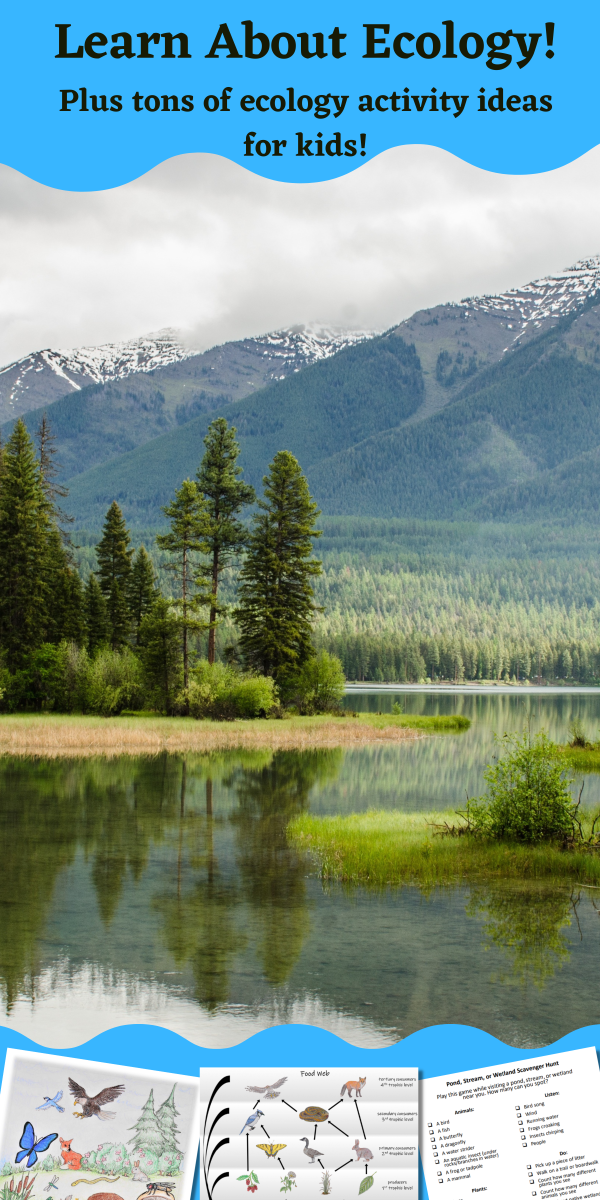
Photo of a mountain pond on a banner stating learn about ecology! plus tons of ecology activity ideas for kids!"

In this article, learn about ecosystems and ecology! Plus, you’ll learn the difference between biotic and abiotic. Also, read about why ecology is important and learn about what ecologists study!

Click here to skip to the the list of Ecology Activity Ideas for Kids!

Or, check out my food webs resources here!

What is an ecosystem?

An ecosystem is a community of living things (or organisms) that interact with one another and the environment where they live. Ecosystems include living (biotic) things such as animals, fungi, and plants. Furthermore, ecosystems also includes non-living (abiotic) parts of the environment, such as rocks, soil, water, and weather. All the living and non-living parts of an ecosystem are interacting and affecting each other over time in many ways.

Food webs educational materials, flashcards, and activities.
Looking for ecology lessons? Try out my food webs unit!

What is ecology?

Ecology is a type of science that looks at the relationships living things have with one another and with their environment. In other words, ecology is all about understanding the connections between organisms and their surroundings.

An ecosystem includes both living and non-living parts of an environment!

Why is ecology important?

We as humans do not live outside of ecosystems. Just like mushrooms, mice, and maple trees, humans are organisms that are a part of ecosystems! The ecosystems around us affect our lives, and often more noticeably, we affect our ecosystems. It’s important for us to understand the inner workings of ecosystems and how we impact them, so that we can find ways to go about our lives while also promoting healthy ecosystems. The scientists doing this work are called ecologists.

What are some important topics in ecology?

Ecologists study many topics that relate to ecosystems and the species that live in them. Here are some important topics that ecologists study:

  • Food webs
  • Relationships between species, including symbiotic relationships!
  • Impacts of natural disasters on ecosystems (e.g., wildfire, floods, volcanic eruptions)
  • Succession (changes in ecosystems after disturbances like fire)
  • Types of habitats and the ways that species use them
  • The impacts caused by invasive species
  • Assessing ecosystem health and human impacts
An example of a food web!

Ecology Activity Ideas for Kids:

  • Food Chains & Food Webs: Print out some animal, plant, and fungi pictures and build your own food chains and food webs (example here)
  • Biotic & Abiotic: Fill an egg carton or other container with tiny treasures found outdoors (e.g., pebbles, feathers, shells, a clump of dirt, etc.). Sort the items into two piles: biotic things (are living or were once part of a living thing) and abiotic things (never were alive)
  • Clean it Up: Participate in a clean up day at a natural area and help improve your local ecosystems!
  • Invasive Species: Participate in a invasive species removal day at a local natural area!
  • Symbiosis: Learn about symbiotic relationships! Check out this resource.
  • Population Sampling: Learn how to estimate populations with random sampling. Here’s an example of an ecological sampling lesson plan from Northern Arizona University.

Teaching kids about ecology with Wild Earth Lab:

I have tons of both free and paid resources to help you teach your kids or students all about ecology! Please check out the following:

Blog Posts & Articles:

Units (complete curriculum)

Mini Studies

Printable Classroom Posters

Free Worksheets & Posters From Wild Earth Lab

Are you interested in reading more posts about ecology & environmental sciences? Subscribe or follow Wild Earth Lab using the links below!


Sharing options and discussion for this post:

Posted on — 6 Comments

Food Chains vs Food Webs: definitions, differences explained, and examples

art of a food web

Maybe you’ve studied a little ecology and come across the terms “food chain” and “food web.” Both help ecologists explain the ways that energy from food travels through an ecosystem. In this post, we will dive into the differences between food chains and food webs, and look at some examples of both!

Before we dive in: If you’re an educator planning to teach food webs, great activities are key to deepening understanding! I think you and your students will love my Food Webs Unit (plus you’ll support my blog with your purchase! ❤️)

Food Chains

In an ecosystem, organisms are connected through feeding relationships: basically, who eats whom. There are feeding relationships between plants and plant-eating animals and feeding relationships between prey and predators. A food chain is an ordered list of who eats whom in an ecosystem. It is just one of the many paths that allow energy to move through an ecosystem, from organism to organism.

Food chains will always start with a producer: a plant or microorganism that can make its food through photosynthesis, creating sugar and oxygen from water, carbon dioxide gas, and sunlight. The next organism on every food chain will be the primary consumer – a plant-eating animal, also known as an herbivore. Following the primary consumers are one or more additional consumers, called the secondary (2nd) consumer, tertiary (3rd) consumer, quaternary (4th) consumer, etc… Secondary and higher consumers will always be omnivores or carnivores. The final consumer on any food chain is also known as a top predator because it has no predators of its own.

An example of a food chain

Food Chain Diagrams:

We visually represent food chains with a list of organisms connected by arrows to show the movement of energy through food (see above). Food chains are also sometimes represented as pyramids (see below) because it takes many producers to feed each primary consumer, many primary consumers to feed each secondary consumer, and so on. This is why ecosystems have many plants but few top predators. Each layer on the pyramid represents a position in the food chain, called a trophic level.

A food chain pyramid diagram with labels
A pyramid food chain diagram reminds us how it takes many organisms in lower trophic levels to support just a few organisms in higher trophic levels.

Food chains vary in length. Some may be short, with as few as two trophic levels. Others have more trophic levels due to many different producers eating one another. Below, you will find a few examples of food chains.

Food Chain Examples:

Clover -> Rabbit -> Fox

Willow -> Elk -> Wolf

Leaf-> Grasshopper -> Songbird -> Owl

Flower nectar -> Butterfly -> Frog -> Heron

Phytoplankton -> Bivalve -> Walrus -> Orca

Algae -> Caddisfly larva -> Minnow -> Salmon-> Bear

Food Webs

A food chain is just one of the many paths that allow energy to flow through an ecosystem. However, ecosystems are more complicated than a single food chain: every ecosystem includes many overlapping and interconnected food chains. For example, several different herbivores might all graze on one large field of grass. One predator might eat several types of prey to get enough food. The result is a complex network of feeding relationships between organisms in an ecosystem, called a food web. Food webs map the many paths for the movement of energy between all the organisms in an ecosystem.

In addition to the producers and consumers, decomposers are an important part of any food web. Decomposers are ecosystem members who have an important role in recycling organic matter back into the soil. They consume waste and decaying plant and animal matter. Usually, decomposers are fungi, microorganisms, or invertebrate animals like worms. Thanks to decomposers, nutrients are returned to the soil to help plants grow.

The difference between food chains and food webs? In summary, food chains are a single path showing how energy moves from organism to organism through an ecosystem, while a food web is a more complex network that maps the multiple feeding relationships of each organism in an ecosystem.

Food Web Example:
An example diagram of a food web including decomposers, producers, consumers, primary, secondary consumers, and tertiary consumers!

Build Your Own Food Webs:

For a fun, hands-on way to teach students about food webs, try creating models of food webs in your classroom! Read my post about building your own food web models for step-by-step activity directions! Or, you can find all the printable materials, directions, and worksheets for this activity in my complete Food Webs Unit:

Free Food Web Learning Materials:

I’ve created a few free food web learning materials that you can download and print! My email newsletter subscribers can access and download my full collection of free worksheets, handouts, and diagrams, including these:

Download this Free Printable Food Web Poster!
Download some free wildlife research project worksheets! Click here for a list of reference websites for researching wildlife.

Access the free resources: my newsletter email subscribers can access my ENTIRE collection of free resources!

Support Wild Earth Lab with your purchase:

If you haven’t already, try out one of my ecology units!


Are you interested in reading more posts like this? Subscribe or follow Wild Earth Lab using the links below!


References and Further Reading

  1. EPA (n.d.). EPA EcoBox Tools by Exposure Pathways – Food Chains. Available: https://www.epa.gov/ecobox/epa-ecobox-tools-exposure-pathways-food-chains
  2. National Geographic (n.d.). Food Web. Available: https://www.nationalgeographic.org/encyclopedia/food-web/
  3. National Oceanic and Atmospheric Administration (2019). Aquatic Food Webs. Available: https://www.noaa.gov/education/resource-collections/marine-life/aquatic-food-webs

Sharing options and discussion for this post:

Posted on — 4 Comments

The Heart of an Ecosystem: Healthy ponds, streams, and wetlands

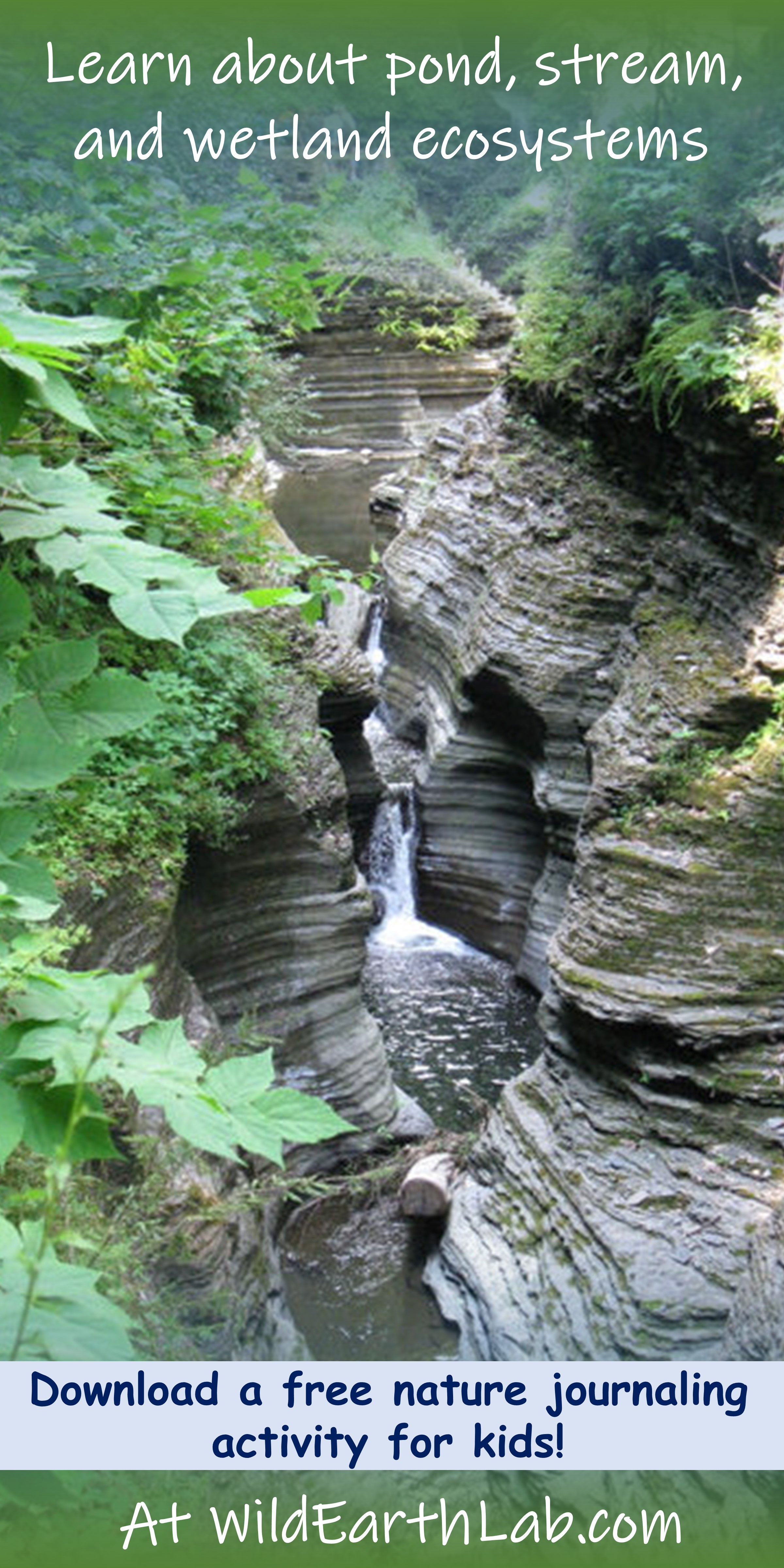
a banner with a photo of a glen with a stream

This week, my students and I took a field trip to a local creek. Getting outside to make observations in nature is one of my favorite hands-on ways to learn about science and the natural world! Ponds, creeks, and wetlands are some of the best places to do this. These aquatic areas are teaming with life and activity – there is so much to watch, listen to, and wonder about. Like most living creatures, we humans are naturally drawn to water sources. Being outside with my students at the creek this week got me thinking more about ponds, streams, and wetlands, and their important role in all kinds of ecosystems...

A stream in Northern Wisconsin is home to a variety of plant and animal species

Perhaps you have noticed that some of the best places in your area to see birds, plants, and other wildlife are near water! Where you find water you usually find an abundance of life! All plants need water to perform photosynthesis, the process plants use to make their own food. A healthy ecosystem will have a healthy food web! An ecosystem with many different plants will attract herbivores or animals that eat plants. You might have seen some herbivores around ponds or streams in your area, such as plant-eating species of fish, birds, and insects. A thriving herbivore population will, in turn, attract predators, or animals that hunt and eat other animals. You may notice predators such as larger fish species like pike and walleye, as well as otters, herons, kingfishers, spiders, and dragonflies. Decomposers, like mushrooms and earthworms, also thrive in moist environments. It is no surprise that water features like streams, ponds, and wetlands are the lively, bustling centers of many ecosystems! 

I became very familiar with aquatic ecosystem health while collecting field samples for an aquatic ecology laboratory several years ago. While going out and collecting samples from streams, ponds, and rivers all over Colorado, I quickly learned that not all aquatic ecosystems are equal. I saw and studied all kinds of aquatic ecosystems  – from streams that were little more than stagnant ditches on the sides of roads,  to roaring mountain rivers overflowing with spring snowmelt. I visited remote beaver meadows miles from the nearest dirt road, and also popular lakes in national parks that host thousands of hikers, fishers, and sight-seers every year. I studied mountain springs that bubbled out of the ground looking as clean and clear as tap water and also streams where the water flowed bright orange, polluted with runoff from mining sites. It didn’t take long for me to start noticing some other big differences between these contrasting aquatic ecosystems…

As I visited these places, I would listen, touch, smell, and look – and notice the differences. I heard the sounds of many songbirds or the sounds of nearby highways. I felt the squishy, moss-covered river banks between my toes as I waded bare-foot in remote streams, or I felt the hardened plant-less dirt under my wader boots on riverbanks where too many boots from too many visitors had over-compacted the soil. I smelled the earthy scents of decaying leaves and wildflowers, or the stench of manure from a nearby herd of cattle grazing on the sweet riparian vegetation.  I counted the number of native plants or the number of invasive species.

Ponds, streams, and wetlands are the heart of many ecosystems. If these water features are unhealthy, the whole ecosystem will decline. Take away a clean and plentiful source of water, and the vegetation will suffer, sending ripple effects through the local populations of herbivores, predators, and decomposers. 

Consequently, these vital water features are also a great indicator of ecosystem health. If something is not right in an ecosystem, you can often observe signs of poor health in the streams, ponds, and wetlands. An unhealthy ecosystem cannot support a diverse community of plants, herbivores, predators, and decomposers. Scientists monitor ponds, streams, and wetlands due to their importance to animals and plants (and humans) in a variety of environments, and also because the symptoms of ecosystem imbalance are often quite visible there.

A variety of animal and plant species that are found around healthy ponds and wetlands
  • Continue to part 2 to learn how to recognize the signs of healthy aquatic ecosystems wherever you go!
  • If you are looking for ways to teach kids or young students about aquatic ecosystem health, you can download and print the free nature journal page for kids, about pond ecosystems or purchase the Pond Ecology Bundle on Etsy!
  • If you enjoyed this post, please share it with a friend and subscribe to Wild Earth Lab’s blog to get new posts about science, sustainability, and nature sent to your inbox!

Wild Earth Lab is new to blogging as of March 2021 and is dedicated to telling engaging stories about the natural world and creating unique learning resources to spark curiosity about nature. You can also visit Wild Earth Lab on social media to preview new learning resources in the making, using the links below:


Get more printable resources like this on the free learning resources page! and visit my Etsy Shop!


References and Further Reading

  1. Environmental Protection Agency. (2020). Impacts of Mismanaged Trash. Available: https://www.epa.gov/trash-free-waters/impacts-mismanaged-trash
  2. Environmental Protection Agency. (2016). Indicators: Benthic Macroinvertebrates. Available: https://www.epa.gov/trash-free-waters/impacts-mismanaged-trash
  3. Frey, D. (2018). Study shows Yellowstone wolves’ impact on streams. The Wildlife Society. Available: https://wildlife.org/study-shows-yellowstone-wolves-impact-on-streams/
  4. National Park Service. (2017). Elk and moose exclusion fence. Available: https://www.nps.gov/articles/elk-and-moose-exclusion-fence.htm

Sharing options and discussion for this post: