What is an aquatic macroinvertebrate? Perhaps you are studying aquatic ecology or bioindicators and came across this term. In this case, the name provides us with a few hints… Let’s break it down:
Aquatic – lives in or on water.
Macro – large enough to be seen by the naked eye.
Invertebrate – animal with no backbone.
So… an aquatic macroinvertebrate is an animal with no backbone that lives in or on water and is big enough that you can see it with your naked eye. This includes animals like aquatic insects, other aquatic arthropods (e.g., crayfish, water mites), aquatic mollusks (e.g., mussels), aquatic worms, and more.
What do these ten animals have in common? They are all aquatic macroinvertebrates! 1. stonefly, 2. caddisfly, 3. mayfly, 4. aquatic beetle, 5. water strider, 6. freshwater snail, 7. freshwater mussel, 8. aquatic worm, 9. water mite, 10. crayfish.
Why do aquatic macroinvertebrates matter?
Aquatic food webs
Now that you know what aquatic macroinvertebrates are, your next question is likely… “Why should I care about them?” True, these tiny critters may seem unremarkable, or even “icky”. However, these creatures have important roles in aquatic ecosystems. Aquatic macroinvertebrates are key members of aquatic food webs. Many macroinvertebrates help recycle nutrients back into the food web by consuming detritus (decaying matter) that settles to the bottom of the water. All those nutrients would be lost if the aquatic macroinvertebrates were not around to use them!
Macroinvertebrates are a key food source for other aquatic animals. Many fish, birds, and amphibians eat macroinvertebrates. If the macroinvertebrate community is not thriving, all the animals that rely on macroinvertebrates as food will feel the impact. Problems for the macroinvertebrate community are problems for the whole ecosystem.
An example of an aquatic food chain
Use as bioindicators
Certain macroinvertebrates are very sensitive to poor water quality and other human-caused impacts to aquatic ecosystems. For this reason, scientists consider macroinvertebrate species to be excellent bioindicators. A bioindicator is a type of organism whose well-being relates closely to ecological conditions and is studied by scientists
Scientists sometimes struggle to find ways to quantitatively measure overall ecosystem health. Ecosystem health depends on many factors (e.g., temperature, nutrient cycling, water chemistry). How do we know if an ecosystem is healthy? How can we tell if our actions are improving or harming an ecosystem?
To help answer these questions, scientists created indexes of biological integrity. Indexes allow scientists to give an ecosystem a score for its overall health, based on its community. Indexes use things like species richness to represent ecosystem health. A popular index for aquatic ecosystem health looks at EPT richness – that is the number of different types of Ephemeroptera, Plecoptera, and Trichoptera (mayflies, stoneflies, and caddisflies).
Indexes of biological integrity use the relationships between number of taxa and the level of human impact on an ecosystem
Study macroinvertebrates in your classroom!
If you enjoyed this post, I know you will love my Macroinvertebrates Unit. It includes posters, lab activities, readings, worksheets – everything you need for an awesome aquatic macroinvertebrates unit with your students. Find it in my shop.
UNH Center for Freshwater Biology (2013). An image-based key to stream insects. Department of Biological Sciences, University of New Hampshire, Durham, NH 03824 USA. Available: http://cfb.unh.edu/StreamKey/html/index.html
Ward, J. V., Kondratieff, B. C., & Zuellig, R. E. (2002). Mountain stream insects of Colorado (2nd edition). University Press of Colorado.
Wild Earth Lab is supported by readers like you. This post includes links to my own products and affiliate products. If you purchase through links on my site, I may earn a small commission at no additional cost to you.
Ponds are an amazing place to teach children about ecology, biodiversity, and wildlife. Here are 10 fun pond activity ideas to try out with your students! I hope these lesson ideas help you have a great pond field trip or pond unit study with your class.
A Special Note For Teachers: are you planning to teach your students about ponds? For great printable handouts, worksheets, and activity directions, look no further than my complete Pond Ecology Unit. Plus, you’ll support this blog with your purchase! 💚
Grab your binoculars and go birdwatching for waterfowl at a local pond or wetland! How many different types of birds can you spot? Find a bird guidebook or waterfowl species checklist for your local area. Can you identify any of the birds you see? And if you are ready to take flight into the amazing world of wetland birds, I recommend trying my Waterfowl and Waterbirds Unit or reading my blog post about Waterbird Activities.
Did you know that the larvae of many common insects like dragonflies and mayflies live in pond water? Flip over rocks and logs in shallow water and see how many aquatic insects you can find! Learn more about the different types of aquatic insects in my recent blog post or grab some materials and worksheets for identifying common aquatic insects in my Aquatic Insects Mini Study! Finding aquatic insects is one of my personal favorite pond activities and I think your students are going to love it too!
Study aquatic insects – the cool critters living at the bottom of ponds and streams- with these unique printable study aids!
3. Pond Dipping:
Learn about some of the tiniest of pond plants & critters. Grab a sample of pond water and look at it under a microscope or with a magnifying glass. What can you see?
Create your own mini model of a pond habitat in an aquarium or tank. Include abiotic features like rocks and sand, and biotic features like pond plants, algae, and sticks. You can even go a step further and capture a few aquatic insects such as water beetles to release into your habitat!
Prefer a kit? Skip the hassle of gathering materials by trying a Wabi Kusa Ecosystem Kit – perfect for making your very own pond ecosystem in a pretty vase!
5. Froggy Fun:
Study the frog life cycle and learn about the roles that frogs play in pond ecosystems. Then learn to fold an origami frog with this tutorial!
Teach students about riparian areas: the ecologically important boundary zones between water and land. After teaching students aboutriparian areas, ask students to research a favorite plant or animal that lives in or uses riparian areas – there are many possibilities, including cattails, willows, waterfowl, and frogs. I’ve created some complimentary animal research project worksheets that you can download for free. To access these worksheets and my full library of free learning resources, sign up for my newsletter using the link below:
Participate in a clean-up day at a local pond or wetland. Help pick up trash to improve a pond ecosystem! Then you can stick around afterwards to complete some of the other pond activities. You can also read about the signs of a healthy aquatic ecosystem in these two blog posts:
Use different senses to observe the pond! Then write or draw about it. You can find guided natural journals with weekly prompts on Etsy like this one (external link). Or, for a free option, I’ve put together this free pond nature journaling page for kids. To access the free journaling page (and more free resources), sign up for my email newsletter below:
If you enjoyed these pond activity ideas, I think you’re going to love my Pond Ecology Unit! It includes tons of activities, worksheets, posters, and more for an awesome pond unit study – all featuring my artwork!
In this post, you’ll read about the different types of aquatic insects. You’ll learn how to identify the different types and see example images. This post also discusses aquatic insects’ important use as bioindicators in ecosystems.
A Note For Teachers: If you’re an educator planning to teach aquatic insects, great learning resources are key to deepening understanding! I think you and your students will love my aquatic insects mini study, which you can also find within my huge Macroinvertebrates Unit (plus you’ll support my blog with your purchase! ❤️ )
If you flip over a few rocks in the shallow water at any healthy pond or stream, you’re sure to see a few aquatic insects! Many aquatic insects are the larvae or nymphs of well-known flying insects, like dragonflies and mayflies! They begin their lives in the water, then emerge from the surface of the pond or stream as flying adults.
These little creatures play an important role in pond and stream food webs. Aquatic insects help recycle nutrients from the pond’s bottom back into the food web! The juvenile life stages, called either larvae or nymphs, eat algae and waste that settles to the bottom of the water. Many other animals eat aquatic insects. Fish feed on aquatic insect larvae and nymphs living along the pond or stream bed. Some fish will snatch the emerging adult insects from the water’s surface or leap from the water to eat flying adult insects. Birds and amphibians may eat the aquatic insect adults as well.
Aquatic insects can teach us a lot about ecosystems – in other words, they are bioindicators. Some aquatic insects are very sensitive to water pollution. An unhealthy pond or stream ecosystem cannot support a large and diverse population of aquatic insects. Healthy ecosystems should have lots of different aquatic insect species. Scientists use aquatic insects to check in on pond and stream ecosystem health. They will use nets to scoop up samples of aquatic insects from the water. Then, back in a lab, they use microscopes to figure out the different species of aquatic insects that were living there. If you are a teacher or parent, you can try catching aquatic insects with your students/kids too, by following these directions. Usually, more different species means a healthier ecosystem. Here are some examples of aquatic insects and a few tips on how to identify them!
Mayflies
Order: Ephemeroptera
Nymph Identification: Aquatic mayfly nymphs have bodies with distinct head, thorax, and abdomen. They have three pairs of segmented legs, two antennae on their heads, and either two or three long strand-like tails on the ends of their abdomens. There will appear to be two miniature wings on the thorax – these are non-functional “wing pads”. Mayflies and stoneflies look quite similar. Mayflies, however, have claws on the end of each of their legs with a single hook, while stoneflies have claws with two hooks. Of course, you might need a magnifying glass or even a microscope to count the number of hooks on these insects’ tiny claws!
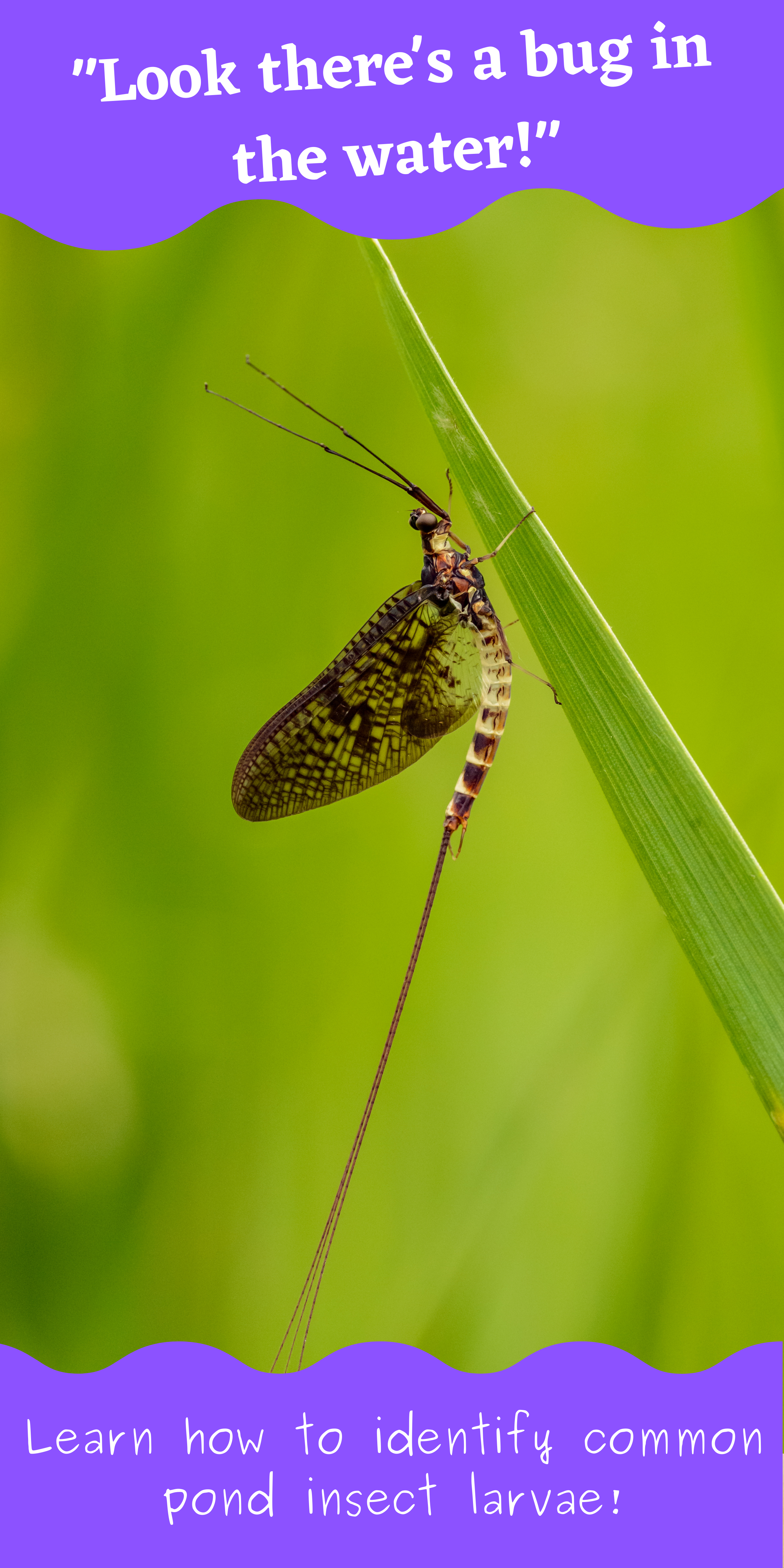
About: Mayflies thrive in standing (lentic) and flowing (lotic) water habitats. As nymphs, they live underneath rocks along the bottoms of streams, ponds, and lakes. There are many mayfly species, which feed in different ways: gathering debris, scraping algae from rocks, and even hunting smaller aquatic creatures. After incomplete metamorphosis (no pupa stage), the winged adults emerge from the water’s surface. They molt their exoskeletons once during adulthood. Adulthood lasts, at most, a few days because adults don’t have mouths and cannot feed.
A mayfly nymph, Drunella grandis, or western green drake.
Stoneflies
Order: Plecoptera
Nymph Identification: Aquatic stonefly nymphs look very similar to mayflies (see above), with distinct heads, thoraxes, and abdomens. Like mayflies, they also have wing pads, three pairs of segmented legs, and two antennae. However, stoneflies will always have just two long, thin tails, and they always have two hooks on the end of each claw.
About: Stonefly nymphs live in clean, flowing (lotic) water like streams and rivers. Nymphs live along the streambeds gathering debris and plant matter as food, or in some cases eating smaller aquatic insects. After their incomplete metamorphosis (no pupa stage), the winged adult stoneflies emerge from the water. Most species reach adulthood and emerge between late winter and early summer.
A stonefly nymph, Pteronarcys californica, or giant salmonfly
Caddisflies
Order: Trichoptera
Larvae Identification: Many aquatic caddisfly larvae are easily recognizable by their distinct cases. These larvae construct tiny cases out of little pieces of plant matter or rock, which they live inside of, with only their heads, thoraxes, and legs exposed. Hidden within the case, the abdomen of the caddisfly is relatively soft and ends in two anal claws instead of tails. There are some species of “free-living” caddisfly larvae that do not make cases. In all caddisfly larvae, the classic head, thorax, and abdomen body sections can seem less easily recognizable compared to mayflies and stoneflies. Caddisflies may have a more maggot-like appearance, especially the free-living caseless ones.
About: Caddisflies live in flowing (lotic) water and sometimes in standing (lentic)water. Caddisfly larvae produce silk. The larvae will use the silk to fasten bits of plant matter or sand together into a case (looks like a shell). Some larvae don’t make shells and instead use silk to tether themselves to streambeds or build tiny nets to catch prey (like a spider’s web). Before adulthood, caddisflies transition through a pupa stage, during a process called complete metamorphosis. Many caddisfly pupae seal themselves in their cases for safety during this stage. The winged adults emerge from the water.
A caddisfly larva in the family Brachyceridae
Dragonflies and Damselflies
Order: Odonata
Nymph Identification: One of the best characteristics for identifying dragonfly and damselfly nymphs is their specialized labium or lower jaw. The labium is designed to extend in front of the body and retract as it grasps prey. Like all insects, members of the family Odonata have a head, thorax, abdomen, and three pairs of segmented legs. You may also notice their wing pads. You can tell damselflies and dragonflies apart by the endings of their abdomens. Damselflies have three long but flat tails on the ends of their abdomens, while dragonflies have no tails, but instead short triangular features, creating a pyramid-like shape on the rear tip of their abdomen.
About: The order Odonata includes dragonflies and damselflies. Nymphs are often found in ponds. Dragonflies are predators of other insects during both the nymph and adult life stages. Dragonflies have a modified labium (lower jaw) that rapidly extends and pulls in prey. After incomplete metamorphosis (no pupa phase), the winged dragonfly adults emerge from the water. Female dragonflies have specialized ovipositors on the tips of their tails, an organ that allows them to dip their tails below the surface of the water to safely lay their eggs in aquatic plants.
A dragonfly nymph, Ophiogomphus severus, or pale snaketail
Fly larvae
Order: Diptera
There are numerous species of aquatic fly larvae. Horseflies, mosquitoes, black flies, and midges are just a few examples. As larvae, flies have an elongated body that looks almost like a segmented worm. They have three pairs of legs, which may be small and hard to see. Aquatic flies undergo complete metamorphosis (i.e., with the pupa stage) before emerging from the water as flying adults.
Water beetles
Order: Coleoptera
There are several families of beetles that live in water during their larval, pupal, and adult stages. Beetle larvae may look somewhat similar to fly larvae, with long and segmented bodies. Adult water beetles will have a rounded, hardened forewing that covers most of their bodies.
Water striders and water scorpions
Order: Hemiptera
Water striders and water scorpions are two common aquatic insects in the order Hemiptera (“true bugs“). Water striders have elongated bodies and thin, widely spread-out legs, which allow them to stay on the surface of the water. Similarly, water scorpions have elongated and sometimes flat bodies. Water scorpions use their front pair of legs to capture prey; the front pair of legs is noticeably bulkier than the other legs.
Looking through a lake sample for aquatic insects.
Study Aquatic Insects & Ecology with Wild Earth Lab
Are you interested in teaching your students about aquatic insects? Check out my complete aquatic macroinvertebrates unit:
Are you interested in reading more posts about animals and insects you can spot in your local area? Subscribe or follow Wild Earth Lab using the links below!