Posted on 3 Comments

10 pond activities to try in your classroom!

banner advertising a blog post with a pond activity round up and an image of a pond food web on a whiteboard

Wild Earth Lab is supported by readers like you. This post includes links to my own products and affiliate products. If you purchase through links on my site, I may earn a small commission at no additional cost to you.

Ponds are an amazing place to teach children about ecology, biodiversity, and wildlife. Here are 10 fun pond activity ideas to try out with your students! I hope these lesson ideas help you have a great pond field trip or pond unit study with your class.

A Special Note For Teachers: are you planning to teach your students about ponds? For great printable handouts, worksheets, and activity directions, look no further than my complete Pond Ecology Unit. Plus, you’ll support this blog with your purchase! ๐Ÿ’š

1. Bird Biodiversity:

Grab your binoculars and go birdwatching for waterfowl at a local pond or wetland! How many different types of birds can you spot? Find a bird guidebook or waterfowl species checklist for your local area. Can you identify any of the birds you see? And if you are ready to take flight into the amazing world of wetland birds, I recommend trying my Waterfowl and Waterbirds Unit or reading my blog post about Waterbird Activities.

2. Aquatic Insects:

Did you know that the larvae of many common insects like dragonflies and mayflies live in pond water? Flip over rocks and logs in shallow water and see how many aquatic insects you can find! Learn more about the different types of aquatic insects in my recent blog post or grab some materials and worksheets for identifying common aquatic insects in my Aquatic Insects Mini Study! Finding aquatic insects is one of my personal favorite pond activities and I think your students are going to love it too!

photo of printed classroom handouts for learning about aquatic insects
Study aquatic insects – the cool critters living at the bottom of ponds and streams- with these unique printable study aids!

3. Pond Dipping:

Learn about some of the tiniest of pond plants & critters. Grab a sample of pond water and look at it under a microscope or with a magnifying glass. What can you see?

4. Petite Pond:

Create your own mini model of a pond habitat in an aquarium or tank. Include abiotic features like rocks and sand, and biotic features like pond plants, algae, and sticks. You can even go a step further and capture a few aquatic insects such as water beetles to release into your habitat!

Prefer a kit? Skip the hassle of gathering materials by trying a Wabi Kusa Ecosystem Kit – perfect for making your very own pond ecosystem in a pretty vase!

5. Froggy Fun:

Study the frog life cycle and learn about the roles that frogs play in pond ecosystems. Then learn to fold an origami frog with this tutorial!

6. Riparian Research:

Teach students about riparian areas: the ecologically important boundary zones between water and land. After teaching students about riparian areas, ask students to research a favorite plant or animal that lives in or uses riparian areas – there are many possibilities, including cattails, willows, waterfowl, and frogs. I’ve created some complimentary animal research project worksheets that you can download for free. To access these worksheets and my full library of free learning resources, sign up for my newsletter using the link below:

7. Give Back to Nature:

Participate in a clean-up day at a local pond or wetland. Help pick up trash to improve a pond ecosystem! Then you can stick around afterwards to complete some of the other pond activities. You can also read about the signs of a healthy aquatic ecosystem in these two blog posts:

8. Try nature journaling!

Use different senses to observe the pond! Then write or draw about it. You can find guided natural journals with weekly prompts on Etsy like this one (external link). Or, for a free option, I’ve put together this free pond nature journaling page for kids. To access the free journaling page (and more free resources), sign up for my email newsletter below:

A worksheet for a visit to a pond

9. Pond Scavenger Hunt:

Ponds are a great place to observe tons of biodiversity! See how many different species you can spot with this free pond scavenger hunt worksheet:

A worksheet for a scavenger hunt

10. Try out my Pond Ecology Unit:

If you enjoyed these pond activity ideas, I think you’re going to love my Pond Ecology Unit! It includes tons of activities, worksheets, posters, and more for an awesome pond unit study – all featuring my artwork!

Or, find more Wild Earth Lab Units to try…

Are you interested in reading more posts with activity ideas? Subscribe or follow Wild Earth Lab using the links below

Sharing options and discussion for this post:

Posted on 7 Comments

Aquatic Insects: identification, examples, and use as bioindicators

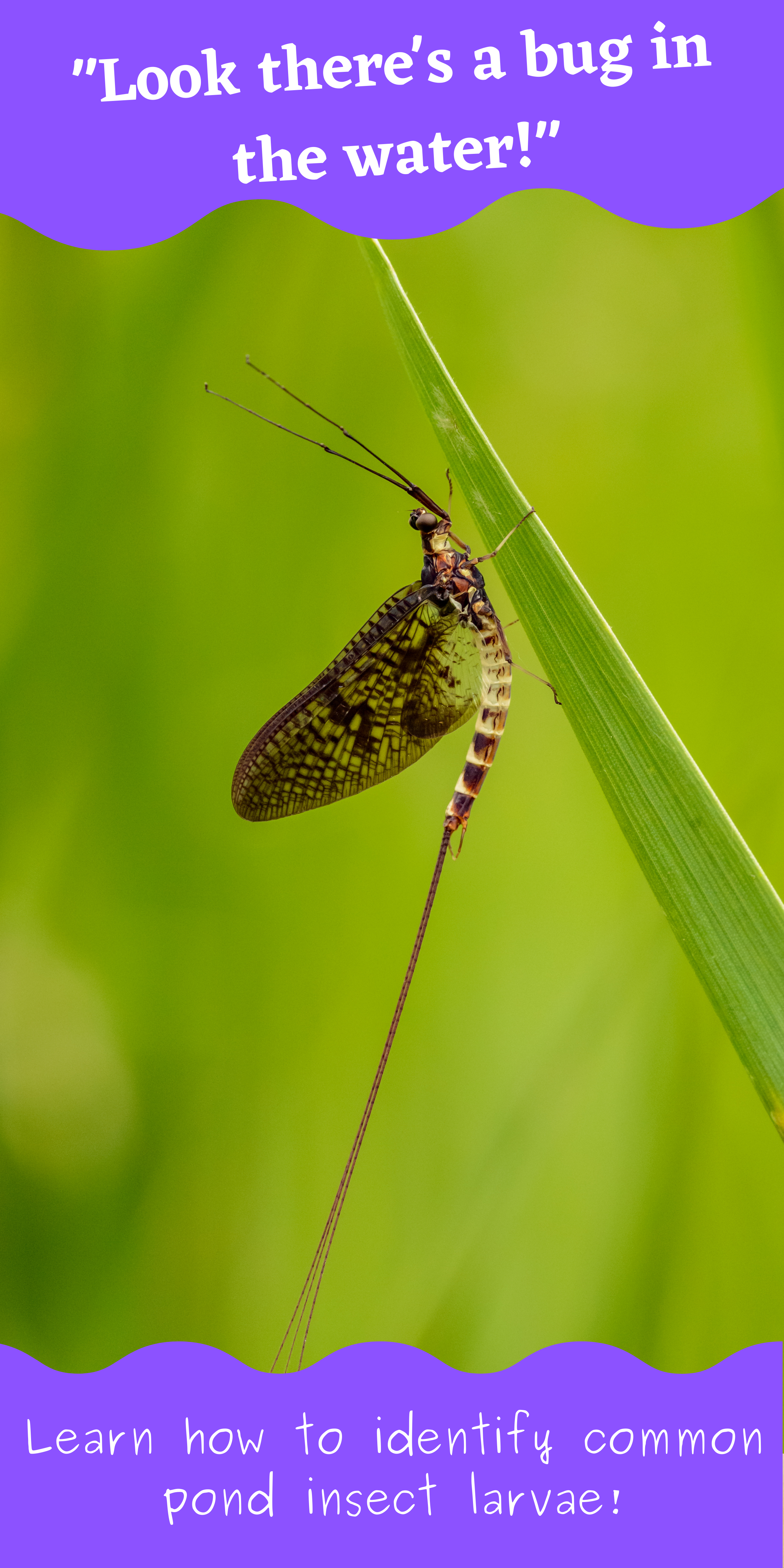
mayfly on grass

In this post, you’ll read about the different types of aquatic insects. You’ll learn how to identify the different types and see example images. This post also discusses aquatic insects’ important use as bioindicators in ecosystems.

A Note For Teachers: If youโ€™re an educator planning to teach aquatic insects, great learning resources are key to deepening understanding! I think you and your students will love my aquatic insects mini study, which you can also find within my huge Macroinvertebrates Unit (plus youโ€™ll support my blog with your purchase! โค๏ธ )

If you flip over a few rocks in the shallow water at any healthy pond or stream, youโ€™re sure to see a few aquatic insects! Many aquatic insects are the larvae or nymphs of well-known flying insects, like dragonflies and mayflies! They begin their lives in the water, then emerge from the surface of the pond or stream as flying adults.

These little creatures play an important role in pond and stream food webs. Aquatic insects help recycle nutrients from the pondโ€™s bottom back into the food web! The juvenile life stages, called either larvae or nymphs, eat algae and waste that settles to the bottom of the water. Many other animals eat aquatic insects. Fish feed on aquatic insect larvae and nymphs living along the pond or stream bed. Some fish will snatch the emerging adult insects from the waterโ€™s surface or leap from the water to eat flying adult insects. Birds and amphibians may eat the aquatic insect adults as well.

Aquatic insects can teach us a lot about ecosystems – in other words, they are bioindicators. Some aquatic insects are very sensitive to water pollution. An unhealthy pond or stream ecosystem cannot support a large and diverse population of aquatic insects. Healthy ecosystems should have lots of different aquatic insect species. Scientists use aquatic insects to check in on pond and stream ecosystem health. They will use nets to scoop up samples of aquatic insects from the water. Then, back in a lab, they use microscopes to figure out the different species of aquatic insects that were living there. If you are a teacher or parent, you can try catching aquatic insects with your students/kids too, by following these directions. Usually, more different species means a healthier ecosystem. Here are some examples of aquatic insects and a few tips on how to identify them!

Mayflies

Order: Ephemeroptera

Nymph Identification: Aquatic mayfly nymphs have bodies with distinct head, thorax, and abdomen. They have three pairs of segmented legs, two antennae on their heads, and either two or three long strand-like tails on the ends of their abdomens. There will appear to be two miniature wings on the thorax – these are non-functional “wing pads”. Mayflies and stoneflies look quite similar. Mayflies, however, have claws on the end of each of their legs with a single hook, while stoneflies have claws with two hooks. Of course, you might need a magnifying glass or even a microscope to count the number of hooks on these insects’ tiny claws!

About: Mayflies thrive in standing (lentic) and flowing (lotic) water habitats. As nymphs, they live underneath rocks along the bottoms of streams, ponds, and lakes. There are many mayfly species, which feed in different ways: gathering debris, scraping algae from rocks, and even hunting smaller aquatic creatures. After incomplete metamorphosis (no pupa stage), the winged adults emerge from the waterโ€™s surface. They molt their exoskeletons once during adulthood. Adulthood lasts, at most, a few days because adults donโ€™t have mouths and cannot feed.

A mayfly nymph, Drunella grandis, or western green drake.

Stoneflies

Order: Plecoptera

Nymph Identification: Aquatic stonefly nymphs look very similar to mayflies (see above), with distinct heads, thoraxes, and abdomens. Like mayflies, they also have wing pads, three pairs of segmented legs, and two antennae. However, stoneflies will always have just two long, thin tails, and they always have two hooks on the end of each claw.

About: Stonefly nymphs live in clean, flowing (lotic) water like streams and rivers. Nymphs live along the streambeds gathering debris and plant matter as food, or in some cases eating smaller aquatic insects. After their incomplete metamorphosis (no pupa stage), the winged adult stoneflies emerge from the water. Most species reach adulthood and emerge between late winter and early summer.

A stonefly nymph, Pteronarcys californica, or giant salmonfly

Caddisflies

Order: Trichoptera

Larvae Identification: Many aquatic caddisfly larvae are easily recognizable by their distinct cases. These larvae construct tiny cases out of little pieces of plant matter or rock, which they live inside of, with only their heads, thoraxes, and legs exposed. Hidden within the case, the abdomen of the caddisfly is relatively soft and ends in two anal claws instead of tails. There are some species of “free-living” caddisfly larvae that do not make cases. In all caddisfly larvae, the classic head, thorax, and abdomen body sections can seem less easily recognizable compared to mayflies and stoneflies. Caddisflies may have a more maggot-like appearance, especially the free-living caseless ones.

About: Caddisflies live in flowing (lotic) water and sometimes in standing (lentic)water. Caddisfly larvae produce silk. The larvae will use the silk to fasten bits of plant matter or sand together into a case (looks like a shell). Some larvae donโ€™t make shells and instead use silk to tether themselves to streambeds or build tiny nets to catch prey (like a spiderโ€™s web). Before adulthood, caddisflies transition through a pupa stage, during a process called complete metamorphosis. Many caddisfly pupae seal themselves in their cases for safety during this stage. The winged adults emerge from the water.

A caddisfly larva in the family Brachyceridae

Dragonflies and Damselflies

Order: Odonata

Nymph Identification: One of the best characteristics for identifying dragonfly and damselfly nymphs is their specialized labium or lower jaw. The labium is designed to extend in front of the body and retract as it grasps prey. Like all insects, members of the family Odonata have a head, thorax, abdomen, and three pairs of segmented legs. You may also notice their wing pads. You can tell damselflies and dragonflies apart by the endings of their abdomens. Damselflies have three long but flat tails on the ends of their abdomens, while dragonflies have no tails, but instead short triangular features, creating a pyramid-like shape on the rear tip of their abdomen.

About: The order Odonata includes dragonflies and damselflies. Nymphs are often found in ponds. Dragonflies are predators of other insects during both the nymph and adult life stages. Dragonflies have a modified labium (lower jaw) that rapidly extends and pulls in prey. After incomplete metamorphosis (no pupa phase), the winged dragonfly adults emerge from the water. Female dragonflies have specialized ovipositors on the tips of their tails, an organ that allows them to dip their tails below the surface of the water to safely lay their eggs in aquatic plants.

A dragonfly nymph, Ophiogomphus severus, or pale snaketail

Fly larvae

Order: Diptera

There are numerous species of aquatic fly larvae. Horseflies, mosquitoes, black flies, and midges are just a few examples. As larvae, flies have an elongated body that looks almost like a segmented worm. They have three pairs of legs, which may be small and hard to see. Aquatic flies undergo complete metamorphosis (i.e., with the pupa stage) before emerging from the water as flying adults.

Water beetles

Order: Coleoptera

There are several families of beetles that live in water during their larval, pupal, and adult stages. Beetle larvae may look somewhat similar to fly larvae, with long and segmented bodies. Adult water beetles will have a rounded, hardened forewing that covers most of their bodies.

Water striders and water scorpions

Order: Hemiptera

Water striders and water scorpions are two common aquatic insects in the order Hemiptera (“true bugs“). Water striders have elongated bodies and thin, widely spread-out legs, which allow them to stay on the surface of the water. Similarly, water scorpions have elongated and sometimes flat bodies. Water scorpions use their front pair of legs to capture prey; the front pair of legs is noticeably bulkier than the other legs.

Scientist sits on the shore of a lake while sorting through a pan containing a lake benthic sample, looking for aquatic insects.
Looking through a lake sample for aquatic insects.

Study Aquatic Insects & Ecology with Wild Earth Lab

Are you interested in teaching your students about aquatic insects? Check out my complete aquatic macroinvertebrates unit:


Are you interested in reading more posts about animals and insects you can spot in your local area? Subscribe or follow Wild Earth Lab using the links below!


References and Further Reading

  1. Merritt, R. W., Cummins, K. W., & Berg, M. B. (2008). Aquatic insects of North America (4th edition). Kendall Hunt, Dubuque.
  2. Neuswanger, J. (n.d.). Mayfly species Drunella grandis (Western Green Drake). Troutnut.com. Retrieved from: http://www.troutnut.com/hatch/446/Mayfly-Drunella-grandis-Western-Green-Drake
  3. Ward, J. V., Kondratieff, B. C., & Zuellig, R. E. (2002). Mountain stream insects of Colorado (2nd edition). University Press of Colorado.

Sharing options and discussion for this post:

Posted on 3 Comments

Aquatic Ecosystems: How to tell if a pond, stream, or wetland is healthy

a banner with a photo of a stream

This is part 2 of a two-part post on aquatic ecosystems. If you haven’t already, check out part 1!

In a rush? Click here to go straight to the printable scavenger hunt!

In my last post, I shared my experience working as a science technician studying aquatic ecosystems like streams, ponds, and wetlands. These water features are critically important to many ecosystems and the creatures that live there. They also provide us with a lens through which we can glimpse the overall health of an ecosystem. In this post, I’ll teach you some signs to look for to recognize healthy aquatic ecosystems in your area. How do your local ponds, streams, and wetlands measure up?

Watkin’s Glen in New York state is home to some incredible water features and lush vegetation

Free of Trash

This one seems obvious, but it is worth including first because of how important it is, and because it is something we can all help prevent and fix. Litter and trash can be harmful to wildlife and plants. Lots of trash floating on the surface of water can impact the amount of light and oxygen in a pond or stream. Below the waterโ€™s surface, aquatic plants need sunlight and oxygen for photosynthesis, the process through which plants make their own food. Furthermore, our trash, especially plastics, contains harmful chemicals that may harm aquatic animals. Animals like fish, birds, and turtles confuse trash for food and eat it, which can be very toxic to them. Healthy aquatic ecosystems should be free of human trash.

Diverse Plant Communities

Any time you see an area dominated by just one plant, that might be a clue that something is wrong. Unhealthy ecosystems are more susceptible to invasive plant species. When an invasive plant species is introduced to an ecosystem, it can outcompete native plant species. Where there were once many diverse plant species, a single invasive plant may take over. This will send ripple effects through the whole local food chain. Examples of invasive plants species in North America include cheat grass, kudzu, garlic mustard, and buckthorn trees.

The Poudre River in Northern Colorado is an example of an ecosystem impacted by an invasive plant. Invasive cheat grass is found along its floodplain in some areas.

Some Algae, but not Too Much

It is natural for stagnant bodies of water (non moving bodies of water like ponds and wetlands), and slower moving streams to have a good bit of algae. Fish, aquatic insects, and other invertebrates need algae as a source of food. But how much is too much? When ponds are near farm fields, the runoff into them may contain too much of the nutrients phosphorous and nitrogen, which is found in many fertilizers. After rain, water flowing off of farm fields and lawns will wash fertilizers containing phosphorous, nitrogen, and other chemicals into low-lying ponds and wetlands. This can cause massive, unnatural plumes of algae to form, which block out sunlight, deplete oxygen, and make it difficult for any other life forms to survive in the pond. When one species takes over, such as a massive plume of algae, it is often a sign that something is out of balance in an ecosystem.

A remote pond below Vestal and Arrow Peaks near Silverton, Colorado, in the San Juan Mountains contains clear water with a small amount of algae.

Abundant and Diverse Aquatic Macroinvertebrates

Have you ever flipped over a rock in a pond or stream? Chances are you saw tons of wriggling little creatures underneath! These creatures are aquatic insect larvae, such as mayflies, dragonflies, and caddisflies (โ€œcase-makersโ€) and other aquatic macroinvertebrates! “Aquatic macroinvertebrates” is a general word for tiny creatures with no backbones that live in water. They include insect larvae, worms, snails, crayfish, and more. Many aquatic macroinvertebrates are herbivores of algae and provide an important food source for many fish species.  A healthy ecosystem should have a variety of different aquatic macroinvertebrates!

Many macroinvertebrate species are sensitive to disturbances and contaminants in an ecosystem, so their populations will reflect an ecosystem’s health. The aquatic macroinvertebrates in a pond or stream are actually such an excellent indicator of ecosystem health that scientists routinely use studies of the aquatic macroinvertebrates in a stream or pond as a holistic measure of aquatic ecosystem health! A healthy aquatic community will have abundant and diverse macroinvertebrates.

This is me, collecting aquatic insects from a lake while I was an undergraduate in college. Using a mesh net and a pan, I found all sorts of benthic macroinvertebrates, including stonefly larvae, caddisfly larvae, and mayfly larvae.

Multiple Trophic Levels

A healthy ecosystem should also contain a variety of different living things including plants, herbivores, predators, and decomposers. These life forms represent different trophic levels, or positions in the food chain, and all play different roles in the ecosystem to maintain balance. A classic example is the relationship between wolves, elk, and riparian plants. When an ecosystem is healthy, all three thrive. However, if wolves (or other top predators) are driven out of an area, the elk population will increase since no one is eating them any more. That will cause the plant populations to suffer, because more elk eat more plants. Additionally, without fear of predation, herbivores like elk will be emboldened to graze out in the open near wetlands and streams, rather than hiding in the woods. This leads to greater stress on the plants around aquatic ecosystems.

Scientists study this effect by building fences around small areas of an ecosystem, to keep out elk, and to see what an area would look like without exaggerated grazing. This same sort of imbalance between plants, herbivores, and predators can happen on a smaller scale too. In some pond ecosystems, the top predators (predators that are not prey to any other animals) might be herons, hawks, or otters, rather than wolves. See if you can identify a top predator in a local pond or stream ecosystem near you. In a healthy ecosystem, look for a variety of insects, fish, birds, amphibians, and other animals.

A bald eagle, a top predator, perches overlooking the Wisconsin river
Many turtles are omnivores that eat a variety of both plant and animal foods

Free of Chemicals

Chemicals can get washed into water from surrounding human settlements and agriculture. Some chemicals might be noticeable, and appear as a white or yellow froth on top of water, an oily sheen floating on the surface, or an unnatural metallic or rusty color. Some chemical pollutants are invisible, but their impact on wildlife is not! For example, road salts, when dissolved in water might be invisible, but it can impact the number of female frogs that are born in a pond – which can impact a frog species’ ability to reproduce.

Another example of a harmful but nearly invisible chemical is a mosquito pesticide called DDT. When DDT gets into pond and stream water, it accumulates in the tissues of plants. These contaminated plants are eaten by macroinvertebrates and small fish, which are in turn eaten by larger fish, which are eaten by raptors like bald eagles. On each step up the food chain, the amount of the DDT chemical would build up in the organisms, in an effect called biomagnification. The bioaccumulated DDT in the eagles caused the shells of the eggs they laid to be too weak, which caused an enormous threat to this species. Luckily a biologist named Rachel Carson figured out the cause of the problem and DDT was later banned in the United States. DDT is still legal in some countries.

Healthy Soils

We love visiting streams and wetlands, but too many human or livestock visitors traveling over fragile surfaces can have a big impact. Human visitors and livestock that are not natural to an area can cause soil compaction by repeatedly walking over the same area, this can make it very difficult for plants to grow. Plants are an important part of a pond or stream ecosystem because their roots help stabilize the banks or shores, preventing erosion. Signs of excessive erosion like undercut banks and over compacted, plant-less soil can be signs that an ecosystem isnโ€™t doing so well. Water also cannot infiltrate into soils as easily when they are too compacted – which may cause floodwaters to pool rather than seep back into the ground. To help prevent impacts to soils, you can stay on designated trails and recreation areas when visiting a local stream, pond, or wetland.

Spring Creek in Fort Collins, Colorado. A corridor of grassy, natural areas along the creek’s floodplain provide an area to accommodate floodwaters and promote water infiltration into the soils.

Ways we can all help promote healthy aquatic ecosystems!

  1. Stay on trails, boardwalks, and already-impacted surfaces when visiting local streams, ponds, and wetlands.
  2. Pack out your trash or dispose of it properly in a trash can or dumpster.
  3. Consider bringing an extra baggie or container on hikes to pick up litter.
  4. Help prevent the spread of invasive plant species by checking your shoes and clothing for burs, seeds, or other plant materials.
  5. Help prevent the spread of invasive animal species by not releasing aquatic pets into local ecosystems.
  6. Consider reducing the amount of chemicals you use in your lawn or garden to prevent chemical run-off into nearby wetlands, ponds, or streams. More about this in my post on improving you backyard wildlife habitat, if you haven’t read it yet!
  7. Consider joining a volunteer group in your area that helps pull up invasive plant species in parks and on public lands.
  8. Teach your family about healthy aquatic ecosystems. I’ve made a free aquatic ecosystem scavenger hunt for you to download, shown at the bottom of this page! Or purchase my Pond Ecology Unit – which includes activities, flashcards, and posters for learning about ecosystems!
Boardwalks provide a route for visitors to cross fragile riparian areas while minimizing impacts to plants and soils

Are you interested in learning more about ecosystems and conservation? Subscribe at the bottom of this page, or follow Wild Earth Lab using the links below!


Can you spot the signs of a healthy aquatic ecosystem at a pond near you? Download this free learning poster!

Want more printable nature learning activities? Visit the free learning resources page and my Etsy Shop!


References and Further Reading

  1. Dennehy, K. (2016). Road salt can change sex ratios in frog populations, study says. Yale News. Available: https://news.yale.edu/2016/11/22/road-salt-can-change-sex-ratios-frog-populations-study-says
  2. Environmental Protection Agency. (2020). Impacts of Mismanaged Trash. Available: https://www.epa.gov/trash-free-waters/impacts-mismanaged-trash
  3. Environmental Protection Agency. (2016). Indicators: Benthic Macroinvertebrates. Available: https://www.epa.gov/trash-free-waters/impacts-mismanaged-trash
  4. Frey, D. (2018). Study shows Yellowstone wolvesโ€™ impact on streams. The Wildlife Society. Available: https://wildlife.org/study-shows-yellowstone-wolves-impact-on-streams/
  5. National Ocean Service. (n.d.). What is nutrient pollution? Available: https://oceanservice.noaa.gov/facts/nutpollution.html
  6. National Park Service. (2017). Elk and moose exclusion fence. Available: https://www.nps.gov/articles/elk-and-moose-exclusion-fence.htm
  7. Natural Resource Defense Council. (2015). The Story of Silent Spring. Available: https://www.nrdc.org/stories/story-silent-spring
  8. U.S. Fish and Wildlife Service. (2019). Midwest Region – Bald and Golden Eagles Fact Sheet. Available: https://www.fws.gov/midwest/eagle/Nhistory/biologue.html

Sharing options and discussion for this post: