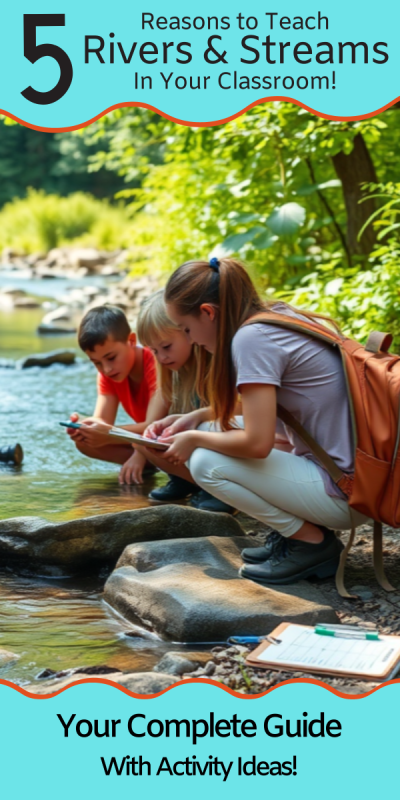
Rivers and streams provide endless opportunities for scientific exploration and discovery – and chances are you can find one right in your community! From their chemistry and physics to their role in ecosystems and human communities, rivers and streams offer excellent opportunities to teach critical concepts in science and math in an applied way. Across many grade levels, incorporating rivers and streams into your curriculum is a fantastic way to spark curiosity and make learning meaningful. Here are five compelling reasons to study rivers and streams in your classroom this year.
Before we dive in: If you’re an educator planning to teach rivers and streams, great learning resources are key to deepening understanding! I think you and your students will love my complete Science on the River Unit (plus you’ll support my blog with your purchase! ❤️)
1. Rivers and Streams Are an Interdisciplinary Subject
One of the most exciting aspects of studying rivers and streams is their interdisciplinary nature. Studying natural waterways relates to many fields of science, allowing students to apply knowledge across disciplines:
Chemistry: Investigate water quality by measuring pH levels, electrical conductivity, or analyzing dissolved oxygen.
Physics: Study fluid mechanics, such as how a stream’s velocity varies with depth, width, and around river bends.
Geology: Discuss rivers’ role in shaping landscapes and carving out canyons over time.
Environmental Science: discuss the challenges facing rivers today, including water conservation, changes in flow due to climate change, pollution from urban and agricultural runoff, and flooding.
By approaching rivers and streams as an interdisciplinary subject, you can help students see how different scientific fields work together to solve real-world problems.
2. Opportunities for Hands-On Learning Activities
Rivers and streams offer a wealth of hands-on learning opportunities that engage students in scientific investigation. Measuring stream flow is a simple yet effective activity that brings science concepts to life. By timing how long it takes for an object to travel a set distance downstream, students can calculate the velocity of a stream.
Other hands-on activities include collecting water samples, catching and identifying aquatic insect larvae, and identifying floodplains and high-water lines. Many of these activities can be conducted with minimal equipment, making them accessible even for classrooms with limited resources. Hands-on learning not only reinforces concepts but also encourages students to ask questions, explore their surroundings, and develop critical thinking skills.
3. A Perfect Example of Applied Math
Studying rivers and streams is an excellent way to integrate applied math into your science curriculum. Hydrologists and engineers rely on mathematics to analyze water flow, predict floods, and manage water resources. By engaging in similar calculations, students can see how math is used to solve real-world problems. Here are a few ways to apply math when studying rivers:
Geometry: students can estimate the cross-sectional area of a river using width and depth data.
Arithmetic: students can calculate river discharge using the formula Q=A×V, where Q is discharge, A is the cross-sectional area of the stream, and V is the velocity of the flowing water.
Probability: students can determine the likelihood of floods based on historical data.
Calculus: For more advanced learners, you can introduce calculus concepts like rating curves. Hydrologists use rating curves to estimate stream discharge based on water height.
These activities reinforce math skills and show students how math is a valuable tool for understanding the natural world.
4. A Great Excuse to Take Learning Outside
Studying rivers and streams provides an opportunity to step outside the classroom and into nature. Field trips to local rivers, streams, or creeks allow students to apply textbook knowledge and observe concepts they’ve studied first-hand. They can look for signs of ecosystem health, observe different river features like goosenecks or riffles, and identify types of river channels.
Outdoor activities not only make lessons more memorable but also help students connect with their local environment. A river field trip can foster an appreciation for rivers and nature in general. Connecting with their local rivers on a field trip may even inspire your students to become involved in local conservation and habitat restoration efforts. If you visit a river with your class, spend 15 minutes picking up trash to leave it nicer than you found it.
Taking stream measurements.
5. Rivers and Streams Are Vital to Our Communities
Rivers and streams play a critical role in human communities, providing drinking water, supporting agriculture, and offering recreational opportunities. By studying these waterways, students can gain a deeper understanding of how rivers impact their daily lives.
Lessons can focus on the challenges of managing rivers sustainably or the impact of pollution and climate change on streams. For example, you can discuss how urban development affects stormwater runoff or how conservation efforts have improved water quality in a local river. Understanding the role of rivers and streams in our communities helps students see the relevance of their studies and fosters a sense of responsibility for protecting these vital resources.
Study this topic with Wild Earth Lab!
There’s no need to scramble to put together the perfect rivers lesson – I’ve already created it for you! This set includes all the worksheets, project guides, and printable materials you need for studying rivers and streams.
Snow hydrology is the study of snow’s role in the water cycle. Snow hydrologists study snowfall, melting, and everything that happens to snow in between! Many snow hydrologists are interested in the ways snow impacts our water resources. They may use data to make predictions about the water supply.
A note for teachers: if you’re looking for a winter-themed way to teach applied science and math, I’ve created something you will love. My Science in the Snow winter STEM unit includes hands-on activities for learning about the scientific study of snow. It covers the properties of water molecules, phase changes, weather stations, and snow-water equivalent calculations. Plus, every purchase helps support this blog!
Snow plays an important role in the water cycle in many parts of the world. For example, in mountainous regions, snow accumulates (builds up) in the mountains all winter, then rapidly melts in the spring. As a result, the amount of water flowing through streams dramatically increases in the spring and early summer. Water from snow melt is used for drinking, household activities, and growing food crops. Many animals also rely on a yearly cycle of snow accumulation and melt. For example, some fish rely on cold water from snowmelt to keep their habitats cool enough during the hot summer.
One of the most important things snow hydrologists study is the impacts of climate change on snow. They seek to understand and predict the ways the amount of snowfall and the timing of snowmelt are changing in different places. This is an important topic to study because snow helps provide water that humans and many ecosystems rely on.
This diagram, from my Science in the Snow Unit, shows snow’s role and movements within the water cycle, via accumulation, redistribution, and melting.
What do snow hydrologists measure?
Snow hydrologists take lots of measurements. They measure the total amount of snowfall, as well as the density, composition, layering, and temperature of the snowpack. To collect this information, snow hydrologists may perform field research, monitor weather stations, or use remote sensing (e.g., monitoring an area from an aircraft or drone). Many snow hydrologists are interested in how much water snow will provide once it melts. Because of this, they measure or estimate snow water equivalent (SWE). You can think of SWE as the depth of standing water that would be left on the ground if all the snow melted instantaneously. This number can vary a lot. The density of snow has a big impact on the SWE. Estimating SWE accurately is important because it helps us make predictions about our water supply.
A basic method for measuring snow depth
Methods for Snow research:
1.) Field Research
To collect data, snow hydrologists sometimes need to put on skis or snowshoes and go take measurements by hand. Often, snow hydrologists must carry all the equipment they need on their backs or in sleds. They head out to a study area to measure snow depth, dig snow pits to observe layers in the snowpack, collect samples, and more.
2.) Weather Stations
Weather stations are great for taking lots of measurements all winter long. These stations can monitor the total amount of snowfall as well as the density of snow, temperature, wind speed, and more. Weather stations in remote areas are often powered by solar panels. They can repeatedly take measurements throughout the winter without anyone there in-person.
3.) Remote Sensing
Many of the newest methods in snow hydrology fall into the category of remote sensing. Remote sensing is a way of learning about something without making direct contact with it. Remote sensing includes using drones, aircrafts, and satellites to monitor the ground’s surface. Today, snow hydrologists can learn about the location and characteristics of snow with remote sensing. Some scientists are even developing tools for estimating snow water equivalent with remote sensing.
Drones can be used for remote sensing. Photo by David Bartus on Pexels.com
Are you studying the water cycle or snow?
Check out my collection of Environmental Science educational materials:
This review article by Anne W. Nolin explains recent advances in remote sensing of snow. The article has sections explaining different parameters related to snow that remote sensing may help measure.
In this post, you’ll learn about ecological disturbance and succession, starting with definitions and examples of disturbances. We will cover the differences between primary succession and secondary succession, as well as the steps of the ecological succession process. Finally, you’ll read about why disturbances like wildfire can be important and natural processes in ecosystems!
A note for teachers: before we dive in, I want to direct you to the classroom materials that I created for teaching this topic. I think you’ll love my wildfire ecology mini study, which is also found within my larger Forest Ecology Unit. Plus, you will support this blog with your purchase!
Explore fire ecology and forest succession with these materials!
What is a disturbance?
What is a disturbance in ecology?
A disturbance is some sort of event that causes a large and rapid change in an ecosystem. Disturbances may abruptly change the ecologicalcommunity – the plants, animals, fungi, etc. in an ecosystem. Disturbances may also impact non-living features of an ecosystem such as the soil and water. Examples of disturbances in nature include wildfires, parasitic insect outbreaks, landslides, avalanches, volcanic eruptions, and floods.
What is ecological succession?
Succession is the natural and gradual change in an ecosystem over time. Different species may live and thrive in an environment depending on how far along the ecosystem is in the succession process.
What are the types of ecological succession?
There are two main types of ecological succession. Primary succession, and secondary succession. Primary succession occurs when species are colonizing a new habitat that was previously devoid of life. An example of primary succession is the formation of an ecological community atop newly formed igneous rocks after a volcanic eruption. Because the rocks just formed, the community is forming on them for the first time (hence, primary succession). Secondary succession happens after a disturbance that caused a sudden change in an existing ecosystem, such as a wildfire or flood. Such disturbances may (temporarily) wipe out or scare off many of the species living there before the disturbance.
Disturbance: A disturbance is an event that causes a large and rapid change in an ecosystem. Natural disturbances include wildfires, insect infestations, landslides, avalanches, volcanic eruptions, and floods.
Post-Disturbance: After a disturbance, there are significant changes to the ecological community (plants, animals, fungi, etc.) as well as to non-living features such as the soil and water. Some severe disturbances may leave behind little more than bare rock.
Pioneer Species: Pioneer species are the first to grow in the post-disturbance landscape. These usually include hardy lichen, fungi, and plant species that can survive in rocky soils without many nutrients. Pioneer plant species are often introduced to a disturbed area when wind or water carries in seeds from nearby. As the pioneer species live and die, they help make a nutrient-rich topsoil, which allows for more plants to grow.
Intermediate (shade intolerant) species: Intermediate plant species include grasses, shrubs, and some trees that can survive in thin topsoil. Intermediate species often include shade-intolerant plants which thrive in the relatively open, post-disturbance landscape. As more and more plant species become established, they help create habitats for different animal species to return to.
Climax (shade tolerant) species: Climax species are the last species to return to an area following a disturbance. Climax species require a thicker layer of nutrient-rich topsoil to grow. Climax species often include shade-tolerant tree species, which can grow from seedlings beneath a canopy of shade-intolerant trees, as well as any animals that rely on these tree species.
Why are ecological disturbances important?
Ecosystems naturally experience a cycle of disturbance and succession. We call the natural timing and magnitude of disturbances in an ecosystem a disturbance regime. Maintaining a natural disturbance regime helps keep an ecosystem healthy! For example, regular, small wildfires can clear out diseased trees and overgrown brush, which helps prevent more severe fires and insect outbreaks from happening later on! Additionally, natural disturbances create the conditions for new trees to grow. Interestingly, some tree species even have cones that only open to release their seeds when they are exposed to extreme heat during wildfires!
How do humans impact disturbance and succession?
Humans impact the cycle of disturbance and succession in many ways. People create unnatural disturbances such as clearcutting forests. Humans sometimes introduce invasive species that take the place of native species during the succession process. We also alter the timing of disturbances, causing disturbances to take place more or less often than they should naturally. Humans often try to prevent disturbances like fires, floods, and landslides because they damage our buildings, roads, and homes. However, altering natural disturbance regimes has a history of coming back to haunt us. For example, preventing small, natural fires can lead to a larger, more damaging fire later on. For this reason, forest managers now set and closely supervise controlled burns over small areas, to mimic natural disturbances in a safer way.
In this post, you’ll read about the different types of aquatic insects. You’ll learn how to identify the different types and see example images. This post also discusses aquatic insects’ important use as bioindicators in ecosystems.
A Note For Teachers: If you’re an educator planning to teach aquatic insects, great learning resources are key to deepening understanding! I think you and your students will love my aquatic insects mini study, which you can also find within my huge Macroinvertebrates Unit (plus you’ll support my blog with your purchase! ❤️ )
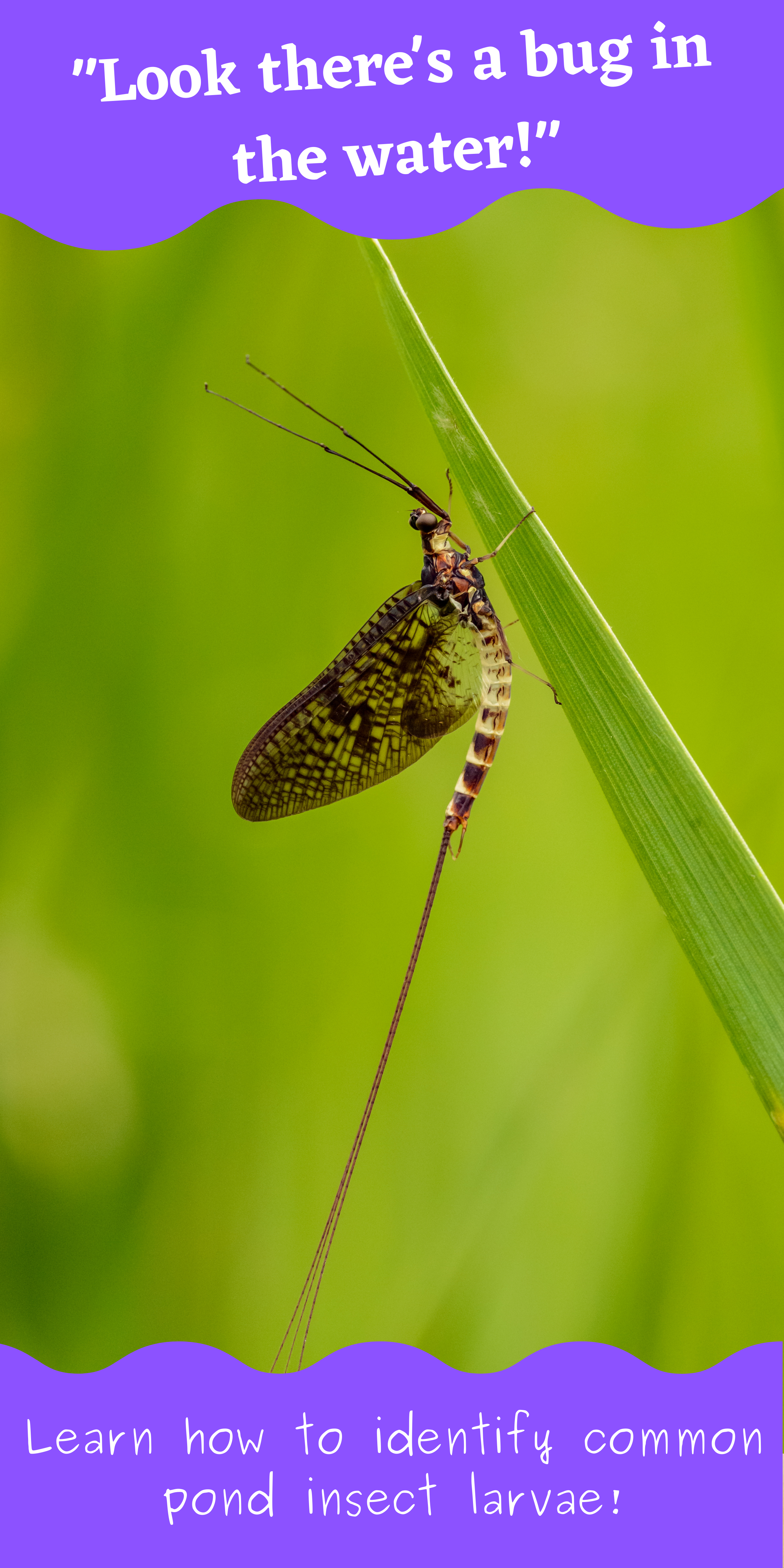
If you flip over a few rocks in the shallow water at any healthy pond or stream, you’re sure to see a few aquatic insects! Many aquatic insects are the larvae or nymphs of well-known flying insects, like dragonflies and mayflies! They begin their lives in the water, then emerge from the surface of the pond or stream as flying adults.
These little creatures play an important role in pond and stream food webs. Aquatic insects help recycle nutrients from the pond’s bottom back into the food web! The juvenile life stages, called either larvae or nymphs, eat algae and waste that settles to the bottom of the water. Many other animals eat aquatic insects. Fish feed on aquatic insect larvae and nymphs living along the pond or stream bed. Some fish will snatch the emerging adult insects from the water’s surface or leap from the water to eat flying adult insects. Birds and amphibians may eat the aquatic insect adults as well.
Aquatic insects can teach us a lot about ecosystems – in other words, they are bioindicators. Some aquatic insects are very sensitive to water pollution. An unhealthy pond or stream ecosystem cannot support a large and diverse population of aquatic insects. Healthy ecosystems should have lots of different aquatic insect species. Scientists use aquatic insects to check in on pond and stream ecosystem health. They will use nets to scoop up samples of aquatic insects from the water. Then, back in a lab, they use microscopes to figure out the different species of aquatic insects that were living there. If you are a teacher or parent, you can try catching aquatic insects with your students/kids too, by following these directions. Usually, more different species means a healthier ecosystem. Here are some examples of aquatic insects and a few tips on how to identify them!
Mayflies
Order: Ephemeroptera
Nymph Identification: Aquatic mayfly nymphs have bodies with distinct head, thorax, and abdomen. They have three pairs of segmented legs, two antennae on their heads, and either two or three long strand-like tails on the ends of their abdomens. There will appear to be two miniature wings on the thorax – these are non-functional “wing pads”. Mayflies and stoneflies look quite similar. Mayflies, however, have claws on the end of each of their legs with a single hook, while stoneflies have claws with two hooks. Of course, you might need a magnifying glass or even a microscope to count the number of hooks on these insects’ tiny claws!
About: Mayflies thrive in standing (lentic) and flowing (lotic) water habitats. As nymphs, they live underneath rocks along the bottoms of streams, ponds, and lakes. There are many mayfly species, which feed in different ways: gathering debris, scraping algae from rocks, and even hunting smaller aquatic creatures. After incomplete metamorphosis (no pupa stage), the winged adults emerge from the water’s surface. They molt their exoskeletons once during adulthood. Adulthood lasts, at most, a few days because adults don’t have mouths and cannot feed.
A mayfly nymph, Drunella grandis, or western green drake.
Stoneflies
Order: Plecoptera
Nymph Identification: Aquatic stonefly nymphs look very similar to mayflies (see above), with distinct heads, thoraxes, and abdomens. Like mayflies, they also have wing pads, three pairs of segmented legs, and two antennae. However, stoneflies will always have just two long, thin tails, and they always have two hooks on the end of each claw.
About: Stonefly nymphs live in clean, flowing (lotic) water like streams and rivers. Nymphs live along the streambeds gathering debris and plant matter as food, or in some cases eating smaller aquatic insects. After their incomplete metamorphosis (no pupa stage), the winged adult stoneflies emerge from the water. Most species reach adulthood and emerge between late winter and early summer.
A stonefly nymph, Pteronarcys californica, or giant salmonfly
Caddisflies
Order: Trichoptera
Larvae Identification: Many aquatic caddisfly larvae are easily recognizable by their distinct cases. These larvae construct tiny cases out of little pieces of plant matter or rock, which they live inside of, with only their heads, thoraxes, and legs exposed. Hidden within the case, the abdomen of the caddisfly is relatively soft and ends in two anal claws instead of tails. There are some species of “free-living” caddisfly larvae that do not make cases. In all caddisfly larvae, the classic head, thorax, and abdomen body sections can seem less easily recognizable compared to mayflies and stoneflies. Caddisflies may have a more maggot-like appearance, especially the free-living caseless ones.
About: Caddisflies live in flowing (lotic) water and sometimes in standing (lentic)water. Caddisfly larvae produce silk. The larvae will use the silk to fasten bits of plant matter or sand together into a case (looks like a shell). Some larvae don’t make shells and instead use silk to tether themselves to streambeds or build tiny nets to catch prey (like a spider’s web). Before adulthood, caddisflies transition through a pupa stage, during a process called complete metamorphosis. Many caddisfly pupae seal themselves in their cases for safety during this stage. The winged adults emerge from the water.
A caddisfly larva in the family Brachyceridae
Dragonflies and Damselflies
Order: Odonata
Nymph Identification: One of the best characteristics for identifying dragonfly and damselfly nymphs is their specialized labium or lower jaw. The labium is designed to extend in front of the body and retract as it grasps prey. Like all insects, members of the family Odonata have a head, thorax, abdomen, and three pairs of segmented legs. You may also notice their wing pads. You can tell damselflies and dragonflies apart by the endings of their abdomens. Damselflies have three long but flat tails on the ends of their abdomens, while dragonflies have no tails, but instead short triangular features, creating a pyramid-like shape on the rear tip of their abdomen.
About: The order Odonata includes dragonflies and damselflies. Nymphs are often found in ponds. Dragonflies are predators of other insects during both the nymph and adult life stages. Dragonflies have a modified labium (lower jaw) that rapidly extends and pulls in prey. After incomplete metamorphosis (no pupa phase), the winged dragonfly adults emerge from the water. Female dragonflies have specialized ovipositors on the tips of their tails, an organ that allows them to dip their tails below the surface of the water to safely lay their eggs in aquatic plants.
A dragonfly nymph, Ophiogomphus severus, or pale snaketail
Fly larvae
Order: Diptera
There are numerous species of aquatic fly larvae. Horseflies, mosquitoes, black flies, and midges are just a few examples. As larvae, flies have an elongated body that looks almost like a segmented worm. They have three pairs of legs, which may be small and hard to see. Aquatic flies undergo complete metamorphosis (i.e., with the pupa stage) before emerging from the water as flying adults.
Water beetles
Order: Coleoptera
There are several families of beetles that live in water during their larval, pupal, and adult stages. Beetle larvae may look somewhat similar to fly larvae, with long and segmented bodies. Adult water beetles will have a rounded, hardened forewing that covers most of their bodies.
Water striders and water scorpions
Order: Hemiptera
Water striders and water scorpions are two common aquatic insects in the order Hemiptera (“true bugs“). Water striders have elongated bodies and thin, widely spread-out legs, which allow them to stay on the surface of the water. Similarly, water scorpions have elongated and sometimes flat bodies. Water scorpions use their front pair of legs to capture prey; the front pair of legs is noticeably bulkier than the other legs.
Looking through a lake sample for aquatic insects.
Study Aquatic Insects & Ecology with Wild Earth Lab
Are you interested in teaching your students about aquatic insects? Check out my complete aquatic macroinvertebrates unit:
Are you interested in reading more posts about animals and insects you can spot in your local area? Subscribe or follow Wild Earth Lab using the links below!
In my last post, I shared my experience working as a science technician studying aquatic ecosystems like streams, ponds, and wetlands. These water features are critically important to many ecosystems and the creatures that live there. They also provide us with a lens through which we can glimpse the overall health of an ecosystem. In this post, I’ll teach you some signs to look for to recognize healthy aquatic ecosystems in your area. How do your local ponds, streams, and wetlands measure up?
Watkin’s Glen in New York state is home to some incredible water features and lush vegetation
Free of Trash
This one seems obvious, but it is worth including first because of how important it is, and because it is something we can all help prevent and fix. Litter and trash can be harmful to wildlife and plants. Lots of trash floating on the surface of water can impact the amount of light and oxygen in a pond or stream. Below the water’s surface, aquatic plants need sunlight and oxygen for photosynthesis, the process through which plants make their own food. Furthermore, our trash, especially plastics, contains harmful chemicals that may harm aquatic animals. Animals like fish, birds, and turtles confuse trash for food and eat it, which can be very toxic to them. Healthy aquatic ecosystems should be free of human trash.
Any time you see an area dominated by just one plant, that might be a clue that something is wrong. Unhealthy ecosystems are more susceptible to invasive plant species. When an invasive plant species is introduced to an ecosystem, it can outcompete native plant species. Where there were once many diverse plant species, a single invasive plant may take over. This will send ripple effects through the whole local food chain. Examples of invasive plants species in North America include cheat grass, kudzu, garlic mustard, and buckthorn trees.
The Poudre River in Northern Colorado is an example of an ecosystem impacted by an invasive plant. Invasive cheat grass is found along its floodplain in some areas.
Some Algae, but not Too Much
It is natural for stagnant bodies of water (non moving bodies of water like ponds and wetlands), and slower moving streams to have a good bit of algae. Fish, aquatic insects, and other invertebrates need algae as a source of food. But how much is too much? When ponds are near farm fields, the runoff into them may contain too much of the nutrients phosphorous and nitrogen, which is found in many fertilizers. After rain, water flowing off of farm fields and lawns will wash fertilizers containing phosphorous, nitrogen, and other chemicals into low-lying ponds and wetlands. This can cause massive, unnatural plumes of algae to form, which block out sunlight, deplete oxygen, and make it difficult for any other life forms to survive in the pond. When one species takes over, such as a massive plume of algae, it is often a sign that something is out of balance in an ecosystem.
A remote pond below Vestal and Arrow Peaks near Silverton, Colorado, in the San Juan Mountains contains clear water with a small amount of algae.
Abundant and Diverse Aquatic Macroinvertebrates
Have you ever flipped over a rock in a pond or stream? Chances are you saw tons of wriggling little creatures underneath! These creatures are aquatic insect larvae, such as mayflies, dragonflies, and caddisflies (“case-makers”) and other aquatic macroinvertebrates! “Aquatic macroinvertebrates” is a general word for tiny creatures with no backbones that live in water. They include insect larvae, worms, snails, crayfish, and more. Many aquatic macroinvertebrates are herbivores of algae and provide an important food source for many fish species. A healthy ecosystem should have a variety of different aquatic macroinvertebrates!
Many macroinvertebrate species are sensitive to disturbances and contaminants in an ecosystem, so their populations will reflect an ecosystem’s health. The aquatic macroinvertebrates in a pond or stream are actually such an excellent indicator of ecosystem health that scientists routinely use studies of the aquatic macroinvertebrates in a stream or pond as a holistic measure of aquatic ecosystem health! A healthy aquatic community will have abundant and diverse macroinvertebrates.
This is me, collecting aquatic insects from a lake while I was an undergraduate in college. Using a mesh net and a pan, I found all sorts of benthic macroinvertebrates, including stonefly larvae, caddisfly larvae, and mayfly larvae.
Multiple Trophic Levels
A healthy ecosystem should also contain a variety of different living things including plants, herbivores, predators, and decomposers. These life forms represent different trophic levels, or positions in the food chain, and all play different roles in the ecosystem to maintain balance. A classic example is the relationship between wolves, elk, and riparian plants. When an ecosystem is healthy, all three thrive. However, if wolves (or other top predators) are driven out of an area, the elk population will increase since no one is eating them any more. That will cause the plant populations to suffer, because more elk eat more plants. Additionally, without fear of predation, herbivores like elk will be emboldened to graze out in the open near wetlands and streams, rather than hiding in the woods. This leads to greater stress on the plants around aquatic ecosystems.
Scientists study this effect by building fences around small areas of an ecosystem, to keep out elk, and to see what an area would look like without exaggerated grazing. This same sort of imbalance between plants, herbivores, and predators can happen on a smaller scale too. In some pond ecosystems, the top predators (predators that are not prey to any other animals) might be herons, hawks, or otters, rather than wolves. See if you can identify a top predator in a local pond or stream ecosystem near you. In a healthy ecosystem, look for a variety of insects, fish, birds, amphibians, and other animals.
A bald eagle, a top predator, perches overlooking the Wisconsin river
Many turtles are omnivores that eat a variety of both plant and animal foods
Free of Chemicals
Chemicals can get washed into water from surrounding human settlements and agriculture. Some chemicals might be noticeable, and appear as a white or yellow froth on top of water, an oily sheen floating on the surface, or an unnatural metallic or rusty color. Some chemical pollutants are invisible, but their impact on wildlife is not! For example, road salts, when dissolved in water might be invisible, but it can impact the number of female frogs that are born in a pond – which can impact a frog species’ ability to reproduce.
Another example of a harmful but nearly invisible chemical is a mosquito pesticide called DDT. When DDT gets into pond and stream water, it accumulates in the tissues of plants. These contaminated plants are eaten by macroinvertebrates and small fish, which are in turn eaten by larger fish, which are eaten by raptors like bald eagles. On each step up the food chain, the amount of the DDT chemical would build up in the organisms, in an effect called biomagnification. The bioaccumulated DDT in the eagles caused the shells of the eggs they laid to be too weak, which caused an enormous threat to this species. Luckily a biologist named Rachel Carson figured out the cause of the problem and DDT was later banned in the United States. DDT is still legal in some countries.
We love visiting streams and wetlands, but too many human or livestock visitors traveling over fragile surfaces can have a big impact. Human visitors and livestock that are not natural to an area can cause soil compaction by repeatedly walking over the same area, this can make it very difficult for plants to grow. Plants are an important part of a pond or stream ecosystem because their roots help stabilize the banks or shores, preventing erosion. Signs of excessive erosion like undercut banks and over compacted, plant-less soil can be signs that an ecosystem isn’t doing so well. Water also cannot infiltrate into soils as easily when they are too compacted – which may cause floodwaters to pool rather than seep back into the ground. To help prevent impacts to soils, you can stay on designated trails and recreation areas when visiting a local stream, pond, or wetland.
Spring Creek in Fort Collins, Colorado. A corridor of grassy, natural areas along the creek’s floodplain provide an area to accommodate floodwaters and promote water infiltration into the soils.
Ways we can all help promote healthy aquatic ecosystems!
Stay on trails, boardwalks, and already-impacted surfaces when visiting local streams, ponds, and wetlands.
Pack out your trash or dispose of it properly in a trash can or dumpster.
Consider bringing an extra baggie or container on hikes to pick up litter.
Help prevent the spread of invasive plant species by checking your shoes and clothing for burs, seeds, or other plant materials.
Help prevent the spread of invasive animal species by not releasing aquatic pets into local ecosystems.
Consider reducing the amount of chemicals you use in your lawn or garden to prevent chemical run-off into nearby wetlands, ponds, or streams. More about this in my post on improving you backyard wildlife habitat, if you haven’t read it yet!
Consider joining a volunteer group in your area that helps pull up invasive plant species in parks and on public lands.
Teach your family about healthy aquatic ecosystems. I’ve made a free aquatic ecosystem scavenger hunt for you to download, shown at the bottom of this page! Or purchase my Pond Ecology Unit – which includes activities, flashcards, and posters for learning about ecosystems!
Boardwalks provide a route for visitors to cross fragile riparian areas while minimizing impacts to plants and soils
Are you interested in learning more about ecosystems and conservation? Subscribe at the bottom of this page, or follow Wild Earth Lab using the links below!
With the first signs of spring appearing, many of us are looking forward to spending more time enjoying our outdoor living spaces. Spring also means the beginning of yardwork season and time to start new projects in the yard or garden. Maybe you are looking to add more native plants, reduce your water usage, or just change things up to create a more enjoyable outdoor living space. No matter what your goal is or where you live, it is important to remember that we are not the only ones using our backyards. We share the outdoors with all kinds of animals and insects! Whether you are actively trying to attract more wildlife to your backyard, or just aiming to be a little more environmentally conscious, there are some steps that you can take to be more kind to the wildlife that visits and lives in your backyard! For me, I noticed a big difference in the wildlife I saw in my yard a few years ago when I moved to a rental house with a yard that was a bit more wildlife friendly. This spring, as I move into a new house again, I’m excited to use some of the things I learned to make my new yard a bit better for the animals and insects that live there!
My xeriscape backyard in early spring
A few years ago, I moved into a rental house near the edge of town with a yard that contained a variety of native bushes, trees, and flowers rather than being entirely grass. This type of yard is called a xeriscape, a style of landscaping designed to use little to no irrigation. Usually, xeriscapes involve a mixture of native or low water use plants, and non-living features such as rocks, gravel, pavers, and woodchips. While I knew xeriscaping was becoming more popular in my area for water saving purposes, I quickly learned about some other awesome benefits of having a xeriscape yard.
The first summer, I quickly became acquainted with the yard’s resident garter snake. I would often see this small snake on sunny afternoons, slithering through our vegetable garden, hiding amongst the rocks and shrubs, or prowling around the mint and raspberry bushes hunting grasshoppers. My scaly co inhabitant was not the only critter in my backyard. I also saw rabbits, squirrels, frogs, birds, and a variety of insects and invertebrates. From time to time, I would see hawks swoop over my house, returning from hunting at nearby farm fields to nest in the massive elm trees scattered throughout my neighborhood. Occasionally, I would see a hawk carrying a snake, and I would wait with anticipation until the next time I saw my garter snake pal.
My backyard garter snake pal
Prior to moving into my xeriscaped rental, I lived in several other houses, usually along busy roads, with bluegrass and dirt yards that had little variety. I imagine how these monotonous expanses must look to an animal. I would think they must feel very exposed out on a grass lawn – with no places to hide, build dens, or forage. Certainly, I had never seen a snake prowling through the short, uniform grass in my old backyard.
Comparatively, it seemed like there was a whole ecosystem in my new backyard. Through the seasons, I witnessed the small-scale ecosystem interactions happening in my own backyard, such as predation when my garter snake hunted insects (or when the local hawks hunted snakes!). I watched mutualism occur between my flower bushes and the visiting pollinators like hummingbirds and bees, who drank the sweet nectar in exchange for transporting the plants’ genetic material to other flowers. I observed competition too, mainly between the grasshoppers, the rabbits, and myself as we all competed for the limited amount of dwarf kale in my vegetable garden!
A northern goshawk – one of the many raptors you might see living near human-dominated areas
In addition to the joy of watching the day-to-day activity of my mini backyard ecosystem, I realized there might be other benefits to the presence of some of the animals that were attracted to my yard. After several months living in my house, I realized I almost never saw insects like ants and boxelder bugs inside of my house. It was also the only place I’ve lived where I’ve never seen a mouse inside or outside the house! I give credit to my snake friend – hunting its meals of insects and rodents while unknowingly defending the perimeter of my house from unwanted guests!
My lack of house pests was not the only perk of my mini-backyard ecosystem. The yard’s assortment of native flowering shrubs and plant species attracted a variety of hummingbirds, butterflies, bumblebees, and honeybees. In return, my summer vegetable garden reaped the benefits of these pollinators’ presence in my yard. I was grateful for an excellent harvest of squash, cucumbers, peppers, and tomatoes, thanks to the services these creatures provided.
As exciting as it is to witness the behaviors of my backyard wildlife, I sometimes feel a little guilty, knowing that many of these animals would have fared better decades ago, before my neighborhood was built and the land there was semi-arid shrublands. I think about how larger species like coyotes and pronghorn, which require larger swatches of land than snakes or honeybees, are pushed out of areas with humans. As we build roads and buildings, their natural habitat becomes fragmented, or divided into smaller, unusable units. My little backyard ecosystem is far from being like the natural habitat that occurred here long ago. Ultimately, any yard is going to be less desirable than an animal’s natural habitat. That said, there are things we can do to make our yards a little better for local wildlife:
1. Consider alternatives to chemicals
Using chemicals on the garden and lawn can help keep garden pests at bay and decrease the amount of time spent pulling weeds. But chemicals also have harmful impacts on backyard wildlife. Amphibians like frogs and salamanders are particularly sensitive to a variety of pesticides, herbicides, and fungicides, which may be contributing to their shrinking population sizes. Chemicals can also harm helpful garden insects like pollinators. If chemicals must be used, try to pick options that target specific pests and are not toxic to bees. Better yet, try chemical-free alternatives, like pulling weeds early and often before they get a chance to grow and spread. Or try using mesh netting to keep the grasshoppers out of the garden. These are just two examples – there are lots of ways to protect your garden from weeds and herbivores other than chemicals, although some methods may be more effective than others. Do some research, get creative, and find out what works best for your garden. For example, my great grandma insisted on painting pebbles with red nail polish and placing them around the bottom of her strawberry plants, as an unappetizing decoy for the birds and insects trying to eat the tasty berries!
The leopard frog, like many amphibians in impacted by pesticides and herbicides.
2. Reduce your pet’s impact
We all love our cats and dogs, but they are not a natural part of the ecosystem. Many pets will instinctually hunt or harass wildlife. Leaving a dog or cat outdoors unsupervised is like introducing an unnatural predator into an ecosystem – which can increase stress in wild animals and change their natural behavior. You can help by always supervising your pets when they are outside to make sure they do not bother wildlife. Cats especially may cause problems for wildlife. Outdoor domesticated cats kill a significant number of birds each year! Consider keeping your cat indoors to protect songbirds. If you must have an outdoor cat, add a jingle bell to its collar to increase the chance that birds will be able to hear your kitty sneaking up on them.
A ruby-throated hummingbird is one of many birds species impacted by outdoor cats
3. Create variety
Regardless of where you live, the natural environment in your area is likely not a monotonous expanse of grass, pebbles, or wood chips. Animals and insects are used to more complex environments that include places to hide. Adding a variety of trees, shrubs, groundcover plants, and rock features to your yard can provide critters with places to hide and build their nests. A more complex habitat allows for a greater diversity of species: simply put, a variety animals need a variety places in their environment to live, hide, and forage.
The swallowtail is a butterfly that overwinters as a chrysalis
4. Leave your yard waste
Raking leaves keeps lawns looking tidy. But leaves may actually provide important winter habitat for spiders and some insects. Spiders are a predator of many pest insects and can help decrease the number of insect invaders to your home. Additionally, yard waste like plant stalks and leaves may contain hibernating caterpillars or the cocoons and chrysalises of certain overwintering moth and butterfly species. Cocoons and chrysalises are the non-moving, intermediate life stages of moths and butterflies, respectively. In the spring, overwintering moth and butterfly species will emerge in their adult form, at which time they may pollinate plants in your garden! By removing yard waste, you may be unknowingly removing some of your pollinators! Raking leaves and cleaning up yard waste is a pain, so I know I am glad to hear there is a great excuse to put it off until after the spring!
Attracting pollinators to your yard is as easy as planting their favorite flowers! It is fun to watch butterflies and bees in your yard, and they can help pollinate your vegetable garden. It is important to select the right plants: choose native species that provide the necessary nutrients for the pollinators native to your local area. Visit a local plant nursery or research online to find out what native plant species can attract pollinators in your area!
A honeybee is one pollinator you might see in your yard!
This spring, I’m moving into a new house again. I’m looking forward to xeriscaping a few areas of my yard by adding native, pollinator-friendly plants – both to make my household more sustainable and to attract backyard wildlife. Maintaining xeriscape, especially a xeriscape with many plants and shrubs, can be hard work. I’m planning on writing another piece sometime soon weighing the pros and cons of xeriscape, as well as keeping everyone updated on my various sustainability projects in my yard and garden this summer.
If you enjoyed reading about my backyard wildlife experiences and learning about some of the ways you can make your backyard better wildlife habitat, please leave a comment below and subscribe to Wild Earth Lab for more posts like this one! You can also follow Wild Earth Lab using the links below, to get sneak previews of new learning resources in the works!
Finally, I created a free Backyard Wildlife Bingo game and a poster summarizing the tips in this post, linked below or available on the learning resources page! Check off the boxes in Backyard Wildlife Bingo while you and your family spend more time outside this spring!
Kawahara, A. Y., Reeves, L. E., Barber, J. R., & Black, S. H. (2021). Opinion: Eight simple actions that individuals can take to save insects from global declines. Proceedings of the National Academy of Sciences, 118(2). Available: https://www.pnas.org/content/118/2/e2002547117.short