Trees are perennial plants with long, woody trunks. Trees of temperate latitudes are often grouped into two main categories: deciduous trees that lose and regrow their leaves each year, and coniferous trees that stay green year-round! Let’s take a closer look at deciduous vs coniferous trees…
Before we dive in: If you’re an educator planning to teach about trees in your classroom, great activities and visuals are key to deepening understanding! I think you and your students will love my complete Trees Unit (plus you’ll support this blog with your purchase! ❤️)
Deciduous Trees
Here are a few properties of deciduous trees. A tree is a deciduous tree if it:
Has broad, flat leaves
Does photosynthesis during the warm growing season only
Leaves change color at the end of the growing season
Loses its leaves and regrows its leaves once a year
Examples of Deciduous Trees
Ash
Birch
Maple
Oak
Willow
Coniferous Trees
Here are a few characteristics of coniferous trees. A tree is coniferous if it:
Has needles
Does photosynthesis year-round, but may slow down in winter
Needles stay green year-round (“evergreen”)
Needles stay on branches year-round
Has cones
Examples of Conifers
Cedar
Fir
Juniper
Pine
Spruce
Other Evergreens
It’s worth noting that conifers are not the only trees that stay green year-round. You will find many evergreen trees growing at tropical latitudes around the equator. This is because close to the equator, there is little to no temperature difference between summer and winter. Consequently, you will find many unique types of trees growing in the tropics that do not need to shed leaves in wintertime. One example is a palm tree.
Learning Activity Idea:
Play “Deciduous or Coniferous?” Collect samples of parts from several different deciduous and coniferous trees (leaves, needles, seedpods, flowers, fruits, cones, etc.). Grab two jars and label one “deciduous” and one “coniferous”. Ask your child to sort the parts into the jars.
Support Wild Earth Lab with your purchase?
If you enjoyed this post, I think you will love my Trees Unit! It’s a complete set of printable learning materials for teaching kids all about trees – featuring my illustrations! You’ll learn about deciduous vs coniferous, tree anatomy, life cycles, tree ring science, and more!
Wild Earth Lab is supported by readers like you. This post includes links to my own products and affiliate products. If you purchase through links on my site, I may earn a small commission at no additional cost to you.
If you’re learning about pollination with your students or kids this school year, try out some of these fun pollination activity ideas in your classroom!
Special note for educators: if you’re planning to teach pollination, you can find all the activity directions, handouts, and printable materials you’ll need in my complete Pollination Unit– and you will support this blog with your purchase.
A flower that looks fairly plain to the human eye may look completely different through the eyes of an insect! Flower petals sometimes reflect UV and infrared light, which are colors that the human eye cannot see but are visible to some insect pollinators.
Grab a UV marker plus black light set, paper, and regular markers. Start by using a regular marker to draw the outline of a flower and cut it out. Then, create “invisible” patterns on the petals with the black light marker. Then shine the black light on your flower to reveal the hidden designs!
A flower that looks fairly plain to the human eye may look completely different through the eyes of an insect!
2. Pollinator Garden
Plant a pollinator garden with native wildflower species to attract pollinators to your yard. Start by researching native wildflower species in your local area. A plant nursery or garden center can be a great place to start, and you can also find seeds online. To further promote pollinator habitat in your yard, you can even build a pollinator hotel!
3. Flower Dissection
Dissect a flower to learn about flower anatomy. Can you find the stamen, carpel, petals, and sepals? Talk about how brightly colored petals can attract pollinators, how stamens spread pollen onto the pollinator’s body or legs, and how carpels have pollen tracked onto them by the pollinators.
Anatomy of a flower!
4. DIY Flower Anatomy Diagram
Here’s a fun pollination activity idea that’s completely free! I created this free printable flower anatomy coloring activity. You can download and print it from my free resources page. To access the free resources page, simply join my newsletter (you can unsubscribe at any time, but stay subscribed if you’d like my fun science and nature-related activities and more sent to your inbox!)
Visit a butterfly pavilion or butterfly house to observe pollination up close!
Better yet, raise your own butterflies from caterpillars, then release them into your garden where they can feed on your flowers! You do this using a butterfly grower’s kit or by finding caterpillars in your yard to raise.
Raise and release monarch or painted lady butterflies. You can even find kits to band monarch butterflies and discover if they migrated successfully! For more information on monarch banding and tracking, visit Monarch Watch.
7. Healthy Habitats
Participate in an invasive species removal workday at a local natural area. This will help create room for the native wildflowers to grow and feed pollinators!
8. Honey Fun
Learn about how bees make honey (for example, here’s an article about bees making honey from Southern Cross University). Then cook or bake something with honey!
Read about or watch a video of the “waggle dance” that bees use to tell hive members the distance and direction to flowers (e.g., here’s a waggle dance video on YouTube from Bienentanz GmbH). Then, try doing your own waggle dance in the same pattern as the bee!
10. Pollination at Night
If you have night-time opening flowers in your area (e.g., evening primrose, moonflower, night phlox), go for a nighttime walk with a flashlight to observe the open flowers. Go back during the day to see them when they are closed.
Learn about some unusual pollinators with this fun ice-breaker game! I’ve created a printable handout with the game directions and free cards. You can download and print it from my free resources page. To access the free resources page, simply join my newsletter.
Did you know that pollination is a type of symbiotic relationship between a plant and a pollinator? Learn more about symbiotic relationships with my mini study pack:
Wild Earth Lab is supported by readers like you. This post includes links to my own products and affiliate products. If you purchase through links on my site, I may earn a small commission at no additional cost to you.
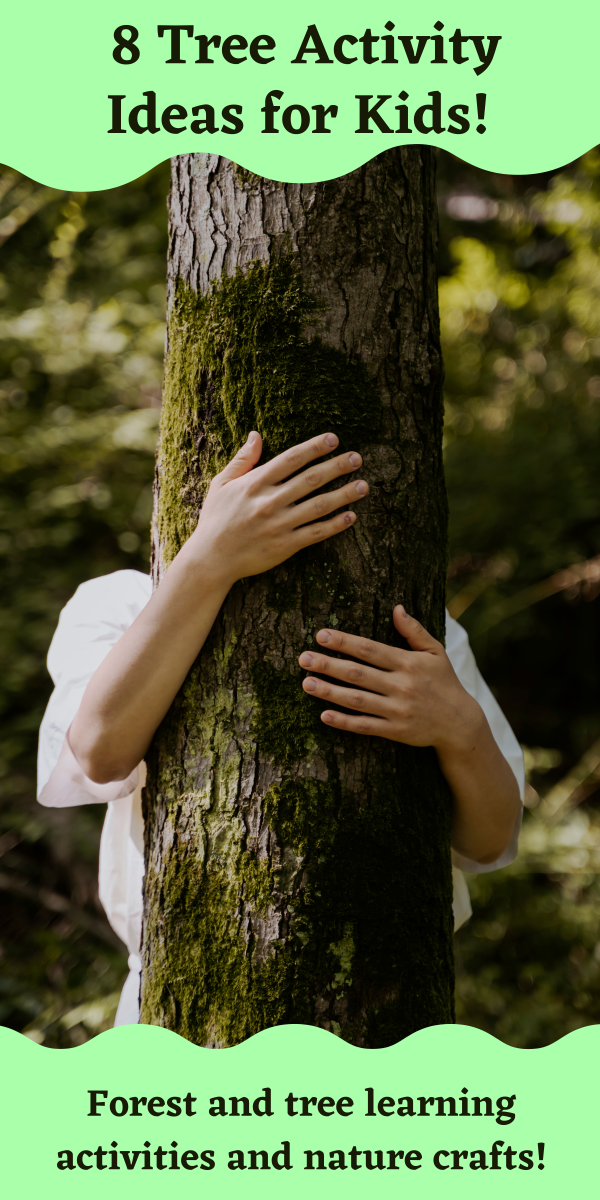
Whether you’re studying forest ecology, plant life cycles, or just looking for a fun nature craft to do after school, you’ll love these tree activity ideas and forest crafts for kids. Try them all!
A note to educators: Looking for great tree teaching materials? I think you will love my complete Trees Unit. It is full of printable worksheets, handouts, activity directions, and everything you need to study trees. Plus, you’ll support this blog with your purchase!
Draw each layer of the forest (floor, understory, canopy, and emergent layers) on a separate piece of paper and cut them out. Assemble them into a booklet, so you can flip through each layer of the forest! These free printable templates will help with this illustration activity. OR, if drawing isn’t your thing, try this completed printable forest layers booklet.
Create your own poster of the common leaf shapes by taking leaf rubbings of different-shaped leaves. Place paper over a leaf and rub the surface of the paper with the side of a crayon. Then label each leaf shape with a marker or pen.
Build a model of tree trunk anatomy by stacking different-sized circles made of construction paper, play dough, or even pancakes! Or – you can use this free printable worksheet as an example/template, or do this as a coloring activity!
If you really want to dive into tree anatomy, I also recommend trying out my tree anatomy mini-study, which includes tree anatomy diagrams and much more:
4. Calculate Tree Height
This is one of my favorite tree activity ideas because it uses math! Make your own inclinometer and use it to calculate tree height! Here’s another article about how to make your own inclinometer and measure tree height, and also download this free tree height math poster!
You can also find additional worksheets and directions for a tree-height activity in my Math in the Forest unit. If you are interested in hands-on math activities and real-world math applications, I think you’ll enjoy this one:
5. Measure Tree Circumference, Diameter, & Radius
Here’s another math-based tree activity idea! Teach your students about circumference, diameter, and radius in a unique and hands-on way! Head outside with a tape measure and measure the circumference of different trees, then calculate their diameter and radius! Or use diameter and circumference measurements on a tree stump to back-calculate pi and see how close you can get to 3.14159265359….
I also created a mini-study with printable posters, worksheets, and activity guides for a pi, diameter, and radius lesson using tree measurements! You can support my blog by checking it out and purchasing it:
The canopy is the upper part of a forest. What does the canopy look like from below? Create a 1-point perspective drawing of the forest canopy. This is a fun way to add an art project to your studies of trees!
A perspective drawing of the forest canopy
7. Tree Ring Crafts
Cut thin slices of a tree trunk or branch. Count the rings to figure out the age of the tree (or branch). Drill a small hole through the top of each slice and then paint them to make hanging ornaments or name tags!
Don’t want to cut your own slices? Fortunately, you can also purchase wood slices in bulk.
Plus, you can read more here about tree rings, why they form, and how scientists use them!
Collect samples of parts from several different deciduous and coniferous trees (leaves, needles, seedpods, flowers, fruits, cones, etc.). Grab two jars and label one “deciduous” and one “coniferous”. Sort the parts into the jars.
All the printable worksheets, directions, & materials you’ll need for the activities in this post are found in my Forest Collection. It’s a bundle of 3 tree and forest-themed units that I know you and your students will love:
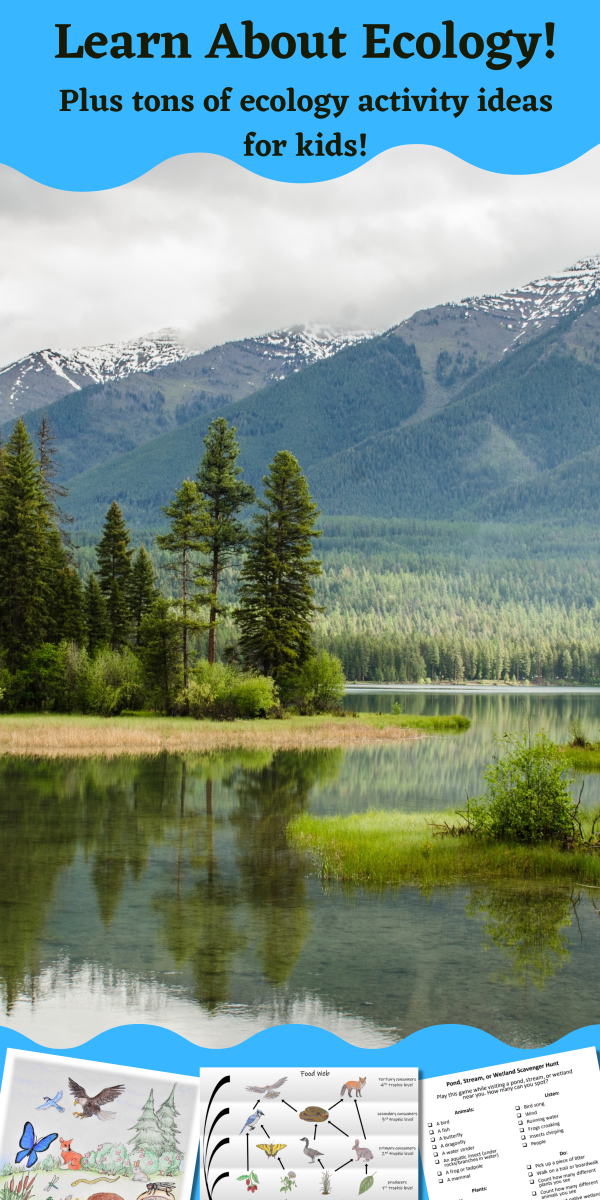
In this article, learn about ecosystems and ecology! Plus, you’ll learn the difference between biotic and abiotic. Also, read about why ecology is important and learn about what ecologists study!
Click here to skip to the the list of Ecology Activity Ideas for Kids!
An ecosystem is a community of living things (or organisms) that interact with one another and the environment where they live. Ecosystems include living (biotic) things such as animals, fungi, and plants. Furthermore, ecosystems also includes non-living (abiotic) parts of the environment, such as rocks, soil, water, and weather. All the living and non-living parts of an ecosystem are interacting and affecting each other over time in many ways.
Looking for ecology lessons? Try out my food webs unit!
What is ecology?
Ecology is a type of science that looks at the relationships living things have with one another and with their environment. In other words, ecology is all about understanding the connections between organisms and their surroundings.
An ecosystem includes both living and non-living parts of an environment!
Why is ecology important?
We as humans do not live outside of ecosystems. Just like mushrooms, mice, and maple trees, humans are organisms that are a part of ecosystems! The ecosystems around us affect our lives, and often more noticeably, we affect our ecosystems. It’s important for us to understand the inner workings of ecosystems and how we impact them, so that we can find ways to go about our lives while also promoting healthy ecosystems. The scientists doing this work are called ecologists.
Ecologists study many topics that relate to ecosystems and the species that live in them. Here are some important topics that ecologists study:
Food webs
Relationships between species, including symbiotic relationships!
Impacts of natural disasters on ecosystems (e.g., wildfire, floods, volcanic eruptions)
Succession (changes in ecosystems after disturbances like fire)
Types of habitats and the ways that species use them
The impacts caused by invasive species
Assessing ecosystem health and human impacts
An example of a food web!
Ecology Activity Ideas for Kids:
Food Chains & Food Webs: Print out some animal, plant, and fungi pictures and build your own food chains and food webs (example here)
Biotic & Abiotic: Fill an egg carton or other container with tiny treasures found outdoors (e.g., pebbles, feathers, shells, a clump of dirt, etc.). Sort the items into two piles: biotic things (are living or were once part of a living thing) and abiotic things (never were alive)
Clean it Up: Participate in a clean up day at a natural area and help improve your local ecosystems!
Invasive Species: Participate in a invasive species removal day at a local natural area!
Symbiosis: Learn about symbiotic relationships! Check out this resource.
Population Sampling: Learn how to estimate populations with random sampling. Here’s an example of an ecological sampling lesson plan from Northern Arizona University.
Teaching kids about ecology with Wild Earth Lab:
I have tons of both free and paid resources to help you teach your kids or students all about ecology! Please check out the following:
Wild Earth Lab is supported by readers like you. This post includes links to my own products and affiliate products. If you purchase through links on my site, I may earn a small commission at no additional cost to you.
Birds of prey, or raptors, are top predators that can be found in almost any type of habitat, from coastal areas to mountains, wetlands to deserts, grasslands to forests. Some of these incredible birds can even adapt to live alongside humans in urban areas! Because they are so widespread, chances are your students have spotted a raptor at some point. These fierce but charismatic birds are sure to be a crowd-pleaser for students, and studying raptors provides a great opportunity to introduce topics like predation, food webs, and wildlife conservation into your classroom.
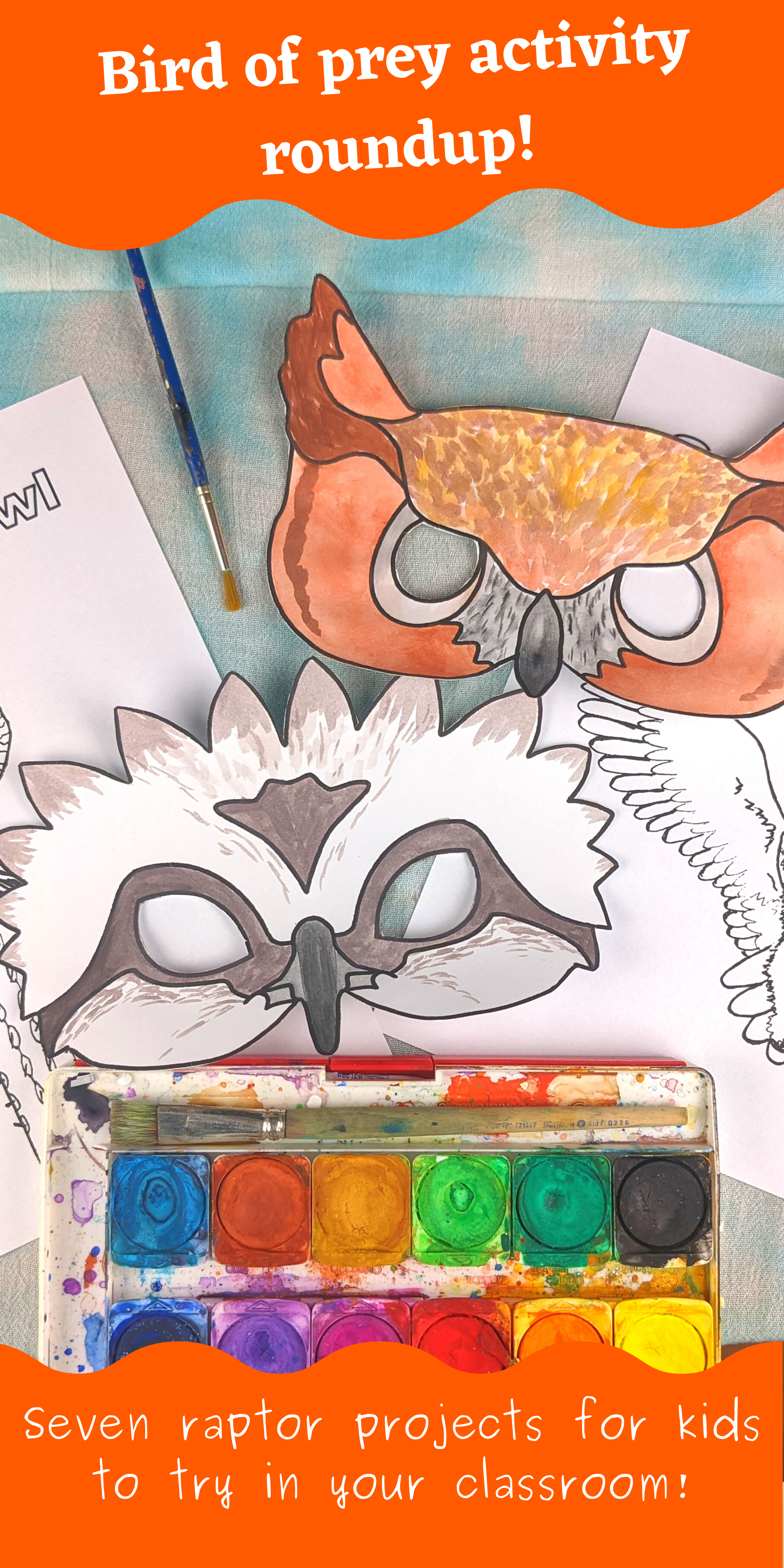
To help with your lesson planning, I’ve rounded up seven bird of prey activity ideas to try out with your class or homeschool group this school year!
1. Visit or volunteer at a raptor center
A red-tailed hawk at a raptor center outreach event! This hawk could no longer survive in the wild due to an injury, but now helps kids learn about birds of prey!
Raptor centers provide homes for injured birds of prey that can no longer survive in the wild, as well as raptor outreach and education for their local communities. You can learn all about raptors from the experts at your local raptor center or wildlife sanctuary while seeing these amazing birds up close! Many Raptor centers offer tours to school groups and homeschoolers, and some have outreach programs that will come to your school!
There’s no better hands-on way to learn about bird of prey diets than directing an owl pellet! After eating, owls regurgitate the parts of their food that they cannot digest, like fur, bones, and beaks. Sometimes you can find whole skeletons of mice, voles, and songbirds inside of owl pellets!
You may be able to order owl pellets through your local raptor center! If you don’t have a local raptor center, you can order owl pellets online through these raptor centers:
Ospreys are one of my favorite raptors! Photo by Tina Nord on Pexels.com
Research a favorite local bird of prey online or at your local library. Print my free wildlife research project worksheets for taking notes! You can also click hereto see a list of online wildlife reference websites that I’ve put together to help you complete this bird of prey activity.
Nothing beats seeing raptors in their habitats! Birds of prey can be found in all sorts of different environments, from forests to grasslands, wetlands to deserts, coasts to mountains! They can even be found adapting to live in urban areas alongside humans, in some cases! If you head out hoping to see a raptor, keep in mind that it’s often easiest to see birds of prey around open, grassy fields where they can hunt.
Don’t forget to bring all the right equipment when you go bird watching. You’ll need:
Pictured books: Baby Owls by Martin Waddel The Book of North American Owls by Helen Roney Sattler Guide to Backyard Birds of the Front Range by the Bird Conservancy of the Rockies
There’s no shortage of raptor children’s books! Here are some reading lists of raptor stories. Or just ask a librarian at your local library for recommendations!
What is a raptor? A raptor is a predatory bird, with sharp talons, a hooked beak, and keen eyesight. Raptors are also sometimes called birds of prey. There are many different types of birds of prey, including eagles, hawks, owls, falcons, vultures, ospreys, and kites. Birds of prey come in many different sizes: from the American kestrel, the smallest of falcons, which is not much larger than a blue jay, to the golden eagle, which can have a wingspan…
If you loved these bird of prey activity ideas, I know you will love this complete unit! Check out my birds of prey unit, featuring my watercolor artwork of common raptors!
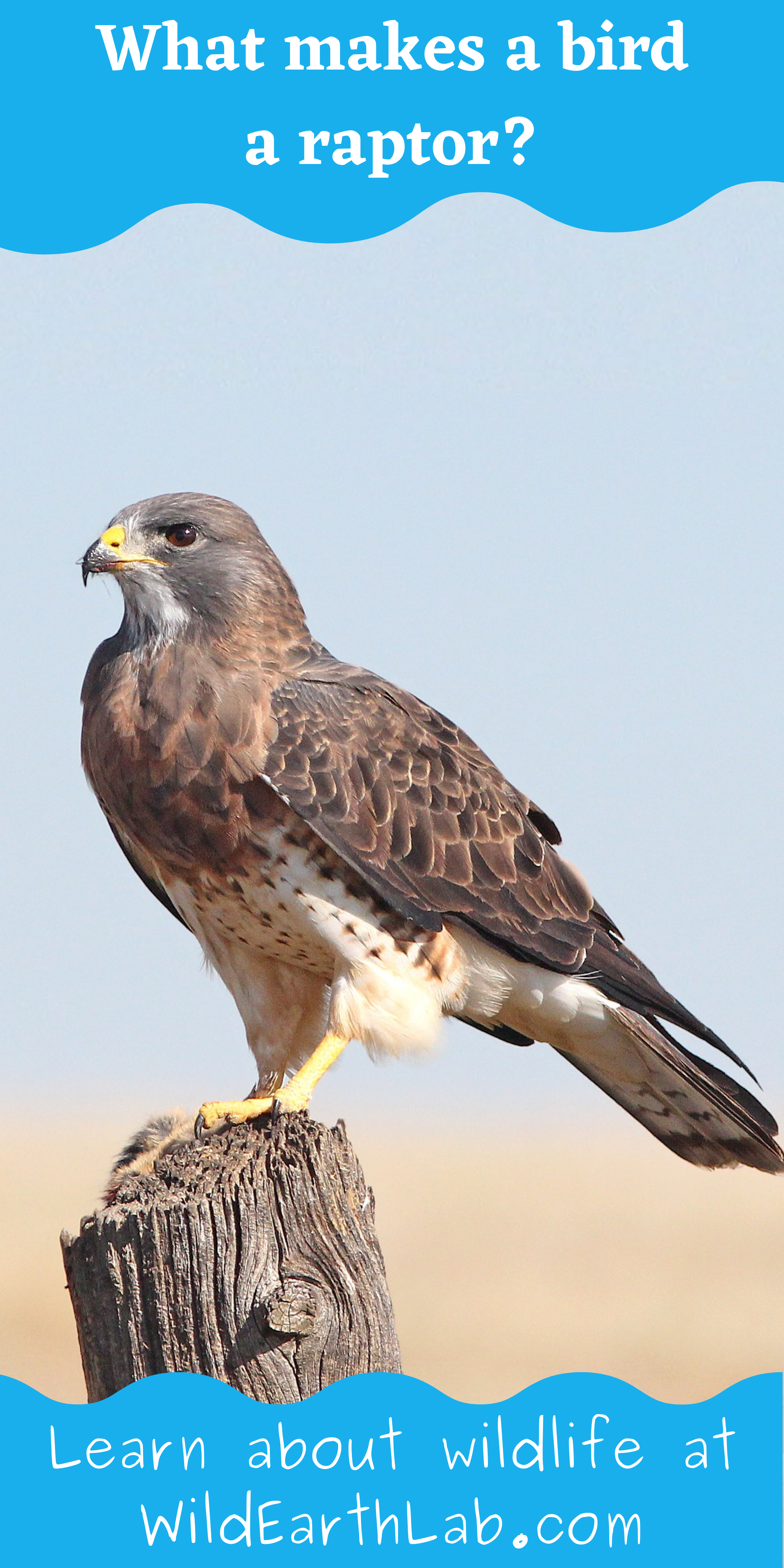
A raptor is a predatory bird, with sharp talons, a hooked beak, and keen eyesight. Raptors are also sometimes called birds of prey. There are many different types of birds of prey, including eagles, hawks, owls, falcons, vultures, ospreys, and kites. Birds of prey come in many different sizes: from the American kestrel, the smallest of falcons, which is not much larger than a blue jay, to the golden eagle, which can have a wingspan over 6 feet (1.8 meters)! Condors, a type of vulture, can be even larger. The Andean condor of western South America may have a wingspan of up to about 10 feet (3 meters).
In this post, you will learn five traits shared by raptors that make them unique and amazing birds. But first…
A note for educators: if you plan to teach birds of prey in your classroom or homeschool, I hope you’ll check out my complete Birds of Prey Unit. It includes all the printable materials needed for a fun raptor study! Plus, every purchase in my shop supports this educational blog!
A bald eagle’s keen eyes. Photo by Darrell Gough on Pexels.com
Birds of prey have excellent eyesight to spot their prey from a great distance. Many birds of prey, hunt by circling high in the air over open fields or perching atop tall trees – it takes some amazing eyesight to spot tiny prey animals like mice and snakes from way up there!
2. Curved Beaks
A falcon’s sharp, curved beak. Photo by Jean van der Meulen on Pexels.com
All birds of prey have curved or hooked beaks. Curved beaks are an evolutionary adaptation of raptors, that serve as a sort of multi-tool. Raptors use their hooked beaks for many purposes, such as killing and eating prey, preening, and feeding their nestlings.
3. Sharp Talons
A raptor’s sharp talons. Photo by Pixabay on Pexels.com
Birds of prey have sharp talons for grasping their prey. Most birds of prey have anisodactyl feet, meaning that they have three talons facing forward, and one talon on the back of the foot (called a hallux). Owls have zygodactyl or semi-zygodactyl feet. Zygodactyl means two talons face forward and two talons face backward. Semi-zygodactyl feet are like zygodactyl feet but one of the back talons can rotate to the front as needed.
4. Meat Eaters
An osprey has caught a fish to eat. Photo by Tina Nord on Pexels.com
Birds of prey eat meat. This means that in a food web, they fill the role of a secondary or higher consumer. Most birds of prey are predators that hunt for a variety of prey animals such as squirrels, mice, rabbits, snakes, and smaller birds. Some raptors also hunt for insects. Vultures are carnivorous scavengers, which usually eat the dead carcasses of animals rather than hunting and killing their own prey.
5. Involved Parents
A pair of great horned owl fledglings. Photo by Tina Nord on Pexels.com
Both male and female parents take active roles in raising the young: incubating eggs, hunting and providing food to the young, and defending the nest from predators. Young raptors, called nestlings, are completely dependent on their parents for food, shelter, and protection. Once they develop flight feathers, the young birds are called fledglings. The fledglings practice leaving and returning to the nest, while still depending on their parents for food.
Chances are you can find raptors in your local area! Raptors are found in all sorts of habitats, including forests, deserts, coastal areas, grasslands, wetlands, and even urban areas! Depending on where you live, you will find different species of raptors. Visit a local raptor center or check out your state or county’s parks and wildlife website to learn about common raptors in your area!
Finally, don’t forget to check out my complete printable birds of prey unit. It is perfect for taking a field trip to the raptor center with your students or studying birds of prey in your classroom or homeschool. Plus, you’ll support my blog with your purchase in my shop!
Are you interested in reading more posts about amazing wildlife? Subscribe or follow Wild Earth Lab using the links below!
Many forces work together to shape the landscape. Plate tectonics, volcanic activity, erosion, and deposition work slowly over time to form and change Earth’s surface. All these forces working together create some pretty unique and cool landforms! In this post, we’ll take a closer look at 12 common landforms – what they look like and how they form!
Landforms are the naturally formed, solid features of the Earth’s surface. They shape the Earth’s topography, or form. Landforms shape the way the Earth’s surface looks and how humans, plants, and animals live in different areas. Next time you head out on a road trip or visit a park, see which of these 12 common landforms you can spot!
For Teachers: If you’re an educator planning to teach landforms, great activities and visuals are key to deepening understanding! I think you and your students will love my complete Landforms Unit, which you can also find in my Landforms and Waterbodies Bundle –plus you’ll support my blog with your purchase! ❤️
A canyon near Elephant Butte, in Arches National Park, Utah
Canyon
Definition: A deep, narrow passage bounded by cliffs on both sides. Canyons are like valleys but with much steeper walls.
Formation: Canyons form due to erosion by running water. The running water may be seasonal and only flow for a few months of the year, or flow year-round.
Definition: A naturally formed, underground chamber, below the earth’s surface or on the side of a hill or cliff.
Formation: Many caves are formed by erosion. Caves can form when slowly seeping groundwater dissolves buried rock, leaving behind hollowed-out caverns. For example, the rock limestone dissolves when in contact with mildly acidic groundwater. Erosion can also form caves when waves carve sea caves into cliffsides.
El Capitan, Yosemite National Park, California, USA
Ampetheatre, Giants Castle Game Reserve, South Africa
A hill along the Colorado Trail, Colorado, USA.
Hill
Definition: A rounded, naturally elevated area of land.
Formation: Hills form in many ways. Some hills form as formerly larger mountains erode. Others form when sediments are deposited and then colonized with plants, such as the hills left behind in areas once covered by glaciers. Some hills form due to plate tectonic activity.
Definition: A body of land surrounded by water. Islands are smaller than continents and can be found in many types of water bodies such as oceans, lakes, and rivers.
Formation: Islands may be formed by volcanic activity or by the deposition of sediments like sand. Plate tectonics also plays a role – where ocean plates converge, uplift and volcanic activity occur – increasing the elevation of the ocean floor until it breaches the water’s surface, forming islands.
Examples of Islands
A Small Island near Pulau Guraici, North Maluku, Indonesia
Isle Royale National Park, Michigan, USA: the largest island in Lake Superior. Isle Royale is so large it has smaller lakes on it, which have smaller islands within them!
Bird Island, near South Georgia and the South Sandwich Islands off the coast of Antarctica
Definition: A narrow strip of land with water on two sides, connecting two bodies of land.
Formation: Isthmuses form when the water level exposes an elevated ridge of land above the water’s surface. Some isthmuses, such as the Isthmus of Panama, form where tectonic plates converge. Others, like the Madison Isthmus, result from the lakes and glacial drumlins (ridges of loose rock and coarse sediment deposited by glaciers) left behind in a post-glacial landscape.
Definition: A naturally elevated, flat-topped area of land with steep sides. It is larger than a butte but smaller than a plateau.
Formation: Mesas form as running water erodes the rocks and sediments surrounding an area, leaving it elevated above the surrounding landscape. A “capstone” made of harder rock than the surrounding area may prevent the mesa itself from eroding as quickly.
The Landforms Unit includes three-part flashcards and this printable classroom poster with watercolor artwork of 12 common landforms.
A glacial valley near Byron Glacier, outside of Anchorage, Alaska.
Valley
Definition: A low area of land between two hills or mountains. Valleys often have streams flowing through them.
Formation: Valleys are formed by erosion. Running water or glaciers can carve out valleys over long time periods. Flowing water tends to cut “V” shaped valleys, while glaciers carve out “U” shaped valleys.
View from inside the crater of a dormant volcano in Haleakalā National Park, Maui, Hawaii.
Volcano
Definition: A mountain or hill with a crater through which lava is projected.
Formation: Volcanoestypically form due to plate tectonic activity, which can allow the molten rock to breach the Earth’s surface. The buildup of solidified lava forms a cone with a crater in it.
Are you planning to teach landforms and water features? You may enjoy the learning materials I’ve created on these topics! All my learning materials feature my artwork! Find them in my shop or click on the links below:
Maybe you’ve studied a little ecology and come across the terms “food chain” and “food web.” Both help ecologists explain the ways that energy from food travels through an ecosystem. In this post, we will dive into the differences between food chains and food webs, and look at some examples of both!
Before we dive in: If you’re an educator planning to teach food webs, great activities are key to deepening understanding! I think you and your students will love my Food Webs Unit(plus you’ll support my blog with your purchase! ❤️)
Food Chains
In an ecosystem, organisms are connected through feeding relationships: basically, who eats whom. There are feeding relationships between plants and plant-eating animals and feeding relationships between prey and predators. A food chain is an ordered list of who eats whom in an ecosystem. It is just one of the many paths that allow energy to move through an ecosystem, from organism to organism.
Food chains will always start with a producer: a plant or microorganism that can make its food through photosynthesis, creating sugar and oxygen from water, carbon dioxide gas, and sunlight. The next organism on every food chain will be the primary consumer – a plant-eating animal, also known as an herbivore. Following the primary consumers are one or more additional consumers, called the secondary (2nd) consumer, tertiary (3rd) consumer, quaternary (4th) consumer, etc… Secondary and higher consumers will always be omnivores or carnivores. The final consumer on any food chain is also known as a top predator because it has no predators of its own.
An example of a food chain
Food Chain Diagrams:
We visually represent food chains with a list of organisms connected by arrows to show the movement of energy through food (see above). Food chains are also sometimes represented as pyramids (see below) because it takes many producers to feed each primary consumer, many primary consumers to feed each secondary consumer, and so on. This is why ecosystems have many plants but few top predators. Each layer on the pyramid represents a position in the food chain, called a trophic level.
A pyramid food chain diagram reminds us how it takes many organisms in lower trophic levels to support just a few organisms in higher trophic levels.
Food chains vary in length. Some may be short, with as few as two trophic levels. Others have more trophic levels due to many different producers eating one another. Below, you will find a few examples of food chains.
A food chain is just one of the many paths that allow energy to flow through an ecosystem. However, ecosystems are more complicated than a single food chain: every ecosystem includes many overlapping and interconnected food chains. For example, several different herbivores might all graze on one large field of grass. One predator might eat several types of prey to get enough food. The result is a complex network of feeding relationships between organisms in an ecosystem, called a food web. Food webs map the many paths for the movement of energy between all the organisms in an ecosystem.
In addition to the producers and consumers, decomposers are an important part of any food web. Decomposers are ecosystem members who have an important role in recycling organic matterback into the soil. They consume waste and decaying plant and animal matter. Usually, decomposers are fungi, microorganisms, or invertebrate animals like worms. Thanks to decomposers, nutrients are returned to the soil to help plants grow.
The difference between food chains and food webs? In summary, food chains are a single path showing how energy moves from organism to organism through an ecosystem, while a food web is a more complex network that maps the multiple feeding relationships of each organism in an ecosystem.
Food Web Example:
An example diagram of a food web including decomposers, producers, consumers, primary, secondary consumers, and tertiary consumers!
Build Your Own Food Webs:
For a fun, hands-on way to teach students about food webs, try creating models of food webs in your classroom! Read my post about building your own food web models for step-by-step activity directions! Or, you can find all the printable materials, directions, and worksheets for this activity in my complete Food Webs Unit:
I’ve created a few free food web learning materials that you can download and print! My email newsletter subscriberscan access and download my full collection of free worksheets, handouts, and diagrams, including these:
Download this Free Printable Food Web Poster!
Download some free wildlife research project worksheets! Click herefor a list of reference websites for researching wildlife.
Looking through a lake sample for aquatic insects.
A monarch butterfly caterpillar munches on milkweed.
A tiny red-spotted newt crawls across the forest floor.
Welcome fellow nature lovers and outdoor adventurers. Welcome backyard naturalists, kitchen table scientists, life-long learners. Welcome fellow wonderers and wanderers. I’m glad to see you here.
My name is Valerie and I’m a scientist, artist, and avid outdoors woman currently in Colorado, USA. My curiosity about the natural world started at a young age, exploring the prairies and woods of Wisconsin where I grew up. This curiosity blossomed into a love of backpacking and hiking as a teenager, which inspired me to embark on what I saw as the ultimate outdoor adventure – a thru-hike of the 2,180-mile Appalachian Trail. This journey took me to places I had never been, where I experienced things I had only dreamt of: I saw my first-ever black bear, as well as moose, baby deer, copperhead snakes, songbirds, foxes, owls, turtles, and red-spotted newts. I marveled at wildflowers that grew above tree line in the White Mountains of New Hampshire. I witnessed seemingly tropical rhododendron plants comfortably survive two feet of snow in the Great Smoky Mountains. I forded rivers where no bridges had been built, bathed in lakes that had never seen a motorboat. I satiated my hiker hunger with wild blueberries.
A box turtle.
Wild blueberries!
I also saw many things I hadn’t expected to see, such as when the trail crossed through a superfund site in Pennsylvania. The area’s history of zinc smelting noticeably impacted the landscape, which abruptly changed from dense forest to barren hillslopes, eerily devoid of birdsong and inhabited by only a scattering of dying trees, invasive grasses, and more deer ticks than I care to remember. I saw firsthand the immense efforts of trail crews to remove litter at overrun shelters and privies. I experienced a mass emergence of invasive caterpillars along a section of trail in West Virginia. I encountered wild animals that were so desensitized by repeated human interaction and feeding that they approached hikers without fear. I witnessed restoration efforts to prevent the encroachment of lower-elevation species onto the mystical bald mountaintops of the southern Appalachians. I learned that the “100-mile wilderness” in Maine, known for being one of the most remote and wild areas on the east coast, is also the site of several logging operations, providing the necessary resource for our wood and paper products. Through this experience I learned there was a lot I didn’t know about our natural world, the resources we extract from it, and the ways that we impact it.
Caterpillars devour leaves.
Restoration efforts with controlled burning.
In part, my experiences along the trail inspired me to pursue a degree in Fish, Wildlife, and Conservation Biology. I felt motivated to better understand the natural world and our relationships with it. Through the eyes of a scientist, I learned. I learned about the big, seemingly-unstoppable cycles of nature – of water, carbon, tides, and seasons – so powerful and yet delicately balanced, to allow for the diversity of life on this planet. And I learned about the small, unlikely relationships existing between pairs of species – between flower and pollinator, bird and fruit-bearing tree, plant and mycorrhizal fungus – allowing both to thrive. I learned about the unseen connections of all beings within an ecosystem, and about how we humans are connected to this world too, even when our lives make it difficult to see the places we are attached.
In the past few years, I have worked as a scientist in both the field and in the laboratory. I’ve measured the flows of headwater streams, counted new seedlings in beetle kill forests, evaluated the health of insect communities in a national park, and studied soils following forest fires and chemical spills. As a scientist, I’ve had the opportunity to intimately understand our relationship as humans with nature: what we are doing right, what we are doing wrong, and how we can do better.
Taking good field notes is key!
An ornithologist handles a hummingbird.
Throughout my education and career, I have wondered how things would be different if education about nature and our relationship with Earth started earlier. My childhood education barely scratched the surface of ecosystem science, and it wasn’t until college that I was introduced to sustainability and conservation. What could our world be like if we all started out with a better understanding of this Earth and all its wild, remarkable, intricate beauty? How could things change if we all carried with us an understanding of the things we can do – big and small – to improve our relationship with Earth? I believe one of the most natural things we can do as humans is to wonder at nature. It’s never too early – or too late – to start learning about the natural world, the diversity of life on this planet, and what we can do as individuals to help protect it.
A Douglas fir pinecone.
Taking stream measurements.
My goal in creating Wild Earth Lab is to create resources for you, your family, and your students to learn about the Earth and our relationship with it. Through combining my passions for nature, science, and art, I hope to use this space to create unique and beautiful educational resources and engaging, informative articles covering a range of topics related to science, sustainability, and the natural world.
Are you still with me? Perhaps this sounds like something you’re interested in too. I hope you will join me on this journey by subscribing to Wild Earth Lab, or by following Wild Earth Lab using the links below:


 Forest Bundle: 3 cross-curricular forest units!Original price was: $30.00.$24.00Current price is: $24.00.
 Forest Ecology: an environmental science unit$12.00
 Trees: a science unit in the forest!$10.00
 Math in the Forest: an applied STEM unit with outdoor activities!$8.00