Posted on — Leave a comment

Insect Activities to Try in Your Classroom

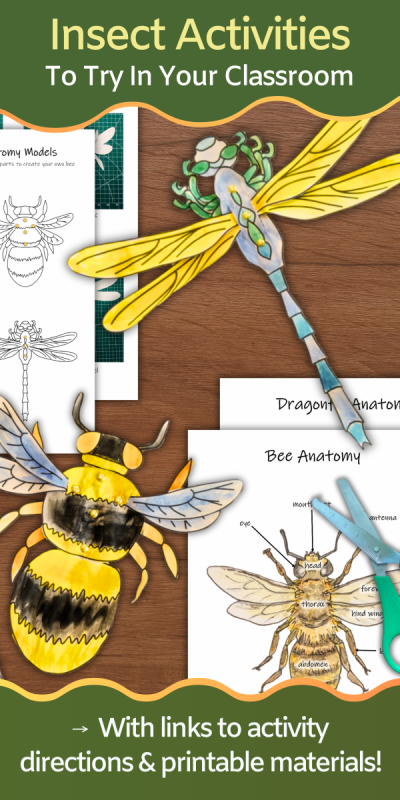
paper models of a dragonfly and a bee
text that says share this post

Whether it is through the lens of metamorphosis, biodiversity, or pollination, insects are a fun and common elementary school classroom topic. In this post, discover insect activity ideas to try out in your classroom – complete with links to relevant worksheets and printable materials.

1.) Study Insect Traits & Anatomy

A great way to start any insect unit is by learning what makes an insect an insect. There are many fun ways to teach students about insects’ 6 legs and 3 body segments.

Read a blog post

These posts from my blog teach the basics of insect traits and anatomy.

Color your own insect anatomy diagram (FREE resource)

You can find the insect anatomy coloring worksheet on my free resources page. You can access this free resource and all the other free resources when you join my email newsletter.

coloring worksheet with the parts of an insect
Build insect anatomy models (paid resource)

Use this set of printable materials to construct your own bee and butterfly models from paper!

2.) Review head, thorax, and abdomen with these fun activities

Head, thorax, and abdomen are the three main body segments of an insect. Review these segments with fun games and activities!

Play Insect Mashups (FREE resource)

This is a hilarious and collaborative game where students take turns drawing the head, thorax, and abdomen of an insect – but no peeking at what the other students have drawn until you’re done!

Head, Thorax, and Abdomen Coloring (paid resource)

Heads, thoraxes, and abdomens come in many shapes and sizes – but insects always have all three! Can your students identify the heads, thoraxes, and abdomens on these different insects?

3.) Study the life cycle of insects

Insects hatch from eggs. Many insects change between distinct stages during their life cycle – a process called metamorphosis. There are many fun ways to teach metamorphosis and insect life cycles in your classroom.

Read about insect life cycles and metamorphosis

Visit these blog posts to learn about insect life cycles and metamorphosis.

Color your own monarch life cycle diagram (FREE resource)

You can find the monarch life cycle coloring worksheet on my free resources page. You can access this free resource and all the other free resources when you join my email newsletter.

a diagram of a monarch butterfly life cycle on paper with colored pencils
Ladybug and Monarch Life Cycle Diagram Printables (Paid resources)

These sets include a printable diagram featuring my watercolor artwork and a practice activity in which students put the life cycle steps in the correct order.

The Monarch Story Booklet (Paid resource)

Put together (and color) your own mini booklet that tells the story of the monarch life cycle!

4.) Learn the difference between “insects” and “bugs”

Insects provide a great opportunity to teach your students about biological classification and taxonomy.

Learn from a blog post

Do you know what makes a “bug” different from other insects? What about what makes insects different from other arthropods? Find the answers in this fun and informative blog post:

Taxonomy Mini Study: with “insect” vs “bug” sorting activity, worksheets, & handouts (paid resource)

Introduce your students to biological classification and taxonomy with this fun activity that highlights the difference between “insects” and “bugs”.

5.) Learn about insect pollinators and pollination

Many insects, like bees and butterflies, play a very important role in their habitats. They are pollinators – animals that help move pollen between flower parts so that fruits can develop. Teaching kids about pollination is a great way to show them the importance of tiny animals like insects in ecosystems.

Read a blog post

Learn about pollination by reading one of these blog posts.

Play the unusual pollinators game (FREE resource)

Discover the diversity of pollinators with this game. Print pictures of a variety of pollinators and tape them to studentsโ€™ backs. Tell students that all the animals and insects on their backs can pollinate plants. Then, instruct the students to ask each other yes/no questions about their pollinator until they correctly guess its identity.

Freebie: Iโ€™ve put together 18 printable pollinator cards, plus directions. You can find the monarch life cycle coloring worksheet on my free resources page. You can access this free resource and all the other free resources when you join my email newsletter.

Try my complete pollination unit (paid resource)

If you’re ready to really dive into all things pollination and pollinators, look no further than my complete Pollination Unit. It is full of hands-on activities, handouts, worksheets, and everything you need to teach pollination in your classroom!

A complete set of pollination activities and pollination unit study materials to use in your classroom!

6.) Dive into the unique world of aquatic insects!

These cool insects – like mayflies, stoneflies, and caddisflies – live in aquatic environments like lakes and rivers. They are sensitive biological indicators that teach us about water quality and ecosystem health. Studying aquatic insects is a fun and unique take on classic insect studies – and a great way to get outside poking around for insects in ponds and shallow creeks!

Read about aquatic insects in the blog:

Aquatic insects are a type of aquatic macroinvertebrate. Read these posts to learn more:

Try my aquatic insects study and macroinvertebrates lessons! (paid resources)

I created a complete aquatic macroinvertebrates unit. It is packed with all the worksheets, handouts, and hands-on activities you’ll need to teach this exciting environmental topic. You can also download just the aquatic insect diagrams “a la carte” in my aquatic insects mini-study.

A photo of classroom handouts for studying aquatic insects
Find life cycle and anatomy diagrams in the aquatic insects mini-study
photo of macroinvertebrate classroom handouts and posters
The mini-study is also found within the complete aquatic macroinvertebrates unit

Study Insects with Wild Earth Lab!

Thereโ€™s no need to scramble to put together the perfect insects unit from scratch โ€“ Iโ€™ve already created it for you! This set includes all the printable materials you need for studying insects.

Explore more lessons from Wild Earth Lab:

If you enjoyed this post, I know you will love trying my other printable science and nature units in your classroom too!


Are you interested in reading more posts like this? Subscribe or follow Wild Earth Lab using the links below!

Subscribe, share, and comment:

Posted on — 2 Comments

How does pollination work? A step-by-step guide to pollination and the plant life cycle

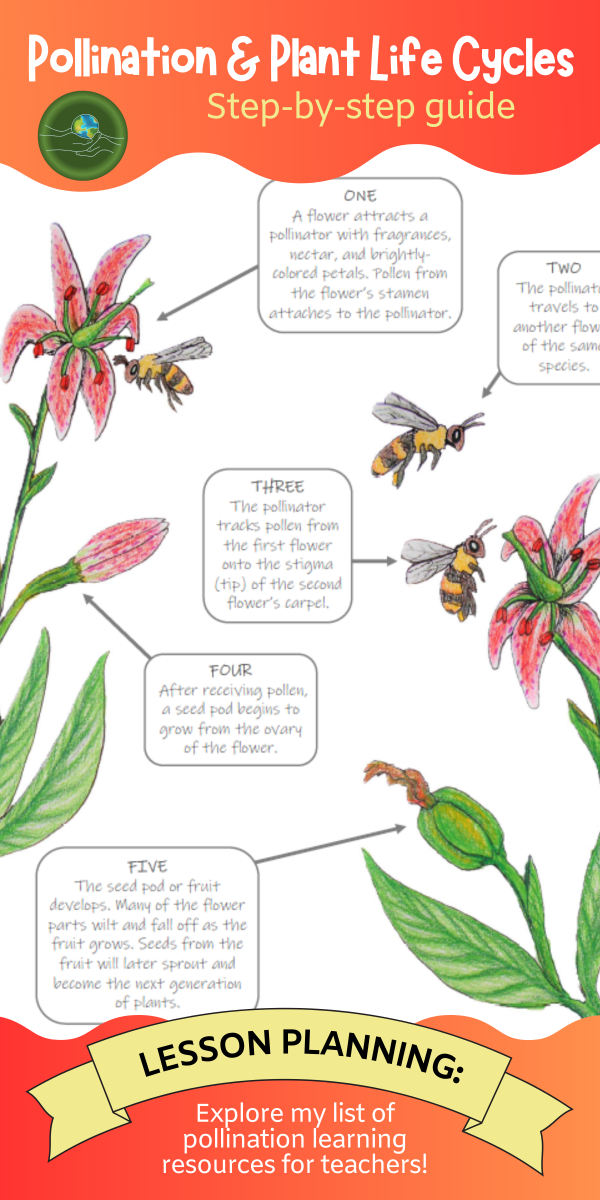
banner advertising a blog post about pollination and plant life cycles with a diagram of bees pollinating flowers
text that says share this post

In this post, we will take a closer look at the steps of animal pollination and the plant life cycle. You might already know that pollination is the transfer of pollen from the stamen to the carpel of a flowering plant (psst – brush up on your plant anatomy by reading my flower anatomy post or checking out my Flowers Unit!). Once pollinated, the plant forms a fruit. Fruits contain seeds, which will grow into the next generation of plants.

A variety of animals can be pollinators, such as bees, butterflies, and many others that may surprise you. The relationship between a pollinator and a plant is key to the survival of both species. This relationship is so important to both the plant and the pollinator that it influences how they evolve. In other words, plants and pollinators coevolved. Plant species developed traits to help them attract pollinators, such as brightly colored petals, sweet nectars, and strong scents. As pollinator species grew reliant on nectar as a food source, they developed body parts and habits for collecting flower nectar more efficiently.

Before we dive in: If youโ€™re an educator planning to teach pollination in your classroom, great activities are key to deepening understanding! I think you and your students will love my Pollination Unit, which is also found within my Botany Collection (plus youโ€™ll support my blog with your purchase! โค๏ธ)

Now, let’s take a look at the steps of pollination and the plant life cycle!

Step 1: Attracting pollinators

A flower attracts a pollinator with fragrances, nectar, and brightly-colored petals. Pollen from the flowerโ€™s stamen attaches to the pollinator.

A pollinator visiting a flower.

Step 2: Pollen transfer

The pollinator travels to another flower of the same species.

A pollinator traveling between flowers of the same species.

Step 3: Pollination

The pollinator tracks pollen from the first flower onto the stigma (tip) of the second flowerโ€™s carpel. Pollen travels via the style to the flower’s ovary.

The pollinator transfers the pollen to a second flower.

Step 4: Fruit growth

 After receiving pollen, a fruit or seed pod begins to grow from the ovary of the flower. Many of the flower parts wilt and fall off as the fruit/seed pod grows.

A fruit starts to form from the flower’s ovary.

Step 5: Seed dispersal

The seed pod or fruit develops. Once the fruit is ripe, the plant must disperse its seeds. At this point, some plants rely on another animal (separate from the pollinator) to help with seed dispersal. After the animal eats the fruit, it travels away from the parent plant and deposits the seeds in its scat. However, many plants do not rely on animals for seed dispersal. Alternative methods for seed dispersal utilize forces such as wind, water, and gravity.

Almost ready for seed dispersal.

Step 6: Germination and growth

After seed dispersal, seeds will germinate (or sprout) into tiny plants. The luckiest of the tiny plants will grow and reach maturity. Once mature, the plants make flowers of their own to attract pollinators, and the cycle begins again!

Germination process.

Teaching Pollination and Plant Life Cycles

Are you teaching pollination in your classroom? Here are some additional activity ideas and resources!

1. Try my free pollinator guessing game in your classroom:

Directions and cards for a pollinator guessing game are available on the free resources page of my website. My email subscribers gain access to the free resources page (plus receive my newsletters with new activity ideas, project guides, and science teaching inspiration!).

2. Read my post about weird and wild pollinators!

3. Check out my list of pollinator activity ideas for classrooms!

4. Try the flower anatomy activity in this blog post:

5. Study pollination with Wild Earth Lab!

Your students will love my Pollination Unit and other science units! I created this set of printable pollination learning materials and it is packed with activities and information, as well as my pollination artwork!

Here are some more units that I think you’ll love:


Are you interested in reading more posts about environmental science topics? Subscribe or follow Wild Earth Lab using the links below!


Sharing options and discussion for this post:

Posted on — 4 Comments

Which animals pollinate? Common pollinators plus a few that will surprise you!

banner with pictures of pollinators and the text "weird and wild: animal pollinators!" and "+ free classroom activity! Learn about the diversity of pollinators!"

Pollinators are animals that transfer pollen between flowers. Many pollinators are insects, such as bees. However, birds, mammals, and a variety of other animals can also be pollinators! Pollinators are key members of most terrestrial (on-land) ecosystems. Pollinated plants produce food that feeds other members of the ecosystem. Pollinators also help humans because they pollinate many of our food crops. For example, a tomato could not form from a tomato plantโ€™s flower without being pollinated by a bee.

Plants and pollinators have symbiotic relationships โ€“ long-lasting, close relationships between two living beings. A pollinator and a plant have a specific type of symbiotic relationship called mutualism, in which the relationship benefits everyone involved. The pollinator gets a tasty meal of nectar. The plant gets pollinated so it can make seeds. Itโ€™s a win-win!

In this post, we’ll take a look at the different types of animals that pollinate plants. But first…

A note for teachers: are you teaching pollination? I think you and your students will love the hands-on activities and thoughtfully crafted visuals in my comprehensive Pollination Unit! It includes all the activities, handouts, worksheets, and diagrams you’ll need for teaching pollination. I hope you love it!

Bees & Wasps

The European honey bee or

Although there are many different animal pollinators, bees (especially honeybees) are usually considered the most important pollinator due to their key role in many ecosystems and their ability to pollinate a wide variety of different plants, including many food crops. Bees rely on flowers as their food source – they fly from flower to flower collecting nectar and pollen.

There are many types of bees that pollinate, including honeybees, bumblebees, and solitary bees. Surprisingly, wasps are also sometimes pollinators. That’s right – while wasps are often thought of as being unfriendly pests, they actually play very important roles in their ecosystems!

Butterflies & Moths

Photo by Erik Karits on Pexels.com

Butterflies drink nectar through a long proboscis – a straw-like mouth part that can reach deeply into flowers. Consequently, butterflies often pollinate deeply tube-shaped flowers. They are attracted to colorful, clustered flowers that are open in the daytime.

On the other hand, nocturnal moths pollinate night-time opening flowers. Moths also have long proboscises and can reach into deeply tubular flowers like their butterfly relatives. In fact, certain moths can have astoundingly long proboscises, such as Darwin’s hawkmoth.

As the tale goes, Charles Darwin came across a species of orchid flower in Madagascar that holds nectar at the end of a foot-long tube. Darwin hypothesized that a species of butterfly or moth with a foot-long proboscis must exist in order to drink nectar and pollinate this flower. Some laughed at this idea, but many years later, scientists identified a species of hawkmoth in Madagascar with a foot-long proboscis, just as Darwin predicted!

More insect pollinators: beetles, ants, & beyond!

Bees, wasps, butterflies, and moths are just four of the many insects that pollinate plants. Some flies are also pollinators, as are some beetles and ants! Many of these insects inadvertently pollinate flowers as they crawl across them, picking up pollen on their bodies.

Birds

brown hummingbird selective focus photography
Photo by Philippe Donn on Pexels.com

Hummingbirds are by far the most common and well-known bird that pollinates. They drink nectar through their long beaks and can pollinate tube-shaped flowers, just like butterflies. It is well known that hummingbirds especially love red flowers. You may see people hanging red plastic hummingbird feeders in their yards, designed to attract these adorable pollinators. Hummingbirds are even known to fly directly into people wearing red, mistaking their clothing for a cluster of tasty red flowers.

In certain ecosystems, other types of birds such as parrots may also sometimes pollinate.

Bats

Photo by HitchHike on Pexels.com

Did you know that bats can be pollinators? While bats are best known for their ability to catch and eat insects using echolocation, some bats prefer eating fruit and flower nectar. Bats are nocturnal and pollinate at night, like moths. But as some of the largest pollinators, bats usually prefer bigger flowers that produce larger volumes of nectar. Agave, bananas, and some cacti are all popular among bats!

Even more unusual pollinators

black brown and white animal on tree
Photo by Alexander Dummer on Pexels.com

The list does not stop here! There are many more unique pollinators out there. Some reptiles pollinate. As do some slugs. Even a variety of mammals, such as some lemurs and sugar gliders, are known to pollinate plants in their ecosystems. There is certainly no shortage in the diversity of pollinators found around the world!

Try this free pollinator game for your classroom…

Are you looking to teach your students about the diversity of pollinators? Here’s a game you can try in your classroom! Print out pictures of a variety of pollinators and tape them to studentsโ€™ backs. Tell students that all the animals on their backs can pollinate plants. Then, instruct the students to ask each other yes/no questions about the animals on their backs until they can guess them correctly.

Freebie: for this game, I’ve put together 18 printable pollinator cards, plus directions. Click here to download the free cards and game!

Support Wild Earth Lab with a curriculum purchase?

Teaching pollination? Your students will love my Pollination Unit! I created this set of printable pollination learning materials, and it is packed with activities and information, as well as my pollination artwork!

Find your next science topic from Wild Earth Lab…

Looking for your next lesson? Try one of these…


Are you interested in reading more posts like this? Subscribe or follow Wild Earth Lab using the links below!


References and Further Reading

  1. California Academy of Sciences (n.d.). Darwin’s Hawk Moth. Available: https://www.calacademy.org/explore-science/darwin%E2%80%99s-hawkmoth
  2. Houston Zoo (2018). Unusual Pollinators and the Plants They Love. Available: https://www.houstonzoo.org/blog/unusual-pollinators-plants-love/
  3. Mize, A. (2018). Lizards, mice, bats, and other vertebrates are important pollinators too. The Ecological Society of America. Available: https://www.esa.org/blog/2018/04/04/vertebrate-polinator-metaanalysis/
  4. USDA Forest Service (n.d.). Unusual Animal Pollinators. Available: https://www.fs.usda.gov/wildflowers/pollinators/animals/unusual.shtml
  5. USDA Forest Service (n.d.). Who are the pollinators? Available: https://www.fs.usda.gov/wildflowers/pollinators/animals/index.shtml

Sharing options and discussion for this post: