Posted on — Leave a comment

What are the main groups of vertebrates?

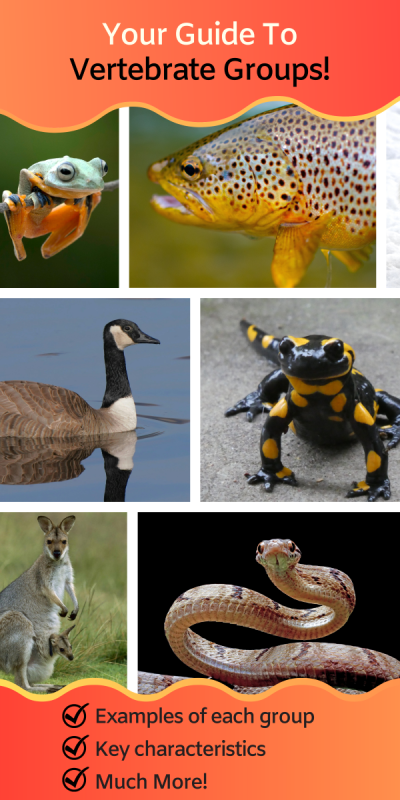
collage animals in the different vertebrate groups
text that says share this post

Vertebrates are a category of animals that share one important trait – they have a backbone. There are seven different groups, or classes, of vertebrates on Earth. These include amphibians, birds, mammals, reptiles, and three kinds of fish. In this post, we’ll explore these groups and find out what makes each one unique.

Before we dive in: If youโ€™re an educator planning to teach vertebrates, great learning resources are key to deepening understanding! I think you and your students will love my 5 units on vertebrate classes, which you can also find within my complete Vertebrates Bundle (plus youโ€™ll support my blog with your purchase! โค๏ธ)

Recommended products

Fish

fishes near coral reefs
Photo by Francesco Ungaro on Pexels.com

Fish are a large and diverse group of vertebrates. Technically, they’re actually three groups of vertebrates. The three main types of fish are jawless fish, cartilaginous fish, and bony fish. Many animals that we might not always think of as fish belong to these groups. For example, sharks, skates, and rays are all types of cartilaginous fish. The bony fish group includes fish that follow the classic body plan, like salmon, tuna, and sturgeons. But this group also includes some unique fish whose bodies look quite different from their relatives – like eels and seahorses.

Fish live almost everywhere there is waterโ€”from icy mountain streams to warm coral reefs and from shallow wetlands to the deepest parts of the ocean. They range in size from tiny guppies to giant sharks and manta rays. Some fish, like tuna, are streamlined for fast swimming across the open ocean. Others, like pufferfish or seahorses, have unusual body shapes and
move slowly among reefs and seaweed.

Their diets and lifestyles vary, too. Some fish, like sharks and tuna, are predators that hunt other animals. Others filter feed tiny plankton from the water or graze on aquatic plants and coral. Some fish, like salmon, migrate long distances between freshwater and the ocean, while others spend their entire lives in one small pond. Regardless of size, shape, or habitat, fish
show an incredible range of adaptations that allow them to survive in aquatic habitats all around the globe!

Fish Traits
  • Spine
  • Typically cold-blooded (some exceptions)
  • Gills
  • Fins
  • Lateral line (sensory organ)
  • Found in water
Examples of Fish
  • Trout
  • Tuna
  • Seahorse
  • Eel
  • Coelacanth
  • Shark
  • Stingray
  • Lamprey

Amphibians

close up shot of a frog
Photo by ะ˜ะณะพั€ัŒ ะšัƒะบัะธะฝัะบะธะน on Pexels.com

Amphibians come in many shapes and sizesโ€”from long-tailed salamanders to tailless frogs and even legless caecilians! Some are huge, like giant salamanders that grow to nearly six feet (two meters) long, while others are so tiny they could sit on your pinky finger. Amphibians also display striking colors, like the brightly patterned fire salamander or the brilliantly huedโ€”but toxicโ€”poison dart frog.

Amphibians all share a few key traits. One of their most distinctive features is their moist, scale-free skin. To stay hydrated, amphibians usually live in damp environments or near water. Their skin contains special mucus glands to keep it moist. Itโ€™s also permeable, allowing water and gases to pass through. This means amphibians can absorb water and even breathe through their skin! However, most species also have lungs or gills for breathing.

Another trait of amphibians is metamorphosisโ€”a dramatic transformation during their life cycle. For example, a tadpole with gills and a tail changes into an adult frog with lungs and legs. Finally, adult amphibians are carnivores, feeding on insects and other small animals.

Amphibian Traits
  • Spine
  • Cold-blooded
  • Moist skin with no scales
  • Skin surface breathing (may also have lungs and/or gills)
  • 0-4 legs
  • Carnivorous predators as adults
  • Metamorphosis (in many species)
Examples of Amphibians
  • Frog
  • Toad
  • Salamander
  • Caecilian

Reptiles

big snake
Photo by Pixabay on Pexels.com

While reptiles and amphibians may look similar, they each represent a distinct vertebrate group. Reptiles can’t breathe through their skin like amphibians. Instead, reptiles always breathe through 1 or 2 lungs, and their skin is dry and scaly. Reptiles also never go through metamorphosis the way many amphibians do.

Reptiles are not the easiest group to define. There is a lot of diversity within this group. From legless snakes to shelled turtles and armored crocodiles, the reptile group has some incredible creatures. Unlike other classes of
vertebrates, scientists now know that the group we call reptiles is not an isolated evolutionary lineage. This means that despite their many similarities, some members of the reptile group are not quite as closely related as people once thought they were. Additionally, we now know that birds descended from a reptile ancestor โ€“ so in a way, birds and reptiles are relatives!

Turtles, tortoises, crocodilians, lizards, snakes, and tuataras are all types of reptiles. They live in freshwater, oceans, and on land. They come in all sizes: from the tiny Brookesia nana chameleon at less than an inch (~2 cm) in length, to giants like Komodo dragons and crocodiles.

The saltwater crocodile is the largest reptile on earth today, measuring over 20 feet (6 meters) long! In the past, even larger reptiles roamed the Earth (dinosaurs) but today they are extinct. All in all, there are over 10,000 amazing species of reptiles alive on Earth today.

Reptile Traits
  • Spine
  • Cold-blooded
  • Scales or scutes
  • 0-4 legs
  • Breathe air with 1 or 2 lungs
Examples of Reptiles
  • Lizard
  • Snake
  • Turtle
  • Crocodile
  • Alligator
  • Tuatara

Birds

goose
Photo by Ellie Burgin on Pexels.com

Birds are a group of egg-laying, warm-blooded vertebrates with feathers, wings, and beaks. If you traced that family tree back far enough, youโ€™d discover that birds evolved from theropod dinosaurs. Because of this shared ancestry, a sparrow is actually more closely related to a dinosaur than to a mammal, amphibian, or any other living vertebrate class. Scientists use these evolutionary relationships to decide which animals belong in the bird group.

Birds live on every continent, including Antarctica, and can be found in nearly every habitatโ€”from forests and deserts to wetlands and open oceans. There are over 10,000 species of birds, and they range in size from tiny hummingbirds to towering ostriches. Birds also show remarkable diversity in behavior. Some migrate thousands of miles each year, while others stay in the same place their entire lives. Their colors, calls, and nesting styles vary just as much as their sizes and shapes.

Bird Traits
  • Spine
  • Warm-blooded
  • Breathe air with lungs
  • Lay eggs
  • Feathers
  • Scutes on legs
  • Beak
  • Wings (many fly, but not all)
Examples of Birds
  • Turkey
  • Sparrow
  • Ostrich
  • Penguin
  • Woodpecker
  • Goose
  • Heron
  • Owl

Mammals

kangaroo
Photo by Aliaksei Semirski on Pexels.com

Like birds, mammals are warm-blooded vertebrates. Mammals are unique because they have hair/fur and nurse their babies with milk. There are over 5,000 different species of mammals alive today. They live in freshwater, oceans, on land, and even take to the skies! They come in all sizes, from tiny creatures like the bumblebee bat to giants like whales. The blue whale is not only the largest mammal, but also the largest animal on earth!

Mammal Traits
  • Spine
  • Warm-blooded
  • Breathe air with lungs
  • Fur, hair, or whiskers (on all or part of the body, for at least part of its life)
  • Produce milk (in females)
  • Single lower jawbone
  • 3 tiny earbones
Examples of Mammals
  • Mouse
  • Deer
  • Tiger
  • Whale
  • Otter
  • Bat
  • Armadillo
  • Kangaroo
  • Human

Study this topic with Wild Earth Lab!

Thereโ€™s no need to scramble to put together the perfect lessons on vertebrates โ€“ Iโ€™ve already created them for you! These sets include all the printable materials you need for studying vertebrate groups.

Explore more lessons from Wild Earth Lab:

If you enjoyed this post, I know you will love trying my other printable science and nature units in your classroom too!


Are you interested in reading more posts like this? Subscribe or follow Wild Earth Lab using the links below!

Subscribe, share, and comment:

Posted on — Leave a comment

Teaching Vertebrates: Key Traits of Mammals

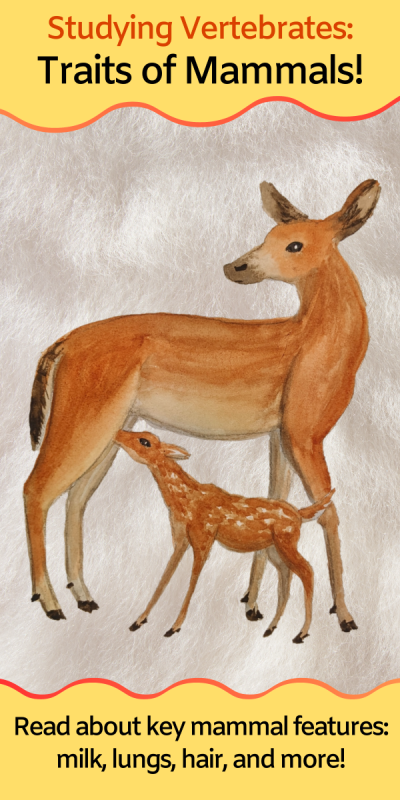
Illustration of a deer fawn nursing from its mother
text that says share this post

Mammals are a special group of creatures with some unique features. Mammals are a huge and diverse group of animals. They live on land, in freshwater, in oceans, and even take to the skies! They come in all sizes, from tiny creatures like the bumblebee bat to giants like whales. Mammals might seem very different from one another, but they share some special traits that help us distinguish them from other animals.

Mammals are part of a bigger category of animals called vertebrates, which means they all have a backbone. There are seven different groups, or classes, of vertebrates on Earth. These include amphibians, birds, mammals, reptiles, and three kinds of fish. In this post, we’ll learn more about the traits that make mammals unique from their other vertebrate relatives.

Before we dive in:ย If youโ€™re an educator planning toย teach mammals in your classroom, great visuals and activities are key to deepening understanding! I think you and your students will love my complete Mammals Unit (plus youโ€™ll support my blog with your purchase! โค๏ธ)

Produce Milk

First, female mammals produce milk to feed their young. This trait is unique to mammals: none of the other vertebrate groups make milk. Milk comes from special mammary glands in female mammals only.

Since mammals nurse their young, the mother must stick around after a baby mammal is born. For this reason, mammal mothers are very involved parents. Parental care is taken to the extreme in a sub-group of mammals called marsupials (e.g., kangaroos and opossums). Not only do they nurse their babies, but they also carry them around in a special pouch or on their backs or bellies.

Other types of mammals called placentals and monotremes don’t carry their babies around. Instead, some hunker down in a den or burrow with their newborn babies. For example, foxes and bears give birth to their babies in dens. Other mammal babies, like horses and elk, are born ready to start walking and even running. Though mammal babies vary in their abilities and needs, they all require milk from their mothers.

Breathe Air With Lungs

Third, all mammals breathe air through their lungs โ€“ even the mammals that live in water must come to the surface to breathe. Despite their excellent swimming skills, whales, otters, seals, manatees, dolphins, and walruses are all mammals and come to the surface to breathe air.

However, these animals can all hold their breath for much longer than you or me. While a human might be able to hold their breath for about a minute, some marine mammals can hold their breath for an hour or more! For example, an elephant seal can hold its breath for up to two hours! However, if they cannot get to the surface to breathe for some reason, a seal (or any mammal) can drown. They do not have gills like fish and sharks.

Hair or Fur

Mammals must have hair or fur on some part of their body for at least part of their lives. You might be saying “Now wait a minute… what about marine mammals like whales?” Even marine mammals that appear hairless, like whales, are born with sensory hairs (whiskers) on their faces. Some species of whales lose these whiskers as they grow older.

From the sensory whiskers of a whale to the thick fur of a polar bear, there’s a huge variety of hairstyles among mammals. Hair and fur may serve several different purposes. Often hair and fur are for staying warm, especially among animals that live in temperate and polar climates. In warmer places, hair and fur help protect a mammal’s skin from intense sun. Hair and fur may also have patterns that help an animal camouflage.

Warm-blooded

Mammals are warm-blooded (also known as endothermic), which means they make their own body heat and maintain a constant temperature. Mammals are not the only vertebrates that are warm-blooded. Birds and even some fish are warm-blooded too.

You may be wondering: what does it mean to be warm-blooded? Warm-blooded animals make enough body heat to keep a relatively constant body temperature. For example, most humans maintain a constant body temperature of around 98ยฐF (37ยฐC). This takes a lot of energy, which comes from eating food.

Many warm-blooded animals have thick fur or feathers to help insulate their body โ€“ the same way a thick sweater keeps you warm by trapping your body heat.ย  If a warm-blooded animal gets too warm, it may sweat or pant to cool off. Can you think of any mammals that sweat or pant?

Skeletal Features

Finally, mammal skeletons have some key characteristics. You already know that mammals are vertebrates, which means they have a backbone. Additionally, mammals always have hinged jaws with a single lower jawbone. All mammals also have three tiny ear bones, sometimes called the hammer, anvil, and stirrup.

Study Mammals with Wild Earth Lab!

Thereโ€™s no need to scramble to put together the perfect lesson for teaching mammalsย โ€“ Iโ€™ve already created it for you! This set includes all the printable materials you need for studying mammals.

Explore more lessons from Wild Earth Lab:

If you enjoyed this post, I know you will love trying my other printable science and nature units in your classroom too!


Are you interested in reading more posts like this? Subscribe or follow Wild Earth Lab using the links below!

References and Further Reading

  1. ElephantSeal.org (n.d.). An Elephant Seal’s Deep Dive. Available: https://elephantseal.org/an-elephant-seal-deep-dive/
  2. Thomas, L. (2017). Monotremes, Marsupials, and Placentals. UC Santa Cruz. Available:ย https://norriscenter.ucsc.edu/collections/mammals/monotremes-marsupials-placentals.html
  3. University of Hawaiโ€™i at Manoa (n.d.). What is a Mammal. Exploring our Fluid Earth. Available:ย https://manoa.hawaii.edu/exploringourfluidearth/biological/mammals/what-mammal

Subscribe, share, and comment:

Posted on — Leave a comment

Reptile Traits: Key Characteristics You Should Know

digital art of green iguana
text that says share this post

What is a Reptile?

Reptiles are a cool group of critters โ€“ and not just because they are cold-blooded! They are part of a bigger category of animals called vertebrates, which means they all have a backbone. There are seven different groups, or classes, of vertebrates on Earth. These include amphibians, birds, mammals, reptiles, and three kinds of fish.

Reptiles are not the easiest group to define. There are many types of reptiles with diverse characteristics and behaviors. From legless snakes to shelled turtles and armored crocodiles, the reptile group has some incredible creatures. Unlike other classes of vertebrates, scientists now know that the group we call reptiles is not an isolated evolutionary lineage. This means that despite their many similarities, some members of the reptile group are not quite as closely related as people once thought they were. Additionally, we now know that birds descended from a reptile ancestor โ€“ so in a way, birds and reptiles are relatives!

Don’t fret if all this seems confusing. Luckily, all reptiles share a few unique traits that can help us distinguish them from other animals. In this post, you’ll read about four traits that all reptiles have!

Before We Dive In: A Quick Resource for Teachers ๐ŸŽ

If youโ€™re teaching reptiles, visuals and hands-on activities are key to keeping your students engaged and excited. My Complete Reptiles Unit is packed with colorful illustrations and fun lessons to bring this topic to life. Plus, every purchase helps support this blog! โค๏ธ

Skeletal Features

Like all vertebrates, reptiles must have a backbone. A backbone is actually made of many individual smaller bones called vertebrae all stacked up in a flexible column. Reptiles’ spines help us tell them apart from invertebrate (backbone-less) creatures like insects and mollusks.

Apart from their spines, reptiles’ skeletons don’t share much in common with each other. While all reptiles have jaws, some have a single jawbone, while others have flexible jaws made of multiple bones. Not all reptiles even have the same number of limbs. While turtles, crocodiles, and most lizards have four limbs, snakes have no limbs at all.

Breathe Air With Lung(s)

All reptiles breathe. However, not all reptiles have two lungs. Interestingly, many snakes only have one working lung. Even the reptiles that live in water have lungs. Despite their excellent swimming skills, sea turtles, water snakes, and marine iguanas all come to the surface to breathe air.

However, some of these animals can all hold their breath for much longer than you or me. While a human might be able to hold their breath for about a minute, a sea turtle might hold its breath for as long as 2 hours when resting. However, if they cannot get to the surface to breathe for some reason, sea turtles (like any reptile) can drown. They do not have gills like fish and sharks.

Scales or Scutes

Reptile scales (left) and scutes (right)

A reptile has scales or scutes covering its body. You may already be familiar with scales. Scales are overlapping, shingle-like surfaces that make up a snake or lizard’s skin. Scales are part of the epidermis or outer skin. They are made of keratin, like your fingernails. A reptile will shed and regrow its scaly skin multiple times throughout its life. Reptiles are not the only animals with scales. Fish have scales too.

You might be wondering: what is a scute? A scute is a thick, armored plate found in turtle shells and the skin of crocodiles and alligators. Reptiles are not the only animals with scutes. Scutes also make up the rough-textured surface of birds’ legs.

While scales and scutes are not unique to reptiles, they are helpful traits that can help us tell the difference between a reptile and an amphibian. Amphibians never have scales or scutes – instead, they have distinct moist, smooth skin.

Some reptiles have scales that help them blend in or camouflage, like a chameleon. Learn more about camouflage by reading this post about the types of camouflage or trying this fun camouflage lab activity.

Cold-blooded

Ever wonder why you see snakes and lizards sitting out in the sun? Reptiles are cold-blooded or ectothermic animals, which means their body temperature depends on the temperature of the air or water around them. They must rely on external (outside of themselves) heat sources to stay warm rather than making their own body heat.

When reptiles need to warm up, they sun themselves. If they get too hot, they go underground, into cool water, or find shade. Because they rely on external heat sources, their temperature varies a lot.  Reptiles, amphibians, and most fish are cold-blooded animals.

Teaching Reptiles in Your Classroom

Thereโ€™s no need to scramble to put together the perfect lesson for teaching reptiles โ€“ Iโ€™ve already created it for you! This set includes all the printable materials you need for studying reptile traits and more.

Explore more lessons from Wild Earth Lab:

If you enjoyed this post on reptile traits, I know you will love trying my other printable science and nature units in your classroom too!


Are you interested in reading more posts about cool science topics like reptile traits? Subscribe or follow Wild Earth Lab using the links below!


References and Further Reading

  1. Greater Cleveland Aquarium (2019). EXPLORING SIMILARITIES, CELEBRATING DIFFERENCES: AMPHIBIANS AND REPTILES. Available: https://www.greaterclevelandaquarium.com/exploring-similarities-celebrating-differences-amphibians-and-reptiles/
  2. NOAA Fisheries (2022). Fun Facts About Terrific Sea Turtles. Available: https://www.fisheries.noaa.gov/national/outreach-and-education/fun-facts-about-terrific-sea-turtles
  3. Sanker, E.A. (2024). What is a scute? All Things Nature. Available: https://www.allthingsnature.org/what-is-a-scute.htm
  4. Schick, M. (2015). Amphibian or Reptile? Hereโ€™s the Difference. Shedd Aquarium. Available: https://www.sheddaquarium.org/stories/amphibian-or-reptile-here-s-the-difference
  5. Uetz, P. (1996). General Information (and โ€œFAQโ€). The Reptile Database. Available: http://www.reptile-database.org/db-info/introduction.html

Subscribe, share, and comment:

Posted on — Leave a comment

Flower Dissection: try this simple hands-on science activity in your classroom!

pink flower, tweezers, and scissors with worksheets.

Are you teaching your students about the parts of a flower or plant anatomy? Sometimes the best way to understand how something works is by taking it apart. A flower dissection is a simple and engaging hands-on activity that brings plant anatomy to life in your classroom. In this activity, students will carefully examine and identify key flower structures like petals, sepals, carpels, and stamens. Plus, theyโ€™ll explore the fascinating connection between flowers and Fibonacci numbers in nature!

If you’re looking for more background information about flower anatomy, be sure to check out my blog post where I cover the four main whorls of a flower. You can also learn more about the functions of flowers and their various parts in the plant life cycle in this post about pollination and the plant life cycle!

Please Note: I’ve made the directions for this flower dissection activity available for free here in this post. If you would like printable directions and worksheets for this activity, you can find them in my complete Flowers Unit in my shop.

Materials

Each student will need the following materials:

  • Flowers
  • Tweezers
  • Glue
  • Pencils or pens
  • Printed student directions and lab worksheet (available in my Flower Unit)

Tips for Success

  • Have flower and plant anatomy diagrams on hand so your students can reference them as they dissect their flowers. Need diagrams? Try one of these options:
    • You can find my hand-drawn flower & plant anatomy diagrams in my flowers unit (linked above)
    • You can also find a free flower diagram on my free resources page (pictured below)!
  • Use a large flower so that students can easily see all the parts.
  • Use a complete flower with all four main flower parts: sepals, petals, carpels, and stamens. For example, lilies, hibiscuses, or tulips are all good choices.
diagram showing the parts of a flower

Directions

Part 1: Flower Dissection

Pass out the materials to your students. Give a brief overview of the main parts of a flower. Then, assist your students as they work through the following steps to dissect their flowers:

  1. Use the tweezers or your fingers to carefully remove the sepals and then the petals from your flower.
  2. Break apart the carpel(s) and stamens.
  3. Count the number of sepals, petals, carpels, and stamens and record the number of each.
  4. Glue one of each part to the lab worksheet.
  5. Use a pencil or pen to draw arrows and label the stigma, style, and ovary on the carpel glued to the lab worksheet.
  6. Use a pencil or pen to draw arrows and label the anther and filament on the stamen glued to the lab worksheet.

Part 2:ย  Fibonacci Numbers in Nature

Fibonacci numbers form a sequence so that each number is the sum of the previous two numbers (e.g., 1+1 = 2; 2+1 = 3, 3+2 = 5; 5+3=8; and so on). Fibonacci numbers are often found in nature. Students should answer the following questions:

  1. Calculate and write down the next 5 numbers in the Fibonacci sequence: 1,1,2,3,5,8,… ___, ___, ___, ___, ___
  2. Look back at your lab worksheet. How many petals did your flower have? Is this a Fibonacci number? What about the sepals? Carpels? Stamens?

Study Flowers with Wild Earth Lab!

If you enjoyed this activity, I know you’ll love my Flowers Unit! It includes everything you need for this activity and other flower projects too!

OR – take your botany learning to the next level with my Botany Collection. It’s a bundle of three plant units: Flowers, Pollination, and Fruit!

Ready for another dissection?

Read my blog post on how to do a Mushroom Dissection Lab!

Explore more lessons from Wild Earth Lab:

If you enjoyed this post, I know you will love trying my other science and nature units in your classroom too!


Are you interested in reading more posts with directions for science activities? You can subscribe or follow Wild Earth Lab using the links below!


Subscribe, share, and comment:

Posted on — 1 Comment

Mushroom Dissection + Spore Prints: Try this fun mycology activity in your classroom!

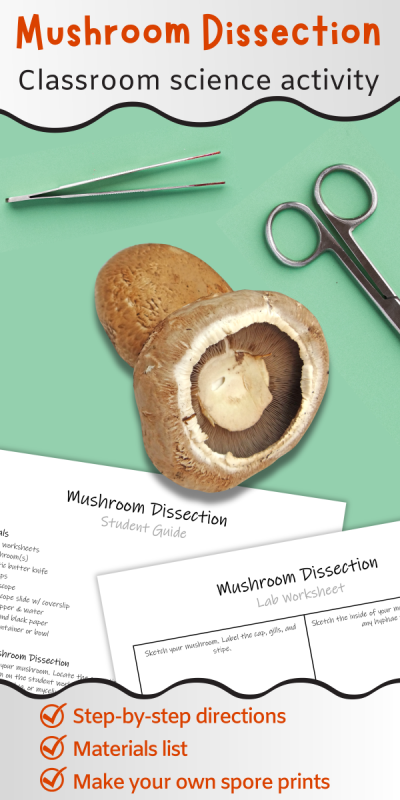
mushrooms, metal instruments, and worksheets

Studying the parts of a mushroom is a fun biology activity for students at many levels. One of the best, hands-on ways to learn mushroom anatomy is by dissecting one. In this mushroom dissection activity, students will observe the internal and external parts of a mushroom. Students will operate a microscope to observe spores and mushroom gill anatomy. Finally, students will create their own spore prints by allowing mushrooms to release their spores onto paper.

Please Note: I’ve made the directions for this mushroom dissection activity available for free here in this post. If you would like printable directions and worksheets for this activity, you can purchase them in my shop. You can find these materials and more mushroom learning materials in my complete Mushrooms Unit!

Materials

  • Printed copies of the Mushroom Dissection Student Guide (1 per student)
  • Printed copies of the Mushroom Dissection Lab Worksheet (1 per student)
  • Printed copies of the Mushroom Anatomy Diagram (1 per lab bench)
  • Fresh, mature mushrooms like portabella, shitake, etc… (a few of each variety per lab bench)
  • Plastic butter knives (1 per lab bench)
  • Forceps (1 per lab bench)
  • Microscopes (1 per lab bench)
  • Microscope slides w/ coverslips (1 per lab bench)
  • Eyedroppers & water (1 per lab bench)
  • Sheets of white and black paper (1 of each per lab bench)
  • Small containers or bowls (1 per lab bench)

Safety Notes and Suggestions

  • Do not eat the mushrooms handled during this lab.
  • Use caution and always supervise your students when handling sharp instruments including forceps, butter knives, and glass microscope slides.
  • You will have a better chance of observing spores using fresh, mature mushrooms (i.e., the gills are visible) rather than immature button mushrooms.
  • If you do not have a microscope skip steps 6-8 in Part 1.
brown mushrooms on beige surface
Photo by Laker on Pexels.com

Directions

Part 1: Mushroom Dissection

A mushroom is the fruiting body of certain fungi. By dissecting a mushroom, you can see the parts of a mushroom up close. These parts help the fungi produce and release spores to create more fungi.

  1. Examine your mushroom. Locate the cap, stipe, and gills (or veil covering the gills). Sketch your mushroom on the student worksheet, labeling the cap, stipe, gills, and other parts you see such as an annulus, volva, or mycelium still attached.
  2. Using fingers or forceps, gently peel away and remove any veil covering the gills (if needed).
  3. Remove the stipe from the cap by gently pulling or twisting on the stipe.
  4. Break or cut the stipe in half length-wise.
  5. Do you see any long, thin filaments or strings on the inside of the stipe? These are hyphae. Sketch the inside of the stipe on the student worksheet, labeling any hyphae.
  6. Remove one gill from the mushroom. Use the forceps to grasp and gently pull away one gill.
  7. Place the gill on a microscope slide. Add a drop of water and a coverslip.
  8. Examine your gill under the microscope and sketch what you see. Basidia are tiny knobs on the gill that make spores. Label the basidia and any spores you see attached to them in your sketch.
  9. If you have a second type of mushroom, repeat steps 1-8 with the second mushroom.
  10. Once finished, discard all mushroom parts EXCEPT for the cap(s) and clean your microscope slide.

Part 2:  Spore Prints

Spores are released from mushrooms as part of the life cycle of a fungus. You can make unique artwork by allowing mushroom caps to drop their spores onto paper.

  1. You can use the mushroom cap(s) from part 1 to make a spore print. Ask your instructor for additional mushrooms to make additional prints.
  2. With any new mushrooms: remove the stipes and peel away any veils covering the gills.
  3. Spores may be light or dark-colored. Try using both black and white paper for your spore prints to ensure the spores are visible.
  4. Place the mushroom caps with the gills facing down on top of the papers.
  5. Place an upside-down container or bowl over the mushroom caps to protect them.
  6. Leave the caps alone overnight. During this time, the gills will release spores which will fall onto the paper.
  7. The next day: remove the containers and mushroom caps to reveal the spore prints.

Study Mushrooms with Wild Earth Lab!

Thereโ€™s no need to create your own mushroom dissection worksheets and print directions – I’ve already made them for you! You can save time and support my blog with your purchase from my shop.

Explore more lessons from Wild Earth Lab:

If you enjoyed this post, I know you will love trying my other science and nature units in your classroom too!


Are you interested in reading more posts with directions for science activities? Subscribe or follow Wild Earth Lab using the links below!


Subscribe, share, and comment:

Posted on — Leave a comment

Teaching The Fungi Life Cycle in Your Classroom: learn how mushrooms grow!

a graphic with a picture of the mushroom life cycle

Wild Earth Lab is supported by readers like you. This post includes links to my own products and affiliate products. If you purchase through links on my site, I may earn a small commission at no additional cost to you.

Although mushrooms grow out of the ground like plants, they belong to a completely different kingdomโ€”the fungi kingdom. The life cycle of fungi, like mushrooms, is unique and distinct from the life cycles of plants and animals. Understanding the stages of a mushroom life cycle provides fascinating insights into how fungi grow, reproduce, and contribute to their ecosystems. In this post, we’ll explore the life cycle of a mushroom step-by-step. For homeschool parents and biology teachers looking for engaging ways to introduce the fungi kingdom, be sure to check out my printable mushroom life cycle materials featuring my artwork!

Support my blog with your purchase of my printable mushroom anatomy diagrams!

Before diving into the mushroom life cycle, be sure to review the parts of a mushroom. It helps to be familiar with mushroom anatomy terms including mycelium, hyphae, and spores.

1. Spores Germinate and Hyphae Form

The life cycle of a mushroom begins with spores. A spore is a single cell, but not just any cell โ€“ itโ€™s a special cell for reproduction. When spores land on the soil or another surface, they germinate, which means start growing. The spores develop into hyphae:  long branching filaments made of many cells.

2. Hyphae Meet

In animals, there are two mating types, known as male and female. Fungi also have different mating types (two or more depending on the species). When two hyphae of different but compatible mating types come into contact, they fuse together. This fusion allows new, unique hyphae to grow.

3. Mycelium Expands and Primordia Form

As the hyphae grow and expand, they form a mycelium โ€“ the underground part of a fungus. As the mycelium spreads, clusters of hyphae called hyphal knots start to develop. These hyphal knots are a sign that a mushroom may soon form. The knots grow into small structures called primordia, which are like baby mushrooms.

4. Button Forms

Many hyphal knots and primordia form in the mycelium, but only a few grow into mature mushrooms. A mushroom is the fruiting body of a fungus โ€“ its reproductive structure that makes spores. When a mushroom is young, it is called a button. Buttons have protective veils covering their gills.

Looking for a hands-on mushroom activity to try with your class? You can grow your own edible mushrooms using a kit, and watch buttons form from the mycelium! Try this grow-your-own oyster mushroom kit from ForestOriginsShop on Etsy.

5. Spores Release

Once the mushroom is fully developed, it opens, revealing its gills.  The gills release spores. A single mushroom can produce billions of spores. Spores are very light, allowing them to travel easily through the air. If they land in a good spot, some will germinate and start the life cycle all over again.

Teach Mushroom Life Cycles with Wild Earth Lab!

Do you need classroom materials for teaching fungi life cycles? Iโ€™ve created some for you! This set includes all the printable materials you need for studying how mushrooms form! Your purchase will support this blog.

Or, get these life cycle materials PLUS more mushroom activities in my complete Mushroom Unit:

Explore units from Wild Earth Lab:

If you enjoyed this post, I know you will love trying my other science and nature units in your classroom too!


Are you interested in reading more about biology classroom topics? Subscribe or follow Wild Earth Lab using the links below!


References and Further Reading

  1. Arora, D. (1986). Mushrooms Demystified (Second Edition). Ten Speed Press and Random House, Inc.
  2. Ha, M., Morrow, M., & Algiers, K. (n.d.). Botany. ASCCC Open Educational Resource Initiative. Available Chapter 2.3 Fungi. Available via LibreTexts: https://bio.libretexts.org/Bookshelves/Botany/Botany_(Ha_Morrow_and_Algiers)/
  3. Various Authors (n.d.). Introductory Biology: Evolutionary and Ecological Perspectives. Chapter XVI. Fungi. Available via University of Minnesota PressBooks: https://pressbooks.umn.edu/introbio/
  4. OpenStax (n.d.). Concepts in Biology (OpenStax). Chapter 13.4 Fungi. Available via LibreTexts: https://bio.libretexts.org/Bookshelves/Introductory_and_General_Biology/Concepts_in_Biology_(OpenStax)/

Subscribe, share, and comment:

Posted on — 2 Comments

Types of Bird Wings: functions, descriptions, and pictures!

A banner that says animal adaptations: types of bird wings, read more about it. With an image of 5 different types of bird wings (active soaring, passive soaring, high-speed, elliptical, and swimming)

Birds are a diverse group of animals. Despite their vast differences, hummingbirds, penguins, and eagles all share a common ancestry! Through the process of natural selection, birds adapted to thrive in unique ecological niches. One of their most fascinating adaptations is their wings. But wings are not one size fits all – bird wings come in many specialized forms that serve different functions and fit different lifestyles. Let’s take a look at a few different types of bird wings and what they do!

A note for teachers: Are you an educator? If you are teaching bird adaptations or animal adaptations, I highly recommend checking out my Bird Beaks Lab Activity Guide and my Bird Adaptations Task Cards:

Active Soaring Bird Wings

Active soaring wings have an extremely long, slender shape. They are ideal for catching horizontal air currents like sea breezes. They help minimize flapping to conserve energy, making them great for staying in the air for long periods while hunting or migrating. You will find many examples of active soaring wings among seabirds.

Examples: albatross, gannet

Passive Soaring Bird Wings

Passive soaring wings appear broad and slotted. They are best for catching updrafts and flying for long periods. They help minimize flapping to conserve energy while circling to look for food on the ground or in the water below. You will find raptors and seabirds with this wing type.

Example: pelican, eagle

High-Speed Bird Wings

High-speed bird wings are not as long as active or passive soaring wings. They may appear pointed at the ends. As the name implies, high-speed wings are great for rapid movement. However, the bird must spend lots of energy flapping to reach high speeds. This makes these wings ideal for short bursts of speed, such as chasing down a flying prey animal or insect.

Examples: falcon, tern

Elliptical Bird Wings

Elliptical bird wings have a more rounded appearance. They are great for quick maneuvers and turns, which is why they are often seen on birds that live in dense forests. They are also good for quick take-offs, which can help a bird escape from a predator. Elliptical wings require lots of flapping to stay in flight.

Examples: dove, turkey

Swimming Bird Wings

Some wings have a fin-like shape. These wings are great for swimming, which can be very useful for a penguin that hunts by pursuit diving for fish underwater. Swimming wings allow a bird to “fly” underwater! These fin-like wings lack true flight feathers and are not suitable for flight (in the air, at least).

Example: penguin

Hovering Bird Wings

Ruby-throated hummingbird drawing: small green, red, and white bird with a long beak and pointy tail.

Hovering wings are great for – you guessed it – hovering. This type of wing allows a bird to stay in one place, suspended in the air. Hovering wings are small and move very, very quickly. Furthermore, when a bird flaps its hovering wings, the motion comes mostly from the shoulder joint rather than joints further down the wing. Hovering lets a hummingbird drink nectar from flowers while in flight. However, a huge amount of energy is used to keep the wings flapping so quickly.

Example: hummingbird

Study Bird Adaptations with Wild Earth Lab:

I’ve created these learning material sets to help you study bird adaptations:

More from Wild Earth Lab:

If you enjoyed this post, I know you will love using my environmental science materials in your classroom!


Are you interested in reading more posts like this? Subscribe or follow Wild Earth Lab using the links below!


References and Further Reading

  1. All About Birds (n.d.). Why Can’t Penguins Fly. Cornell Lab. Available: https://www.allaboutbirds.org/news/why-cant-penguins-fly/
  2. Berberi, I (2020). How the wings of owls and hummingbirds inspire drones, wind turbines and other technology. Carleton Newsroom. Available: https://newsroom.carleton.ca/story/hummingbirds-wings-inspire-technology/
  3. Heisman, R. (2022). Extraordinary Appendages: An Introduction to Bird Wings. American Bird Conservancy. Available: https://abcbirds.org/blog/bird-wings/
  4. Jenney, P. (2022). Winter Wings: The Science of Soaring. Montana Natural History Center. Available: https://www.montananaturalist.org/blog-post/winter-wings-the-science-of-soaring/
  5. Peggy Notebaert Nature Museum (2021). Facts of Flight. Chicago Academy of Sciences. Available: https://naturemuseum.org/chicago-academy-of-sciences/blog/facts-of-flight
  6. Savile, D. B.O. (2006). Bird Fight. The Canadian Encyclopedia. Available: https://www.thecanadianencyclopedia.ca/en/article/bird-flight

Sharing options and discussion for this post:

Posted on — 1 Comment

Seabirds & Shorebirds: types of birds you can spot at the ocean!

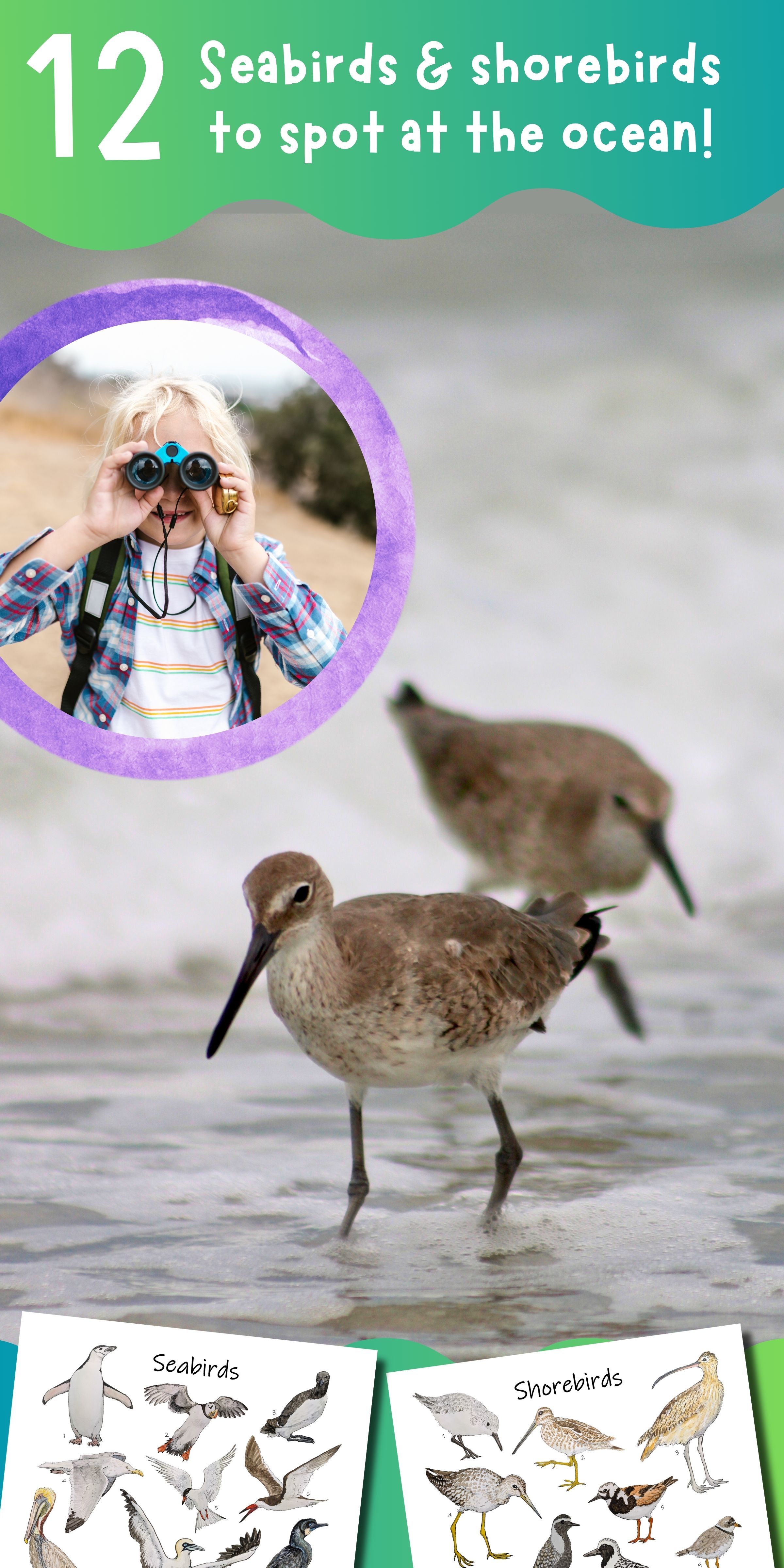
Banner for 12 seabirds and shorebirds to spot at the ocean with a picture of sandpipers and a child with binoculars

The beach is a wonderful place for bird watching, especially if youโ€™re visiting from far away and used to a landlocked setting. A trip to the ocean opens up a world of unique bird species thriving in their natural habitat. Here, youโ€™ll encounter a fascinating array of seabirds and shorebirdsโ€”each adapted to life in a saltwater environment.

Despite the common habitat that they share, the birds of the ocean are very diverse – you’ll see a huge array of beaks, wing shapes, and foot types. Through adaptation, these species have each carved out their own place in the coastal ecosystem, making the ocean an exciting destination for any bird enthusiast.

For teachers and parents: If you are learning about seabirds and shorebirds with kids, whether you’re a parent or an educator, I highly recommend checking out my sea & shorebirds unit (coastal birds) and my waterbirds unit (freshwater birds). These printable sets include everything you need to learn about bird life cycles, adaptations, and bird ID. These two units are also found in my Bird Bundle. Plus, the materials feature my watercolor bird artwork, as seen in this post.

Seabirds vs Shorebirds – what’s the difference?

Seabirds and shorebirds are both seen at the beach, but there are some differences between them. Shorebirds, also called โ€œwadersโ€ in some regions, are birds found along the coast. Shorebirds all fall within the biological order Charadriiformes. This order includes sandpipers and plovers, among others. Many shorebirds have long legs perfect for wading through shallow water, walking, or running. Many feed along the waterโ€™s edge or by probing their bills in shallow water or sand. Unlike seabirds, not all shorebirds can swim particularly well.

On the other hand, โ€œSeabirdโ€ is a blanket term for the many bird species that are adapted to living in a marine environment. Seabirds are excellent swimmers. They use their webbed feet to paddle while floating atop the water. Some even dive beneath the surface and swim to great depths to hunt food. While graceful in water, many seabirds move with considerably more difficulty while on land. Some spend months at a time in the open ocean and only come to land to nest along coasts, lay eggs, and raise their young, often in large groups called colonies.

photo of birds at the beach
Shorebirds in the surf. Photo by Blair Damson on Pexels.com

Types of Shorebirds

Here are some shorebirds you might spot at the beach or coast:

Sandpipers

These birds get their name for the unusual way they feed – probing their bills in the sand for buried goodies like crustaceans and insect larvae. Sandpipers are quite diverse. Within this group, there are many shapes and lengths of bills. This variety allows different species to probe for food at different depths.

For example, the long-billed curlew can extract food from deep in the mud, with its impressively long downward-curved bill! Other examples of sandpipers include yellowlegs, turnstones, and sanderlings. A widespread and diverse group, sandpipers are one bird family you’re likely to spot on your next trip to the beach!

A long-billed curlew probing in the sand

Plovers

If you see a small bird running along the water’s edge, there’s a good chance it’s a plover! Plovers are a diverse group of small shorebirds with long, thin legs. They are quick on their feet, which helps them scamper along the beach as they forage for food on the ground. Any time I see one of these tiny birds at the beach, I find myself worrying that the next wave might just sweep it away – but they always seem to run to safety just in time!

You can tell plovers apart from other shorebirds because they have relatively short necks and bills. Plumage varies between plover species. Examples of plovers include killdeer, golden plovers, and semipalmated plovers.

Semipalmated plover

Stilts and Avocets

You may see these leggy birds probing and scything for food in shallow waters of coastal wetlands with their long, thin bills. To tell the difference between a stilt and an avocet, just look at the bill. Stilts have straight bills while avocets’ bills curve upwards. Both have long necks and long, thin legs.

American avocet

Oystercatchers

These unique shorebirds are most easily recognized by their large, bright-red bills. Their bills are special tools for opening shells to get to the food inside. They also have long, pinkish legs and black and white plumage.

American oystercatcher

Types of Seabirds

Here are some seabirds you might spot at the beach, coast, or in boats on the open ocean.

Gulls & Terns

Gulls and terns are likely some of the most common birds you’ll see at the beach. They come in a variety of sizes and colors, and are opportunistic feeders. They can catch (or find) food in a variety of different ways. Unfortunately, these adaptable birds often end up feeding on human garbage, which can make them (and other wildlife) ill. For this reason, it’s important to always pick up your trash while visiting the shore!

Terns look quite similar to gulls, but usually are smaller with a more streamlined body. Terns are fast fliers, and some make incredible migrations, such as the Arctic tern, which journeys from the Arctic to the Antarctic and back each year. Talk about a long flight!

Herring gull

Skimmers

These distinctive birds are related to gulls and terns, but are of special interest because of the unusual way they catch their food. Skimmers feed by “skimming” the water’s surface with their distinctive bills. They fly low to the water with an open beak, letting the lower beak drag through the water. When the beak touches a fish, it snaps shut like a mousetrap. Pretty cool!

A black skimmer skimming the surface of the water for food

Pelicans

Pelicans are another common bird at the beach. They are most easily identified by their large size and a pouch for holding prey spanning from the lower part of the bill to the throat. If you are lucky, you can watch pelicans hunt while you sit on the beach. They put on a spectacular show, diving from the air into the water to catch fish.

Brown pelican

Cormorants

Cormorants are some of the strangest-looking seabirds, in my opinion. With a long hooked bill, long neck, and fully webbed feet, a cormorant is well-equipped to swim underwater hunting fish like some sort of bizarre sea creature.

While graceful in water, these oddities appear awkward on land, standing with a nearly upright posture since their flippered feet are attached near the rear of their body. Furthermore, cormorants often stand around gawkily holding their wings partially open to dry in the sun since they do not make water-resistant oils for their feathers. If you are lucky enough to spot one of these majestic misfits, feel free to stare!

Double-crested cormorant

Puffins & Auks

If you visit a coast in far-northern regions at the right time of year, you may see puffins! Puffins, and their relatives like murres and guillemots, are sometimes collectively called “auks”. While they may remind us of penguins with their round bodies and black and white plumage, auks are actually more closely related to seagulls. Similar to penguins, auks are excellent divers that pursue fish by using their wings to “fly” underwater. However, auks like puffins can also fly in the air too!

Atlantic puffin

Gannets & Boobies

These birds are absolute diving machines! They are amazingly adapted for one thing – plummeting headfirst from the air into the water! Gannets and boobies have sturdy, pointed bills and streamlined bodies that help them hit the water at high speeds without hurting themselves. They use the momentum of the dive to swim underwater and catch a meal. This special form of hunting is known as “plunge diving”. If you wish to see gannets and boobies hunting, you may want to get on a boat, as these seabirds thrive in an open-ocean environment.

A northern gannet plunge diving for fish

Albatrosses & Tubenoses

Albatrosses and their relatives (petrels, shearwaters, and storm-petrels) make up the bird order known as Procellariiformes, also sometimes called “tube-nosed seabirds” or “tubenoses”. Your best bet at seeing one of these stunning seabirds might be on a boat, as they spend significant portions of the year hunting in the open ocean.

Albatrosses’ claim to fame is their impressive wingspan. Albatrosses have what is known as active soaring wings – which are extra-long and slender wings that act like a glider plane. These wings help them harness sea breezes to fly and migrate without using up too much energy flapping. The wandering albatross has the largest wingspan of any bird – nearly 12 feet!

Black-footed albatross

Penguins

While you are unlikely to see one at the beach (unless you live in Antarctica or other select locations in the Southern Hemisphere), penguins are technically a type of seabird. Like other seabirds, they spend significant time living and hunting in the open ocean. Many penguins are uniquely adapted for life in extremely cold and icy places.

Chinstrap penguin

Other Waterbirds at the Beach

waterfowls near a lake with blue water
Ducks, swans, and egrets are all waterbirds. Photo by Robert So on Pexels.com

Sea and shorebirds are not the only birds that live in water. โ€œWaterbirdโ€ is a general term for any bird that spends significant time swimming or wading in water. This can be in saltwater or freshwater. All seabirds and shorebirds are also waterbirds, but not all waterbirds are sea or shorebirds. Other waterbirds include geese, ducks, herons, coots, grebes, and many more.

Furthermore, sea and shorebirds are not the only birds found at the seaside. Waterbirds like herons and loons live in freshwater and saltwater habitats, but are not specifically considered seabirds or shorebirds.

Study Seabirds and Shorebirds with Wild Earth Lab:

Are you an educator or parent? If you enjoyed this post, I know you and your students will love using my Seabirds & Shorebirds science materials in your classroom or with your kids!

More Units from Wild Earth Lab:


Are you interested in reading more posts like this? Subscribe or follow Wild Earth Lab using the links below!


References and Further Reading

  1. All About Birds (n.d.). Arctic Tern. Available: https://www.allaboutbirds.org/guide/arctic_tern
  2. All About Birds (n.d.). Long-billed curlew. Available: https://www.allaboutbirds.org/guide/Long-billed_Curlew/
  3. Audubon (n.d.). Black Skimmer. Available: https://www.audubon.org/field-guide/bird/black-skimmer
  4. Audubon Seabird Institute (n.d.) The Auk Family. Available: https://seabirdinstitute.audubon.org/birds/auk-family
  5. Cordell Bank National Marine Sanctuary (n.d.). Tube-nosed Seabirds. NOAA. Available: https://cordellbank.noaa.gov/about/seabirds/tube-nosed.html
  6. Dahle, L. (n.d.). 20 TYPES OF SHOREBIRDS IN THE UNITED STATES! (ID GUIDE). Bird Watching HQ. Available: https://birdwatchinghq.com/shorebirds-in-the-united-states/
  7. Heisman, R. (2022). Seabirds: Natureโ€™s Winged Mariners. American Bird Conservancy. Available: https://abcbirds.org/blog/seabirds/
  8. Jaramillo, A. (2017). Shorebirds 101: What to Look for When You Hit the Water. Audubon. Available: https://www.audubon.org/news/shorebirds-101-what-look-when-you-hit-water
  9. Kaufman, K. & Kaufman, K. (2023). Look for Plover Birds Both on (and off) the Shore. Birds and Blooms. Available: https://www.birdsandblooms.com/birding/bird-species/plover-birds/
  10. Wassilieff, M. (2006). Gannets and boobies. Te Ara – the Encyclopedia of New Zealand. Available: http://www.TeAra.govt.nz/en/gannets-and-boobies/print (accessed 9 August 2024)
  11. Pacheco, K., & Liebich, K. (n.d.). Albatross: Lifetime at Sea. U.S. Fish and Wildlife Service. Available: https://www.fws.gov/story/albatross-lifetime-sea

Sharing options and discussion for this post:

Posted on — 1 Comment

Types of Mammals: the difference between monotremes, marsupials, and placentals

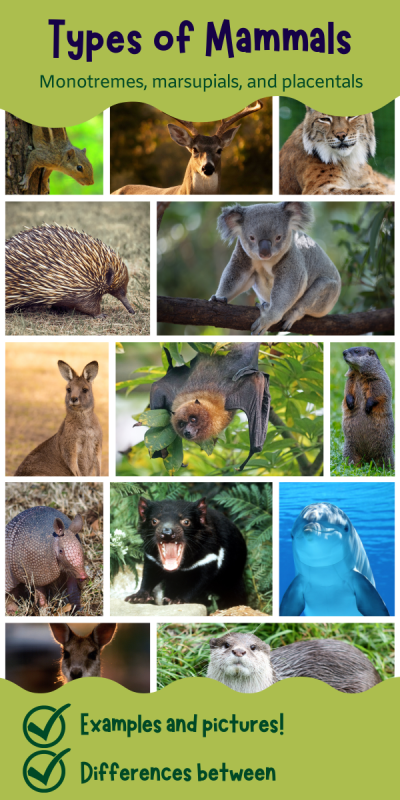
banner with pictures of mammals and the text "types of mammals: monotremes, marsupials, and placentals"

Life’s beginning varies a lot among mammals. We can group mammals into three main categories based on how their babies come into the world. The main types of mammals are called monotremes, marsupials, and placentals.

A Note For Teachers:ย If youโ€™re an educator planning toย teach types of mammals, great learning resources are key to deepening understanding! I think you and your students will love my completeย Mammals Unit, which you can also find within my huge Vertebrates Bundle (plus youโ€™ll support my blog with your purchase! โค๏ธย )

Monotremes

Most mammals give birth to live babies instead of laying eggs. However, there are a couple of exceptions: platypuses and echidnas. They belong to a special group called monotremes. Even though they are unusual, monotremes, like the platypus, still provide milk for their young after they hatch. Monotremes are found in Australia and surrounding islands.

Marsupials

Marsupials are another interesting type of mammal. They have a very short gestation period โ€“ that is the amount of time they are inside their momโ€™s belly. When they are born, they are very tiny and need a lot of care. They crawl into a pouch or open area on their mother’s belly, where they stay warm, safe, and can drink milk while they grow. A famous example of this is a kangaroo with a joey in its pouch. The kangaroo, like most marsupials, lives in Australia. South America is also home to many marsupials, and there is even one marsupial in North America: the opossum.

Placentals

The largest group of mammals is called placentals. They give birth to live babies after a longer gestation period. A special organ called the placenta helps give these mammals the nutrients they need while still in the womb. Placental mammals are born more developed than marsupial babies. Some, like baby deer (called fawns), can even stand up and start walking the same day they are born. Placentals are found in many habitats all around the world.

Learn about mammals with Wild Earth Lab

Check out my Mammals Unit! Learn about monotremes, marsupials, placental mammals, and much more!

Explore more units from Wild Earth Lab:

If you enjoyed learning about the types of mammals in this post, I know you will love using my other earth and environmental science materials in your classroom!


Are you interested in reading more posts about wildlife? Subscribe or follow Wild Earth Lab using the links below!


References and Further Reading

  1. Ferner, K., Schultz, J. A., & Zeller, U. (2017). Comparative anatomy of neonates of the three major mammalian groups (monotremes, marsupials, placentals) and implications for the ancestral mammalian neonate morphotype. Journal of anatomy, 231(6), 798-822. Available via Wiley Online Library: https://onlinelibrary.wiley.com/doi/10.1111/joa.12689
  2. Thomas, L. (2017). Monotremes, Marsupials, and Placentals. UC Santa Cruz. Available: https://norriscenter.ucsc.edu/collections/mammals/monotremes-marsupials-placentals.html
  3. University of Hawaiโ€™i at Manoa (n.d.). What is a Mammal. Exploring our Fluid Earth. Available: https://manoa.hawaii.edu/exploringourfluidearth/biological/mammals/what-mammal
  4. Wible, R. (2022). DO ANY MAMMALS LAY EGGS? Carnegie Museum of Natural History. Available: https://carnegiemnh.org/do-any-mammals-lay-eggs/
  5. Used for editing word-choice and tone: OpenAI. (2023). ChatGPT (September 25 Version) [Large language model]. https://chat.openai.com

Sharing options and discussion for this post: