Posted on — Leave a comment

Flower Dissection: try this simple hands-on science activity in your classroom!

pink flower, tweezers, and scissors with worksheets.

Are you teaching your students about the parts of a flower or plant anatomy? Sometimes the best way to understand how something works is by taking it apart. A flower dissection is a simple and engaging hands-on activity that brings plant anatomy to life in your classroom. In this activity, students will carefully examine and identify key flower structures like petals, sepals, carpels, and stamens. Plus, theyโ€™ll explore the fascinating connection between flowers and Fibonacci numbers in nature!

If you’re looking for more background information about flower anatomy, be sure to check out my blog post where I cover the four main whorls of a flower. You can also learn more about the functions of flowers and their various parts in the plant life cycle in this post about pollination and the plant life cycle!

Please Note: I’ve made the directions for this flower dissection activity available for free here in this post. If you would like printable directions and worksheets for this activity, you can find them in my complete Flowers Unit in my shop.

Materials

Each student will need the following materials:

  • Flowers
  • Tweezers
  • Glue
  • Pencils or pens
  • Printed student directions and lab worksheet (available in my Flower Unit)

Tips for Success

  • Have flower and plant anatomy diagrams on hand so your students can reference them as they dissect their flowers. Need diagrams? Try one of these options:
    • You can find my hand-drawn flower & plant anatomy diagrams in my flowers unit (linked above)
    • You can also find a free flower diagram on my free resources page (pictured below)!
  • Use a large flower so that students can easily see all the parts.
  • Use a complete flower with all four main flower parts: sepals, petals, carpels, and stamens. For example, lilies, hibiscuses, or tulips are all good choices.
diagram showing the parts of a flower

Directions

Part 1: Flower Dissection

Pass out the materials to your students. Give a brief overview of the main parts of a flower. Then, assist your students as they work through the following steps to dissect their flowers:

  1. Use the tweezers or your fingers to carefully remove the sepals and then the petals from your flower.
  2. Break apart the carpel(s) and stamens.
  3. Count the number of sepals, petals, carpels, and stamens and record the number of each.
  4. Glue one of each part to the lab worksheet.
  5. Use a pencil or pen to draw arrows and label the stigma, style, and ovary on the carpel glued to the lab worksheet.
  6. Use a pencil or pen to draw arrows and label the anther and filament on the stamen glued to the lab worksheet.

Part 2:ย  Fibonacci Numbers in Nature

Fibonacci numbers form a sequence so that each number is the sum of the previous two numbers (e.g., 1+1 = 2; 2+1 = 3, 3+2 = 5; 5+3=8; and so on). Fibonacci numbers are often found in nature. Students should answer the following questions:

  1. Calculate and write down the next 5 numbers in the Fibonacci sequence: 1,1,2,3,5,8,… ___, ___, ___, ___, ___
  2. Look back at your lab worksheet. How many petals did your flower have? Is this a Fibonacci number? What about the sepals? Carpels? Stamens?

Study Flowers with Wild Earth Lab!

If you enjoyed this activity, I know you’ll love my Flowers Unit! It includes everything you need for this activity and other flower projects too!

OR – take your botany learning to the next level with my Botany Collection. It’s a bundle of three plant units: Flowers, Pollination, and Fruit!

Ready for another dissection?

Read my blog post on how to do a Mushroom Dissection Lab!

Explore more lessons from Wild Earth Lab:

If you enjoyed this post, I know you will love trying my other science and nature units in your classroom too!


Are you interested in reading more posts with directions for science activities? You can subscribe or follow Wild Earth Lab using the links below!


Subscribe, share, and comment:

Posted on — 1 Comment

The Saguaro Cactus Life Cycle: step-by-step guide with pictures!

A picture of the saguaro cactus life cycle with the text "saguaro cactus life cycle: a step-by-step guide"
text that says share this post

Some saguaro cacti live for 200 years or longer! Saguaro cacti grow very slowly. The speed of growth depends on many factors such as precipitation, temperature, and soil quality. Let’s explore the saguaro cactus life cycle in five steps! Notice that desert animals play a key role in two of these steps.

For Teachers and Parents:ย If youโ€™re an educator planning toย teach kids about cacti in your classroom or at home, great activities and visuals are key to deepening understanding! I think you and your students will love my complete Cactus Unit (plus youโ€™ll support my blog with your purchase! โค๏ธ)

1. Germination

Saguaro cactus seedling

A seed germinates. The two cotyledons open to form a tiny plant. Seeds that germinate in shady areas such as beneath palo verde trees are most likely to survive through the fragile young stages and reach maturity.

The seedling cactus grows through its first summer and develops more areoles and spines. At just a few millimeters in height, the seedling is so small that it can be difficult to spot.

2. Maturity

It may take ~35 years for a saguaro cactus to reach maturity and produce its first flowers.

The rate of growth depends on environmental conditions such as precipitation, temperature, soil quality, and the type of cactus. For saguaro cacti, growth happens very slowly over many years.

When a cactus reaches reproductive maturity, it can produce its own flowers. Time to reach maturity depends on the cactus species. For example, the saguaro cactus takes several decades to reach maturity.

3. Flowering & Pollination

The lesser long-nosed bat is a nighttime pollinator of the saguaro cactus

The cactus flowers bloom. Cactus flowers make tasty nectar to attract pollinators like bats, bees, and doves. Pollen is transferred between plants by the pollinators. This is a type of symbiotic relationship called mutualism because both the pollinator and the plant benefit. The pollinator gets a tasty meal of nectar, and the plant gets pollinated.

4. Fruiting

Saguaro fruits are a food source for many animals in the Sonoran desert. People sometimes eat the fruit too.

Once pollinated, the cactus fruit begins forming from the ovary of the flower. Cacti can produce huge amounts of fruit. For example, a single saguaro cactus may produce upwards of 100 fruits each year. Thatโ€™s a lot of fruit! The ripened fruit splits open, revealing sweet flesh and seeds.ย  This sends the signal to animals that the fruit is ready to eat!

5. Seed Dispersal

When an animal eats the saguaro fruit, it ingests some seeds. The seeds are then dispersed in the animal’s scat.

Desert animals like birds, coyotes, and tortoises eat cactus fruit and disperse seeds in their scat. This is another example of a mutualistic relationship between an animal and a cactus. The animal gets a meal of fruit, and the cactus gets its seeds dispersed. If the cactus is lucky, some of its seeds will be deposited in locations with good growing conditions. Over its lifespan, a single saguaro may produce millions of seeds. However, only a few of those seeds will germinate, grow, and reach maturity.

Classroom cactus materials:

Explore units from Wild Earth Lab:

If you enjoyed this post, I know you will love using my environmental science materials in your classroom!


Are you interested in reading more posts like this? Subscribe or follow Wild Earth Lab using the links below!


References and Further Reading

  1. Ceotto, E. (2009). Cultivation of Carnegiea gigantea from seeds: a journey in desert ecology. Desert Plants, 25(1), 10. Available: https://repository.arizona.edu/bitstream/handle/10150/556548/dp_25_01-010-015.pdf?sequence=1
  2. Dimmitt, M. (n.d.). Cactaceae (cactus family). Arizona-Sonora Desert Museum. Available: https://www.desertmuseum.org/books/nhsd_cactus_.php
  3. Helmy, Olga. 2021. Carnegiea gigantea, saguaro. In: Fire Effects Information System, (Online). U.S. Department of Agriculture, Forest Service, Rocky Mountain Research Station, Missoula Fire Sciences Laboratory (Producer). Available: www.fs.usda.gov/database/feis/plants/cactus/cargig/all.html
  4. National Park Service (n.d.). The Saguaro Cactus (Carnegiea gigantea). Organ Pipe Cactus National Monument. Available: https://www.nps.gov/orpi/learn/nature/saguaro-cactus.htm
  5. National Park Service (2017). How Saguaros Grow. Saguaro National Park. Available: https://www.nps.gov/sagu/learn/nature/how-saguaros-grow.htm

Sharing options and discussion for this post:

Posted on — 1 Comment

Types of Cacti: explore the diversity of cactus species – with pictures!

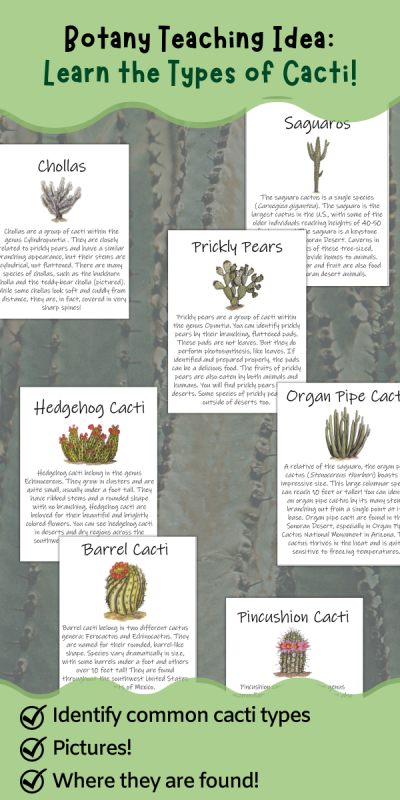
banner with the text "Botany teaching idea: learn the types of cacti"

There are many types of cacti, which are found in dry places and deserts. Cacti are succulent plants. Succulent plants are thick and fleshy for storing water. While all cacti are succulents, not all succulents are cacti. Cacti are unique because they have areoles โ€“ cushion-like bumps that cover the outside of a cactus. One or more sharp, pointy spines are attached to each areole. Spines are a type of modified leaf. Most cacti species have no true leaves. They do, however, produce flowers and fruit, which provide an important food source to desert animals.

A note for teachers and parents: Are you teaching your students or children about cacti? I think you will love my complete set of printable cactus learning materials. Plus, you’ll support this blog with your purchase! โค๏ธ

Cacti are a diverse group. There are more than one thousand different species of cacti. Some look like a single rounded shape (like a barrel cactus). Others have complex, branching arms or pads (like a prickly pear). They can be as tiny as a grape or grow taller than a house.

Without further ado, let’s explore some of the types and groups of cacti in the United States:

Saguaro Cactus

The saguaro is the largest cactus in the U.S., with some of the older individuals reaching heights of 40-50 feet or more! While it is probably the best-known cactus in the United States, the mighty saguaro actually has a fairly small range and is native to the Sonoran Desert only. The saguaro is actually a keystone species of the Sonoran Desert. Cavities in the large trunks of these tree-sized, columnar cacti provide homes to animals. Their flower nectar and fruit are also food for many Sonoran desert animals. The saguaro cactus is a single species (Carnegiea gigantea).

close up photo of prickly cactus plant
Photo by Nicole Ashley Rahayu Densmoor on Pexels.com

Organ Pipe Cactus

A relative of the saguaro, the organ pipe cactus (Stenocereusthurberi) boasts an impressive size. This large columnar species can reach 10 feet or taller! You can identify an organ pipe cactus by its many stems branching out from a single point at its base. Organ pipe cacti are found in the Sonoran Desert, especially in Organ Pipe Cactus National Monument in Arizona. This cactus thrives in the heat and is quite sensitive to freezing temperatures.

Prickly Pears

Prickly pears are a group of cacti within the genus Opuntia. You can identify prickly pears by their branching, flattened pads. These pads are not leaves. But they do perform photosynthesis, like leaves. If identified and prepared properly, the pads can be a delicious food. The fruits of prickly pears are also eaten by both animals and humans. You will find prickly pears in many deserts. Some species of prickly pears grow outside of deserts too.

selective focus photography of prickly pear cactus
Photo by mali maeder on Pexels.com

Chollas

Chollas are a group of cacti within the genus Cylindropuntia . They are closely related to prickly pears and have a similar branching appearance, but their stems are cylindrical, not flattened. There are many species of chollas, such as the buckhorn cholla and the teddy-bear cholla (pictured). While some chollas look soft and cuddly from a distance, they are, in fact, covered in very sharp spines!

Hedgehog Cacti

Hedgehog cacti belong in the genus Echinocereus. They grow in clusters and are quite small, usually under a foot tall. They have ribbed stems and a rounded shape with no branching. Hedgehog cacti are beloved for their beautiful and brightly colored flowers. You can see hedgehog cacti in deserts and dry regions across the southwest United States and Mexico.

Barrel Cacti

Barrel cacti belong in two different cactus genera: Ferocactus and Echinocactus. They are named for their rounded, barrel-like shape. Species vary dramatically in size, with some barrels under a foot and others over 10 feet tall! They are found throughout the southwest United States and parts of Mexico.

Pincushion Cacti

Pincushion cacti belong in the genus Mammillaria. Types of cacti in this genus are also sometimes called nipple cacti. Pincushion cacti are characterized by hooked spines and a very small size. Often, they are just a few inches tall. There are many species of pincushion cacti. You will find pincushions across Central America and Mexico. A handful of pincushion species have ranges extending into the southwest United States.

Study types of cacti with Wild Earth Lab!

Want to learn about cacti with your students or children? Look no further than my cactus unit study. It includes posters featuring my watercolor cactus artwork and all the worksheets, flashcards, and lessons you need!

Explore more units from Wild Earth Lab:

If you enjoyed this post, I know you will love using my environmental science materials in your classroom!


Are you interested in reading more posts like this? Subscribe or follow Wild Earth Lab using the links below!


References and Further Reading

  1. The American Southwest (n.d.). Cacti of West and Southwest USA. Available: https://www.americansouthwest.net/plants/cacti/index.html
  2. CactiGuide.com (n.d.). Notes for the Genus: Mammillaria. Available: https://cactiguide.com/cactus/?genus=Mammillaria
  3. DesertUSA (n.d.). Barrel Cactus. Available: https://www.desertusa.com/cactus/barrel-cactus.html
  4. Dimmitt, M. (n.d.). Cactaceae (cactus family). Arizona-Sonora Desert Museum. Available: https://www.desertmuseum.org/books/nhsd_cactus_.php
  5. Gauna, F. J. (n.d.). Prickly Pear (Opuntia basilaris P. Mill.). Plant of the Week. U.S. Forest Service. Available: https://www.fs.usda.gov/wildflowers/plant-of-the-week/opuntia_basilaris.shtml
  6. Gauna, F. J. (n.d.). Barrel Cactus (Ferocactus sp., Britt. & Rose). Plant of the Week. U.S. Forest Service. Available: https://www.fs.usda.gov/wildflowers/plant-of-the-week/ferocactus_sp.shtml
  7. National Park Service (2005). Ecology of the Saguaro: II. NPS Scientific Monograph No. 8. Chapter 5. Available: https://www.nps.gov/parkhistory/online_books/science/8/chap5.htm
  8. National Park Service (n.d.). The Organ Pipe Cactus (Stenocereus thurberi). Organ Pipe Cactus National Monument. Available: https://www.nps.gov/orpi/learn/nature/organ-pipe-cactus.htm
  9. North Carolina State University (n.d.). Echinocactus. Extension Gardener Plant Toolbox. Available: https://plants.ces.ncsu.edu/plants/echinocactus/
  10. Notes from the Road (2022). Types of Cactus in the Desert Southwest. Available: https://www.notesfromtheroad.com/desertsouthwest/cactus-species.html

Sharing options and discussion for this post: