
Share This Post:
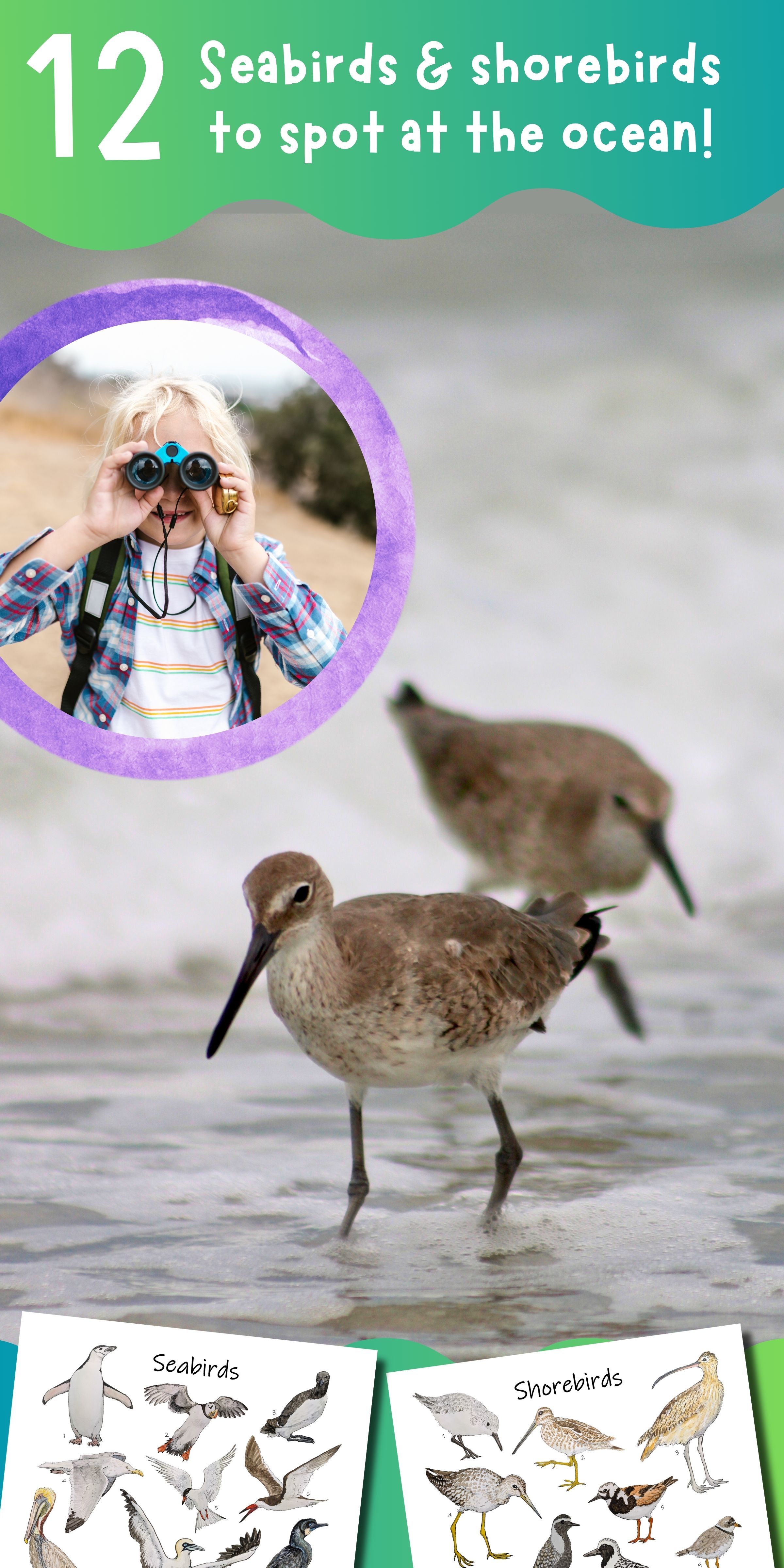
The beach is a wonderful place for bird watching, especially if you’re visiting from far away and used to a landlocked setting. A trip to the ocean opens up a world of unique bird species thriving in their natural habitat. Here, you’ll encounter a fascinating array of seabirds and shorebirds—each adapted to life in a saltwater environment.
Despite the common habitat that they share, the birds of the ocean are very diverse – you’ll see a huge array of beaks, wing shapes, and foot types. Through adaptation, these species have each carved out their own place in the coastal ecosystem, making the ocean an exciting destination for any bird enthusiast.
For teachers and parents: If you are learning about seabirds and shorebirds with kids, whether you’re a parent or an educator, I highly recommend checking out my sea & shorebirds unit (coastal birds) and my waterbirds unit (freshwater birds). These printable sets include everything you need to learn about bird life cycles, adaptations, and bird ID. These two units are also found in my Bird Bundle. Plus, the materials feature my watercolor bird artwork, as seen in this post.
Recommended products
-

Sea & Shorebirds: a wildlife unit for the coast!
$12.00 -

Waterfowl & Waterbirds: a wildlife unit with animal adaptation activities!
$12.00 -
Bird Bundle: 4 Complete Units for Ornithology with Kids
Original price was: $44.00.$35.20Current price is: $35.20.

Seabirds vs Shorebirds – what’s the difference?
Seabirds and shorebirds are both seen at the beach, but there are some differences between them. Shorebirds, also called “waders” in some regions, are birds found along the coast. Shorebirds all fall within the biological order Charadriiformes. This order includes sandpipers and plovers, among others. Many shorebirds have long legs perfect for wading through shallow water, walking, or running. Many feed along the water’s edge or by probing their bills in shallow water or sand. Unlike seabirds, not all shorebirds can swim particularly well.
On the other hand, “Seabird” is a blanket term for the many bird species that are adapted to living in a marine environment. Seabirds are excellent swimmers. They use their webbed feet to paddle while floating atop the water. Some even dive beneath the surface and swim to great depths to hunt food. While graceful in water, many seabirds move with considerably more difficulty while on land. Some spend months at a time in the open ocean and only come to land to nest along coasts, lay eggs, and raise their young, often in large groups called colonies.

Types of Shorebirds
Here are some shorebirds you might spot at the beach or coast:
Sandpipers
These birds get their name for the unusual way they feed – probing their bills in the sand for buried goodies like crustaceans and insect larvae. Sandpipers are quite diverse. Within this group, there are many shapes and lengths of bills. This variety allows different species to probe for food at different depths.
For example, the long-billed curlew can extract food from deep in the mud, with its impressively long downward-curved bill! Other examples of sandpipers include yellowlegs, turnstones, and sanderlings. A widespread and diverse group, sandpipers are one bird family you’re likely to spot on your next trip to the beach!

Plovers
If you see a small bird running along the water’s edge, there’s a good chance it’s a plover! Plovers are a diverse group of small shorebirds with long, thin legs. They are quick on their feet, which helps them scamper along the beach as they forage for food on the ground. Any time I see one of these tiny birds at the beach, I find myself worrying that the next wave might just sweep it away – but they always seem to run to safety just in time!
You can tell plovers apart from other shorebirds because they have relatively short necks and bills. Plumage varies between plover species. Examples of plovers include killdeer, golden plovers, and semipalmated plovers.

Stilts and Avocets
You may see these leggy birds probing and scything for food in shallow waters of coastal wetlands with their long, thin bills. To tell the difference between a stilt and an avocet, just look at the bill. Stilts have straight bills while avocets’ bills curve upwards. Both have long necks and long, thin legs.

Oystercatchers
These unique shorebirds are most easily recognized by their large, bright-red bills. Their bills are special tools for opening shells to get to the food inside. They also have long, pinkish legs and black and white plumage.

Types of Seabirds
Here are some seabirds you might spot at the beach, coast, or in boats on the open ocean.
Gulls & Terns
Gulls and terns are likely some of the most common birds you’ll see at the beach. They come in a variety of sizes and colors, and are opportunistic feeders. They can catch (or find) food in a variety of different ways. Unfortunately, these adaptable birds often end up feeding on human garbage, which can make them (and other wildlife) ill. For this reason, it’s important to always pick up your trash while visiting the shore!
Terns look quite similar to gulls, but usually are smaller with a more streamlined body. Terns are fast fliers, and some make incredible migrations, such as the Arctic tern, which journeys from the Arctic to the Antarctic and back each year. Talk about a long flight!

Skimmers
These distinctive birds are related to gulls and terns, but are of special interest because of the unusual way they catch their food. Skimmers feed by “skimming” the water’s surface with their distinctive bills. They fly low to the water with an open beak, letting the lower beak drag through the water. When the beak touches a fish, it snaps shut like a mousetrap. Pretty cool!

Pelicans
Pelicans are another common bird at the beach. They are most easily identified by their large size and a pouch for holding prey spanning from the lower part of the bill to the throat. If you are lucky, you can watch pelicans hunt while you sit on the beach. They put on a spectacular show, diving from the air into the water to catch fish.

Cormorants
Cormorants are some of the strangest-looking seabirds, in my opinion. With a long hooked bill, long neck, and fully webbed feet, a cormorant is well-equipped to swim underwater hunting fish like some sort of bizarre sea creature.
While graceful in water, these oddities appear awkward on land, standing with a nearly upright posture since their flippered feet are attached near the rear of their body. Furthermore, cormorants often stand around gawkily holding their wings partially open to dry in the sun since they do not make water-resistant oils for their feathers. If you are lucky enough to spot one of these majestic misfits, feel free to stare!

Puffins & Auks
If you visit a coast in far-northern regions at the right time of year, you may see puffins! Puffins, and their relatives like murres and guillemots, are sometimes collectively called “auks”. While they may remind us of penguins with their round bodies and black and white plumage, auks are actually more closely related to seagulls. Similar to penguins, auks are excellent divers that pursue fish by using their wings to “fly” underwater. However, auks like puffins can also fly in the air too!

Gannets & Boobies
These birds are absolute diving machines! They are amazingly adapted for one thing – plummeting headfirst from the air into the water! Gannets and boobies have sturdy, pointed bills and streamlined bodies that help them hit the water at high speeds without hurting themselves. They use the momentum of the dive to swim underwater and catch a meal. This special form of hunting is known as “plunge diving”. If you wish to see gannets and boobies hunting, you may want to get on a boat, as these seabirds thrive in an open-ocean environment.

Albatrosses & Tubenoses
Albatrosses and their relatives (petrels, shearwaters, and storm-petrels) make up the bird order known as Procellariiformes, also sometimes called “tube-nosed seabirds” or “tubenoses”. Your best bet at seeing one of these stunning seabirds might be on a boat, as they spend significant portions of the year hunting in the open ocean.
Albatrosses’ claim to fame is their impressive wingspan. Albatrosses have what is known as active soaring wings – which are extra-long and slender wings that act like a glider plane. These wings help them harness sea breezes to fly and migrate without using up too much energy flapping. The wandering albatross has the largest wingspan of any bird – nearly 12 feet!

Penguins
While you are unlikely to see one at the beach (unless you live in Antarctica or other select locations in the Southern Hemisphere), penguins are technically a type of seabird. Like other seabirds, they spend significant time living and hunting in the open ocean. Many penguins are uniquely adapted for life in extremely cold and icy places.

Other Waterbirds at the Beach

Sea and shorebirds are not the only birds that live in water. “Waterbird” is a general term for any bird that spends significant time swimming or wading in water. This can be in saltwater or freshwater. All seabirds and shorebirds are also waterbirds, but not all waterbirds are sea or shorebirds. Other waterbirds include geese, ducks, herons, coots, grebes, and many more.
Furthermore, sea and shorebirds are not the only birds found at the seaside. Waterbirds like herons and loons live in freshwater and saltwater habitats, but are not specifically considered seabirds or shorebirds.
Study Seabirds and Shorebirds with Wild Earth Lab:
Are you an educator or parent? If you enjoyed this post, I know you and your students will love using my Seabirds & Shorebirds science materials in your classroom or with your kids!

More Units from Wild Earth Lab:
Recommended products
-
Bird Bundle: 4 Complete Units for Ornithology with Kids
Original price was: $44.00.$35.20Current price is: $35.20. -

Birds of Prey: a raptor unit for kids
$8.00 -

Birds: an ornithology unit with animal adaptations
$12.00 -
Vertebrates Bundle: 5 units on amphibians, birds, fish, mammals, reptiles
Original price was: $54.00.$43.20Current price is: $43.20. -
Waterfowl & Waterbirds: a wildlife unit with animal adaptation activities!
$12.00 -

Food Webs: an ecology unit with hands-on activities!
$8.00

Are you interested in reading more posts like this? Subscribe or follow Wild Earth Lab using the links below!
References and Further Reading
- All About Birds (n.d.). Arctic Tern. Available: https://www.allaboutbirds.org/guide/arctic_tern
- All About Birds (n.d.). Long-billed curlew. Available: https://www.allaboutbirds.org/guide/Long-billed_Curlew/
- Audubon (n.d.). Black Skimmer. Available: https://www.audubon.org/field-guide/bird/black-skimmer
- Audubon Seabird Institute (n.d.) The Auk Family. Available: https://seabirdinstitute.audubon.org/birds/auk-family
- Cordell Bank National Marine Sanctuary (n.d.). Tube-nosed Seabirds. NOAA. Available: https://cordellbank.noaa.gov/about/seabirds/tube-nosed.html
- Dahle, L. (n.d.). 20 TYPES OF SHOREBIRDS IN THE UNITED STATES! (ID GUIDE). Bird Watching HQ. Available: https://birdwatchinghq.com/shorebirds-in-the-united-states/
- Heisman, R. (2022). Seabirds: Nature’s Winged Mariners. American Bird Conservancy. Available: https://abcbirds.org/blog/seabirds/
- Jaramillo, A. (2017). Shorebirds 101: What to Look for When You Hit the Water. Audubon. Available: https://www.audubon.org/news/shorebirds-101-what-look-when-you-hit-water
- Kaufman, K. & Kaufman, K. (2023). Look for Plover Birds Both on (and off) the Shore. Birds and Blooms. Available: https://www.birdsandblooms.com/birding/bird-species/plover-birds/
- Wassilieff, M. (2006). Gannets and boobies. Te Ara – the Encyclopedia of New Zealand. Available: http://www.TeAra.govt.nz/en/gannets-and-boobies/print (accessed 9 August 2024)
- Pacheco, K., & Liebich, K. (n.d.). Albatross: Lifetime at Sea. U.S. Fish and Wildlife Service. Available: https://www.fws.gov/story/albatross-lifetime-sea
[…] Penguins, while technically seabirds, are primarily found in Antarctica and the Southern Hemisphere. They spend significant time hunting in the open ocean and have unique adaptations for extremely cold environments. […]