Posted on — Leave a comment

Reptile Traits: Key Characteristics You Should Know

digital art of green iguana
text that says share this post

What is a Reptile?

Reptiles are a cool group of critters โ€“ and not just because they are cold-blooded! They are part of a bigger category of animals called vertebrates, which means they all have a backbone. There are seven different groups, or classes, of vertebrates on Earth. These include amphibians, birds, mammals, reptiles, and three kinds of fish.

Reptiles are not the easiest group to define. There are many types of reptiles with diverse characteristics and behaviors. From legless snakes to shelled turtles and armored crocodiles, the reptile group has some incredible creatures. Unlike other classes of vertebrates, scientists now know that the group we call reptiles is not an isolated evolutionary lineage. This means that despite their many similarities, some members of the reptile group are not quite as closely related as people once thought they were. Additionally, we now know that birds descended from a reptile ancestor โ€“ so in a way, birds and reptiles are relatives!

Don’t fret if all this seems confusing. Luckily, all reptiles share a few unique traits that can help us distinguish them from other animals. In this post, you’ll read about four traits that all reptiles have!

Before We Dive In: A Quick Resource for Teachers ๐ŸŽ

If youโ€™re teaching reptiles, visuals and hands-on activities are key to keeping your students engaged and excited. My Complete Reptiles Unit is packed with colorful illustrations and fun lessons to bring this topic to life. Plus, every purchase helps support this blog! โค๏ธ

Skeletal Features

Like all vertebrates, reptiles must have a backbone. A backbone is actually made of many individual smaller bones called vertebrae all stacked up in a flexible column. Reptiles’ spines help us tell them apart from invertebrate (backbone-less) creatures like insects and mollusks.

Apart from their spines, reptiles’ skeletons don’t share much in common with each other. While all reptiles have jaws, some have a single jawbone, while others have flexible jaws made of multiple bones. Not all reptiles even have the same number of limbs. While turtles, crocodiles, and most lizards have four limbs, snakes have no limbs at all.

Breathe Air With Lung(s)

All reptiles breathe. However, not all reptiles have two lungs. Interestingly, many snakes only have one working lung. Even the reptiles that live in water have lungs. Despite their excellent swimming skills, sea turtles, water snakes, and marine iguanas all come to the surface to breathe air.

However, some of these animals can all hold their breath for much longer than you or me. While a human might be able to hold their breath for about a minute, a sea turtle might hold its breath for as long as 2 hours when resting. However, if they cannot get to the surface to breathe for some reason, sea turtles (like any reptile) can drown. They do not have gills like fish and sharks.

Scales or Scutes

Reptile scales (left) and scutes (right)

A reptile has scales or scutes covering its body. You may already be familiar with scales. Scales are overlapping, shingle-like surfaces that make up a snake or lizard’s skin. Scales are part of the epidermis or outer skin. They are made of keratin, like your fingernails. A reptile will shed and regrow its scaly skin multiple times throughout its life. Reptiles are not the only animals with scales. Fish have scales too.

You might be wondering: what is a scute? A scute is a thick, armored plate found in turtle shells and the skin of crocodiles and alligators. Reptiles are not the only animals with scutes. Scutes also make up the rough-textured surface of birds’ legs.

While scales and scutes are not unique to reptiles, they are helpful traits that can help us tell the difference between a reptile and an amphibian. Amphibians never have scales or scutes – instead, they have distinct moist, smooth skin.

Some reptiles have scales that help them blend in or camouflage, like a chameleon. Learn more about camouflage by reading this post about the types of camouflage or trying this fun camouflage lab activity.

Cold-blooded

Ever wonder why you see snakes and lizards sitting out in the sun? Reptiles are cold-blooded or ectothermic animals, which means their body temperature depends on the temperature of the air or water around them. They must rely on external (outside of themselves) heat sources to stay warm rather than making their own body heat.

When reptiles need to warm up, they sun themselves. If they get too hot, they go underground, into cool water, or find shade. Because they rely on external heat sources, their temperature varies a lot.  Reptiles, amphibians, and most fish are cold-blooded animals.

Teaching Reptiles in Your Classroom

Thereโ€™s no need to scramble to put together the perfect lesson for teaching reptiles โ€“ Iโ€™ve already created it for you! This set includes all the printable materials you need for studying reptile traits and more.

Explore more lessons from Wild Earth Lab:

If you enjoyed this post on reptile traits, I know you will love trying my other printable science and nature units in your classroom too!


Are you interested in reading more posts about cool science topics like reptile traits? Subscribe or follow Wild Earth Lab using the links below!


References and Further Reading

  1. Greater Cleveland Aquarium (2019). EXPLORING SIMILARITIES, CELEBRATING DIFFERENCES: AMPHIBIANS AND REPTILES. Available: https://www.greaterclevelandaquarium.com/exploring-similarities-celebrating-differences-amphibians-and-reptiles/
  2. NOAA Fisheries (2022). Fun Facts About Terrific Sea Turtles. Available: https://www.fisheries.noaa.gov/national/outreach-and-education/fun-facts-about-terrific-sea-turtles
  3. Sanker, E.A. (2024). What is a scute? All Things Nature. Available: https://www.allthingsnature.org/what-is-a-scute.htm
  4. Schick, M. (2015). Amphibian or Reptile? Hereโ€™s the Difference. Shedd Aquarium. Available: https://www.sheddaquarium.org/stories/amphibian-or-reptile-here-s-the-difference
  5. Uetz, P. (1996). General Information (and โ€œFAQโ€). The Reptile Database. Available: http://www.reptile-database.org/db-info/introduction.html

Subscribe, share, and comment:

Posted on — Leave a comment

Reptiles vs Amphibians: learn the key differences + classroom activity!

Banner with pictures of reptiles and amphibians and the text "differences between reptiles and amphibians"

Can you tell the difference between a reptile and an amphibian? It can be challenging. After all, they are both ectothermic vertebrate animals. But there are a few key differences between reptiles and amphibians that you can use to tell them apart.

A note for educators: are you planning to teach reptiles and amphibians in your classroom? If so, I know you will love my complete Reptiles Unit and Amphibians Unit. They’re both packed with all the printable handouts, worksheets, and activity directions you’ll need โ€“ plus you’ll support this blog with your purchase! ๐Ÿ’š(You can also find both of these units in my Vertebrates Bundle!)

Lungs & Gills

First, reptiles always breathe air through lungs. Even aquatic reptiles never have gills and must go to the surface to breathe. But some amphibians have gills. Most amphibians live underwater for at least part of their lives. Many young amphibians live underwater and have gills. Some adult amphibians have gills too, but others develop lungs and live on land.

Life Cycles

Young amphibians look very different from adult amphibians. This is because they go through metamorphosis. An example of metamorphosis is a tadpole becoming a frog. Reptiles do not go through metamorphosis.

Download my my printable frog life cycle study materials.

Skin

Amphibians and reptiles have different skin. Reptiles have dry, scaly skin, like snakes and lizards, or scutes like crocodiles. Instead, amphibians have moist skin that often looks smooth. Amphibians can also breathe through their skin!

Habitats

Reptiles and amphibians are both found on land and in freshwater. A few reptiles, like sea turtles, live in the ocean. But there are no amphibians living in the ocean.

Eggs

Reptile and amphibian eggs look very different. Amphibians lay soft, jelly-like eggs into water. Reptiles lay hard-shelled or leathery eggs on land. Some reptiles do not lay eggs at all and give birth to live young instead.

Examples

 Amphibians include:
  • frogs
  • newts
  • salamanders
Reptiles include:
  • lizards
  • snakes
  • turtles
  • tuataras
  • crocodilians

Reptiles vs Amphibians: Classroom Activity

After students finish reading about reptiles and amphibians, they can review what they have learned with this Venn Diagram activity.

  • Make a Venn diagram with reptiles on one side and amphibians on the other.
  • Write the characteristics specific to amphibians on the amphibian side.
  • Write the characteristics specific to reptiles on the reptiles side.
  • Write the characteristics that reptiles and amphibians share in the middle section.

Are you an educator? I’ve created worksheets and materials for this Venn diagram activity that you can download.

Download these worksheets for studying reptiles and amphibians.

Explore units from Wild Earth Lab:

If you enjoyed this post, I know you will love using my environmental science materials in your classroom!


Are you interested in reading more posts like this? Subscribe or follow Wild Earth Lab using the links below!


References and Further Reading

  1. Greater Cleveland Aquarium (2019). EXPLORING SIMILARITIES, CELEBRATING DIFFERENCES: AMPHIBIANS AND REPTILES. Available: https://www.greaterclevelandaquarium.com/exploring-similarities-celebrating-differences-amphibians-and-reptiles/
  2. Nuwer, R. (2013). Ancient Reptiles Kept Switching Between Laying Eggs And Giving Birth to Live Babies. Smithsonian Magazine. Available: https://www.smithsonianmag.com/smart-news/ancient-reptiles-kept-switching-between-laying-eggs-and-giving-birth-to-live-babies-180948172/
  3. Schick, M. (2015). Amphibian or Reptile? Hereโ€™s the Difference. Shedd Aquarium. Available: https://www.sheddaquarium.org/stories/amphibian-or-reptile-here-s-the-difference
  4. Uetz, P. (1996). General Information (and โ€œFAQโ€). The Reptile Database. Available: http://www.reptile-database.org/db-info/introduction.html

Sharing options and discussion for this post:

Posted on — 4 Comments

Types of Reptiles: snakes, lizards, turtles, and more!

A banner with pictures of reptiles and the text "types of reptiles: snakes, lizards, turtles, and more!"

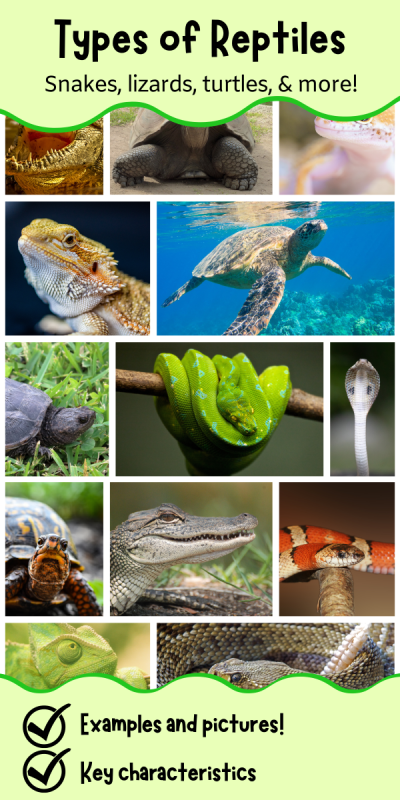
Reptiles are a cool group of critters โ€“ and not just because they are cold-blooded! In this post, you will read about the different types of reptiles: snakes, lizards, turtles, tuataras, and crocodilians. Each of these groups has its own unique characteristics but also has several key traits shared with all reptiles.

A note for teachers: Are you an educator planning a reptiles lesson? I think you’ll love my Reptiles Unit, which can also be found within my even more comprehensive Vertebrates Bundle. The information and some of the artwork in this post come from the reptile unit. The unit also includes hands-on activities, thoughtfully crafted diagrams and visuals, handouts, worksheets, and everything you need to teach reptilesโ€“plus you will support this blog with your purchase! ๐Ÿ’š

Reptiles are part of a bigger category of animals called vertebrates, which means they all have a backbone. There are seven different groups, or classes, of vertebrates on Earth. These include amphibians, birds, mammals, reptiles, and three kinds of fish.

These are the main classes of vertebrates.

Reptiles are not always the easiest group to define. There is a lot of diversity within this group. From legless snakes to shelled turtles and armored crocodiles, the reptile group has some incredible creatures. Unlike other classes of vertebrates, scientists now know that the group we call reptiles is not an isolated evolutionary lineage. This means that some members of the reptile group are not quite as closely related as we once thought they were.

What counts as a reptile?

Some reptiles might seem very different from one another, but all types of reptiles share a few special traits. You can use these traits to help you identify reptiles:

  • A backbone
  • Breathe air with at least 1 functional lung
  • Scales or scutes
  • Ectothermic

From the cute gecko to the venomous rattlesnake, and everything in between, there are so many unique creatures to discover in the world of reptiles! The main types of reptiles covered in this post are: lizards & snakes, tuataras, turtles, and crocodilians.

1. Lizards

close up of lizard on yellow surface
Photo by Oleksandr Pidvalnyi on Pexels.com

Order:

  • Squamata
  • Note: snakes and lizards belong to the same order
Key traits:
  • Usually (but not always) four limbs
  • Long tail
  • External ear holes
  • Scales
Fun Facts:

Some species of lizards can drop their own tails when they feel threatened. This is a great defense because a predator will be distracted by the tail while the lizard escapes. The tail later regrows.

Examples:

Skink, gecko, iguana, chameleon, anole

2. Snakes

watercolor and pen diamondback rattlesnake
Drawing of a rattlesnake – by Wild Earth Lab.
Order:
  • Squamata
  • Snakes belong to the suborder Serpentes
Key traits:
  • No limbs
  • Long, slender body
  • Forked tongue
  • No ear holes
  • Scales
Fun Facts:

Snakes have nostrils for breathing but smell using their tongues.

There are about 600 venomous snake species in the world, but only a few poisonous snake species.

Examples:

Cobra, python, rattlesnake, boa, garter snake

3. Tuatara

tuatara in watercolor
Drawing of a tuatara – by Wild Earth Lab.
Order:
  • Rhynchocephalia
Key traits:
  • Four limbs
  • Long tails
  • Spiny back
  • No ear holes
  • Scales
Fun Facts:

The tuatara is only found in New Zealand. Despite its lizard-like looks, the tuatara is not a lizard. Lizards and snakes are in the order Squamata, but the tuatara belongs in its own order, Rhynchocephalia. All animals in this order except for the tuatara are extinct today.

4. Turtles

watercolor and pen loggerhead sea turtle
Sea turtle illustration by Wild Earth Lab.
Order:
  • Testudines
Key traits:
  • Four limbs
  • Short tail
  • Bony shell with scutes
  • No ear holes
  • Scales
Fun Facts:

Turtles and tortoises can live to be very old. The Galapagos giant tortoise can live for over 150 years. Even small turtles can live for decades. Many people do not realize a pet turtle can be a lifelong responsibility!

Examples:

Snapping turtle, sea turtle, desert tortoise, box turtle

5. Crocodilians

crocodile
Photo by Frans van Heerden on Pexels.com
Order:
  • Crocodilia
Key traits:
  • Four limbs
  • Long tails
  • Semi-aquatic
  • Covered in scutes
  • Large predators with powerful jaws
Fun Facts:

Crocodilians are some of the closest living relatives of the dinosaurs.

The saltwater crocodile, the largest crocodilian, can reach a length of over 20 feet (6 meters)!

Examples:

Alligator, crocodile, caiman

Study Reptiles in Your Classroom:

Are you teaching about reptiles in your classroom or homeschool? There’s no need to scramble to create the perfect set of materials for a reptile unit – I’ve already done it for you! You and your students will love studying reptiles with my complete Reptiles Unit!

Explore more units from Wild Earth Lab:

If you enjoyed this post, I know you will love using my environmental science learning materials in your classroom!


Are you interested in reading more posts like this? Subscribe or follow Wild Earth Lab using the links below!


References and Further Reading

  1. Discovery UK (2019). What On Earth Is A Tuatara? | Modern Dinosaurs (YouTube Video). Available: https://www.youtube.com/watch?v=44JUXPzEI2U
  2. Greater Cleveland Aquarium (2019). EXPLORING SIMILARITIES, CELEBRATING DIFFERENCES: AMPHIBIANS AND REPTILES. Available: https://www.greaterclevelandaquarium.com/exploring-similarities-celebrating-differences-amphibians-and-reptiles/
  3. Uetz, P. (1996). General Information (and โ€œFAQโ€). The Reptile Database. Available: http://www.reptile-database.org/db-info/introduction.html

Sharing options and discussion for this post: