Posted on — 1 Comment

5 Fascinating Adaptations of Arctic and Antarctic Animals

several pictures of various polar animals
Share This Post:

Antarctica and the Arctic are the coldest places on Earth, yet many animals not only survive but thrive in these icy environments. How do they do it? Polar animals have incredible adaptations that help them cope with extreme cold and scarce food in winter. Letโ€™s explore five fascinating polar animal adaptations that make life in the Arctic and Antarctica possible.

Before we dive in: If youโ€™re an educator planning a study of the polar regions, check out my Polar Bundle! It combines my full Arctic and Antarctic learning units at a discountโ€”perfect for busy teachers and homeschoolers looking to bring polar science to life in their classrooms.

1. Hibernation

Some polar animals survive the winter by hibernating. Hibernation is more than just sleeping: the animal’s breathing rate, body temperature, and heart rate become much lower than normal. This helps the animal conserve energy when food is scarce in winter. During hibernation, animals usually stay in a safe, protected space like a den or burrow.

Examples of animals that hibernate:

  • Arctic ground squirrels
  • Grizzly bears
close up photography of brown bear on gray rock
Brown bear. Photo by Pixabay on Pexels.com

2. Taking Shelter

Even if an animal doesn’t hibernate, it may still find a cozy hiding place to escape the cold. A den, borrow, or even a tunnel under the snow will keep an animal sheltered from the wind and cold. Inside, the animal will rest and reduce its activity to conserve energy, but they don’t enter full hibernation.

Examples of animals that shelter in burrows/dens:

  • Arctic lemmings
  • Polar bears (females while birthing cubs overwinter)
  • Arctic foxes
close photography of white polar bear
A polar bear. Photo by Pixabay on Pexels.com

3. Migration

Why face the brutal cold when you can avoid it? Some polar animals migrate to warmer regions during the winter, returning to the Arctic or Antarctic for the breeding season. This is a great option for animals that can cover long distances by flying, swimming, or walking. Migration helps these animals find food and better conditions to raise their young.

Examples of animals that migrate:

  • Arctic terns (famous for traveling from pole to pole!)
  • Humpback whales
humpback whale underwater
Humpback whale. Photo by Elianne Dipp on Pexels.com

4. Insulation

Thick fur, feathers, or layers of blubber act as natural insulation, helping polar animals retain body heat. This polar animal adaptation works like a winter jacket, trapping heat and keeping cold air out. Insulation is important for warm-blooded animals that need to maintain a steady body temperature.

Examples of animals with insulation:

  • Whales (blubber)
  • Seals (blubber and fur)
  • Arctic foxes (thick fur)
  • Penguins (dense feathers)
arctic fox
An Arctic fox with thick fur. Photo by Lena Heckendorn on Pexels.com

5. Huddling

Whatโ€™s warmer than a group hug? Many polar animals huddle together to share body heat and stay warm. By forming a tight group, they reduce heat loss and create a barrier against cold winds. Emperor penguins, for example, are experts at huddlingโ€”taking turns on the outer edges to keep everyone warm on the inside of the huddle!

Examples of animals that huddle:

  • Penguins
  • Arctic hares
Emperor penguin baby penguin
A penguin chick huddles close to its parent for warmth.

Polar animals have evolved some incredible strategies to survive in some of the harshest conditions on Earth. From huddling through the winter to migrating thousands of miles, these polar animal adaptations are a testament to the resilience of life on Earth!

What’s your favorite polar animal adaptation? Share it in the comments below!

Study Polar Animal Adaptations and Ecosystems with Wild Earth Lab!

Thereโ€™s no need to scramble to put together the perfect lesson on polar regions  โ€“ Iโ€™ve already created it for you! Grab my Polar Bundle, which includes my Antarctica Unit and Arctic Unit at a discount!

Looking for more info on animal adaptations? Read my post on desert animal adaptations and my post on camouflage!

Are you interested in reading more about animal adaptations and other cool environmental science topics? Subscribe or follow Wild Earth Lab using the links below!


References and Further Reading

  1. All About Birds (n.d.). Bird Guide. Arctic tern. Available: https://www.allaboutbirds.org/guide/
  2. Audubon (n.d.). Guide to North American Birds. Arctic tern, Atlantic puffin, snowy owl, tundra swan. Available: https://www.audubon.org/bird-guide
  3. Australian Antarctic Program (n.d.). Emperor Penguin. Available: https://www.antarctica.gov.au/about-antarctica/animals/penguins/emperor-penguin/
  4. Center for Biological Diversity (n.d.). ARCTIC FOX } Alopex lagopus. Natural History. Available: https://www.biologicaldiversity.org/species/mammals/Arctic_fox/natural_history.html
  5. Cool Antarctica (n.d.). Arctic Hare – Facts and Adaptations. Available: https://www.coolantarctica.com/Antarctica%20fact%20file/wildlife/Arctic_animals/arctic_hare.php
  6. Global Penguin Society (n.d.). Emperor Penguin โ€“ Aptenodytes forsteri. Available: https://www.globalpenguinsociety.org/portfolio-species-2.html
  7. Mak, M. (2023). What is hibernation? World animal protection. Available: https://www.worldanimalprotection.us/latest/blogs/what-hibernation/
  8. Manning, E. (2007). The Long Sleep: Which Animals Hibernate? Alaska Fish and Wildlife News. Available: https://www.adfg.alaska.gov/index.cfm?adfg=wildlifenews.view_article&articles_id=279
  9. National Park Service (2019). Wildlife of the Arctic. Available: https://www.nps.gov/subjects/Arctic/wildlife.htm
  10. NOAA Fisheries (n.d.). Species Directory. Humpback whale. Available: https://www.fisheries.noaa.gov/species-directory.
  11. OpenAI. (2024). ChatGPT [Large language model]. https://chatgpt.com (used for editing purposes]

Subscribe, share, and comment:

Posted on — 2 Comments

Types of Bird Wings: functions, descriptions, and pictures!

A banner that says animal adaptations: types of bird wings, read more about it. With an image of 5 different types of bird wings (active soaring, passive soaring, high-speed, elliptical, and swimming)
Share This Post:

Birds are a diverse group of animals. Despite their vast differences, hummingbirds, penguins, and eagles all share a common ancestry! Through the process of natural selection, birds adapted to thrive in unique ecological niches. One of their most fascinating adaptations is their wings. But wings are not one size fits all – bird wings come in many specialized forms that serve different functions and fit different lifestyles. Let’s take a look at a few different types of bird wings and what they do!

A note for teachers: Are you an educator? If you are teaching bird adaptations or animal adaptations, I highly recommend checking out my Bird Beaks Lab Activity Guide and my Bird Adaptations Task Cards:

Active Soaring Bird Wings

Active soaring wings have an extremely long, slender shape. They are ideal for catching horizontal air currents like sea breezes. They help minimize flapping to conserve energy, making them great for staying in the air for long periods while hunting or migrating. You will find many examples of active soaring wings among seabirds.

Examples: albatross, gannet

Passive Soaring Bird Wings

Passive soaring wings appear broad and slotted. They are best for catching updrafts and flying for long periods. They help minimize flapping to conserve energy while circling to look for food on the ground or in the water below. You will find raptors and seabirds with this wing type.

Example: pelican, eagle

High-Speed Bird Wings

High-speed bird wings are not as long as active or passive soaring wings. They may appear pointed at the ends. As the name implies, high-speed wings are great for rapid movement. However, the bird must spend lots of energy flapping to reach high speeds. This makes these wings ideal for short bursts of speed, such as chasing down a flying prey animal or insect.

Examples: falcon, tern

Elliptical Bird Wings

Elliptical bird wings have a more rounded appearance. They are great for quick maneuvers and turns, which is why they are often seen on birds that live in dense forests. They are also good for quick take-offs, which can help a bird escape from a predator. Elliptical wings require lots of flapping to stay in flight.

Examples: dove, turkey

Swimming Bird Wings

Some wings have a fin-like shape. These wings are great for swimming, which can be very useful for a penguin that hunts by pursuit diving for fish underwater. Swimming wings allow a bird to “fly” underwater! These fin-like wings lack true flight feathers and are not suitable for flight (in the air, at least).

Example: penguin

Hovering Bird Wings

Ruby-throated hummingbird drawing: small green, red, and white bird with a long beak and pointy tail.

Hovering wings are great for – you guessed it – hovering. This type of wing allows a bird to stay in one place, suspended in the air. Hovering wings are small and move very, very quickly. Furthermore, when a bird flaps its hovering wings, the motion comes mostly from the shoulder joint rather than joints further down the wing. Hovering lets a hummingbird drink nectar from flowers while in flight. However, a huge amount of energy is used to keep the wings flapping so quickly.

Example: hummingbird

Study Bird Adaptations with Wild Earth Lab:

I’ve created these learning material sets to help you study bird adaptations:

More from Wild Earth Lab:

If you enjoyed this post, I know you will love using my environmental science materials in your classroom!


Are you interested in reading more posts like this? Subscribe or follow Wild Earth Lab using the links below!


References and Further Reading

  1. All About Birds (n.d.). Why Can’t Penguins Fly. Cornell Lab. Available: https://www.allaboutbirds.org/news/why-cant-penguins-fly/
  2. Berberi, I (2020). How the wings of owls and hummingbirds inspire drones, wind turbines and other technology. Carleton Newsroom. Available: https://newsroom.carleton.ca/story/hummingbirds-wings-inspire-technology/
  3. Heisman, R. (2022). Extraordinary Appendages: An Introduction to Bird Wings. American Bird Conservancy. Available: https://abcbirds.org/blog/bird-wings/
  4. Jenney, P. (2022). Winter Wings: The Science of Soaring. Montana Natural History Center. Available: https://www.montananaturalist.org/blog-post/winter-wings-the-science-of-soaring/
  5. Peggy Notebaert Nature Museum (2021). Facts of Flight. Chicago Academy of Sciences. Available: https://naturemuseum.org/chicago-academy-of-sciences/blog/facts-of-flight
  6. Savile, D. B.O. (2006). Bird Fight. The Canadian Encyclopedia. Available: https://www.thecanadianencyclopedia.ca/en/article/bird-flight

Sharing options and discussion for this post:

Posted on — 1 Comment

Camouflage Lab: try this simple science activity in your classroom to learn about animal adaptations!

A banner that says "study natural selection and adaptation! Camouflage Lab!"

Are you studying animal adaptations with your class? If so, there is nothing quite like a camouflage lab to learn first-hand how concealing coloration can help animals avoid being eaten by predators! This lab activity is very simple and effective for showing students how natural selection favors animals that can hide from predators.

This lab is entertaining because students get to be the “predators” by hunting for different “prey” (black and white beans) in a “habitat” made of white rice. Which prey will they capture most easily? Which prey will survive? Try this lab activity to find out!

Find these worksheets and handouts in my camouflage lab mini study!

In this post, you will learn how to set up a camouflage lab in your classroom. You can also get printable versions of these directions, worksheets, handouts, and classroom posters to use during this lab in my Camouflage Lab Mini Study!

If you are looking for even more ways to study animal adaptations, I think you will also like my bird beaks lab – read the separate post about the bird beaks lab.

This bird beak adaptations lab is another great way to study animal adaptations!

Gather Your Materials

Gather the following materials for the camouflage lab. Each lab group will need:

  • Dry white rice
  • Dry black beans
  • Dry white beans
  • Tweezers
  • Pie tin or shallow bowl
  • Paper cup
  • Stopwatch
  • Student lab handouts (1 set per student)

Set-Up & Directions

  1. Pour some rice into each bowl. The rice will be the background or habitat.
  2. Mix equal numbers of black beans and white beans into each bowl. The black beans are the regular animals. The white beans are the camouflaged animals.
  3. In each lab group, one student will be the predator and another student will be the timer. Students can take turns in these different roles.
  4. The predator will use the tweezers or โ€œbeakโ€ to catch as many beans as possible in 30 seconds and place them in the paper cup or โ€œstomachโ€.
  5. After 30 seconds, count how many beans of each color were captured, and how many beans of each color survived.
  6. Repeat as needed so all students have a turn being the predator.
  7. Check with your students: which โ€œanimalโ€ was eaten the most? Which avoided the predators the most?
  8. After the activity, discuss the benefits of concealing coloration with your students.
  9. Students should complete the reflection questions.
Don’t forget to download the worksheets and printable directions for this camouflage lab activity!

Reflection Questions

  1. Did more black beans or white beans survive?
  2. Which beans were easiest to spot in the rice?
  3. How does camouflage help animals?
  4. Would the results of the lab activity be different if you used black rice as the background? How so?
  5. Would the results of the lab activity be different if you used gray rice as the background? How so?
  6. Which would get eaten more in a forest with lots of leaves and moss: a green lizard or a yellow lizard?
  7. Which would get eaten more in a desert with lots of sand, rocks, and dry plants: a greenish blue snake or a tan and gray snake?

Expand on this Activity

Try these ways to expand on your camouflage lab:

1. Natural selection over several generations:

Expand on this activity to learn about natural and adaptations.  Repeat the activity a few times to represent successive generations. Use the proportion of beans of each color after predation to determine the proportion of beans of each color in the next generation.

For example, if you started with 50 total beans (25 black beans and 25 white beans), and 5 black beans and 20 white beans remained after predation, then you should start the next generation with 10 black beans and 40 white beans.

Have students perform these calculations to add math to this lab.  Afterwards, discuss which coloration thrived in the long run. Did either coloration disappear from the population after several generations?

2. Mimicry:

Did you know that some harmless animals mimic dangerous animals? A good example of this is the harmless viceroy butterfly, which looks very similar to the poisonous monarch butterfly. Another example is a non-venomous milk snake, which has nearly the same red and black stripes (called “warning coloration“) as a venomous coral snake! This type of disguise is called “mimicry“, and it is a type of camouflage.

Expand on your camouflage lab by adding in a mimicry lab activity. The purpose of a mimicry activity is to show how pretending to be dangerous benefits prey animals. There are many versions of a mimicry lab, such as the activity shown in this candy camouflage YouTube Video from Science Buddies.

This lab comes from my Reptiles Unit!

Your students will love the illustrated learning materials, plus you’ll support Wild Earth Lab with your curriculum purchase!

Explore more curriculum from Wild Earth Lab:

If you enjoyed this post, I know you will love using my environmental science materials in your classroom!


Are you interested in reading more posts like this? Subscribe or follow Wild Earth Lab using the links below!


Sharing options and discussion for this post:

Posted on — 3 Comments

Animal Disguises: types of camouflage and coloration!

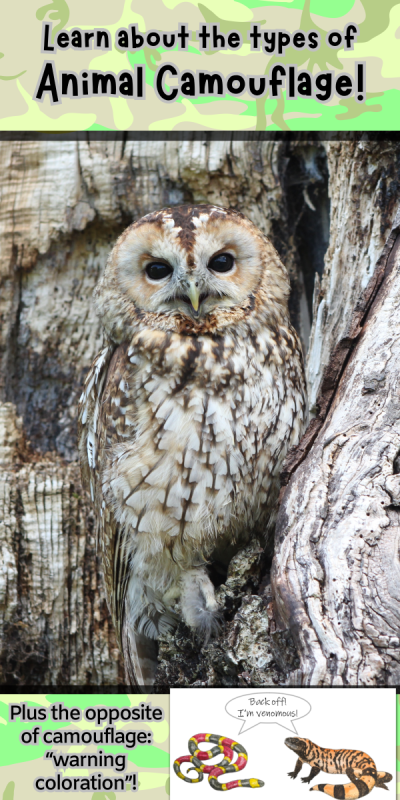
A banner with an owl that says "learn about the types of animal camouflage"
text that says share this post

Camouflage is an adaptation that helps an animal disguise its appearance. There are many types of camouflage. Camouflage may help an animal blend into its background or look like something inedible or toxic.

Many prey animals use camouflage to protect themselves from predators. Also, some predators use certain forms of camouflage to help them hide and sneak up on prey.

Are you an educator planning to teach camouflage in your classroom? You may enjoy trying out this simple camouflage lab activity – read about the lab activity and download my printable worksheets and directions for it:

Ready to teach your class about camouflage? Try this camouflage lab activity!

Types of camouflage include concealing coloration, disruptive coloration, countershading, disguise, and mimicry. Here are a few forms of camouflage:

1. Concealing Coloration

Concealing coloration is when an animalโ€™s colors match its background to help it blend in. Often, animals with concealing coloration are shades of green, gray, and brown so that they do not stand out against leaves, twigs, rocks, and soils. In the polar regions, animals may have white fur so that they blend in with snow.

Examples: A huge number of insects, lizards, turtles, snakes, rodents, and other prey animals have concealing coloration. Some animals, like chameleons, can even change the color of their skin to match their background more closely. Arctic animals with concealing coloration to blend in with snow include some arctic foxes, polar bears, ptarmigans, snowy owls, and arctic hares.

2. Disruptive Coloration

Disruptive coloration includes patterns like spots and stripes that make it difficult to see the outline of an animal. These patterns of contrasting colors can visually break up an animal into pieces. It is difficult to hunt an animal if you cannot tell where its body begins and ends!

Examples: zebra, leopard

3. Countershading

Countershading is a common type of camouflage for aquatic animals. Their bellies are light-colored, like the surface of the water when viewed from below. Their backs are dark, like the waterโ€™s depths when seen from above.

Examples: sea turtles, dolphins, sharks

4. Disguise

Disguise is when an animal looks like something inedible. For example, it disguises itself as a rock or stick. Predators do not realize that the animal is something good to eat.

Examples: walking stick, leaf insects

5. Mimicry

Animals use mimicry to trick predators into thinking they are something yucky, dangerous, or inedible. The mimic may be a relatively harmless animal that looks similar to a dangerous animal. This clever disguise fools predators into thinking the harmless animal is far more dangerous than it is.

Examples: milk snakes look like venomous coral snakes. Viceroy butterflies look like poisonous monarch butterflies.

A Different Strategy: aposematism, aka warning coloration

Aposematism is not camouflage – in fact, it is the opposite of camouflage! Aposematism means warning coloration. Venomous, poisonous, and otherwise dangerous animals often have bold patterns and colors. Contrasting patterns or stripes of red, orange, yellow,  black, and white let predators know to back off! Gila monsters and coral snakes are two venomous reptiles with warning coloration. A skunk’s black and white stripes are another example of warning coloration.

A coral snake and a Gila monster are two venomous reptiles with the striking warning coloration known as aposematism.

Activities for teaching camouflage…

Try teaching a camouflage lab. I created some worksheets for this activity.

classroom handouts of reptiles and worksheets

You will also find the camouflage lab materials in my complete Reptile Unit! From Gila monsters to chameleons, the world of reptiles is full of some crazy patterns and disguises! If you enjoyed learning about the types of camouflage in this post, I know you will love learning more about the camouflage and coloration of reptiles in my complete Reptiles Unit!

Explore more materials from Wild Earth Lab:

If you enjoyed this post, I know you will love using my environmental science materials in your classroom!


Are you interested in reading more posts about cool science topics? Subscribe or follow Wild Earth Lab using the links below!


References and Further Reading

  1. American Museum of Natural History (2017). WARNING: Aposematism Explained. Available: https://www.amnh.org/explore/news-blogs/news-posts/warning-aposematism-explained
  2. Rocky Mountain National Park (n.d.). Animal Camouflage. NPS. Available: https://www.nps.gov/romo/animal_camouflage.htm
  3. Rocky Mountain National Park (n.d.). Warning Coloration. NPS. Available: https://www.nps.gov/romo/warning_coloration.htm
  4. Smithsonian National Zoo and Conservation Biology Institute (n.d.). Sinaloan milksnake. Available: https://nationalzoo.si.edu/animals/sinaloan-milksnake
  5. D’Augustino, T. (2019). Why do animals have different color patterns? Michigan State University Extension. Available: https://www.canr.msu.edu/news/why-do-animals-have-different-color-patterns

Sharing options and discussion for this post: