Posted on 4 Comments

The Heart of an Ecosystem: Healthy ponds, streams, and wetlands

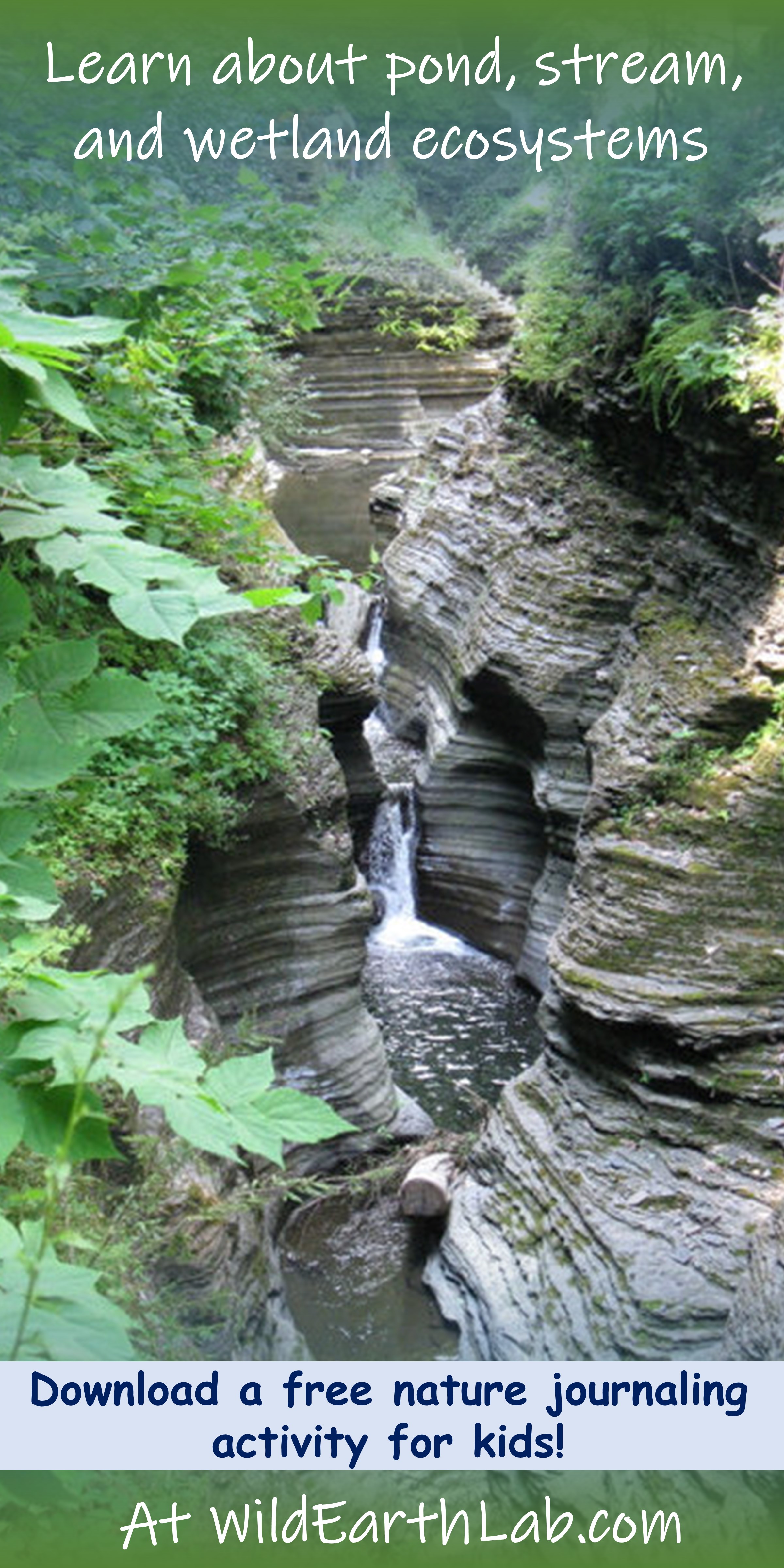
a banner with a photo of a glen with a stream

This week, my students and I took a field trip to a local creek. Getting outside to make observations in nature is one of my favorite hands-on ways to learn about science and the natural world! Ponds, creeks, and wetlands are some of the best places to do this. These aquatic areas are teaming with life and activity – there is so much to watch, listen to, and wonder about. Like most living creatures, we humans are naturally drawn to water sources. Being outside with my students at the creek this week got me thinking more about ponds, streams, and wetlands, and their important role in all kinds of ecosystems...

A stream in Northern Wisconsin is home to a variety of plant and animal species

Perhaps you have noticed that some of the best places in your area to see birds, plants, and other wildlife are near water! Where you find water you usually find an abundance of life! All plants need water to perform photosynthesis, the process plants use to make their own food. A healthy ecosystem will have a healthy food web! An ecosystem with many different plants will attract herbivores or animals that eat plants. You might have seen some herbivores around ponds or streams in your area, such as plant-eating species of fish, birds, and insects. A thriving herbivore population will, in turn, attract predators, or animals that hunt and eat other animals. You may notice predators such as larger fish species like pike and walleye, as well as otters, herons, kingfishers, spiders, and dragonflies. Decomposers, like mushrooms and earthworms, also thrive in moist environments. It is no surprise that water features like streams, ponds, and wetlands are the lively, bustling centers of many ecosystems! 

I became very familiar with aquatic ecosystem health while collecting field samples for an aquatic ecology laboratory several years ago. While going out and collecting samples from streams, ponds, and rivers all over Colorado, I quickly learned that not all aquatic ecosystems are equal. I saw and studied all kinds of aquatic ecosystems  – from streams that were little more than stagnant ditches on the sides of roads,  to roaring mountain rivers overflowing with spring snowmelt. I visited remote beaver meadows miles from the nearest dirt road, and also popular lakes in national parks that host thousands of hikers, fishers, and sight-seers every year. I studied mountain springs that bubbled out of the ground looking as clean and clear as tap water and also streams where the water flowed bright orange, polluted with runoff from mining sites. It didn’t take long for me to start noticing some other big differences between these contrasting aquatic ecosystems…

As I visited these places, I would listen, touch, smell, and look – and notice the differences. I heard the sounds of many songbirds or the sounds of nearby highways. I felt the squishy, moss-covered river banks between my toes as I waded bare-foot in remote streams, or I felt the hardened plant-less dirt under my wader boots on riverbanks where too many boots from too many visitors had over-compacted the soil. I smelled the earthy scents of decaying leaves and wildflowers, or the stench of manure from a nearby herd of cattle grazing on the sweet riparian vegetation.  I counted the number of native plants or the number of invasive species.

Ponds, streams, and wetlands are the heart of many ecosystems. If these water features are unhealthy, the whole ecosystem will decline. Take away a clean and plentiful source of water, and the vegetation will suffer, sending ripple effects through the local populations of herbivores, predators, and decomposers. 

Consequently, these vital water features are also a great indicator of ecosystem health. If something is not right in an ecosystem, you can often observe signs of poor health in the streams, ponds, and wetlands. An unhealthy ecosystem cannot support a diverse community of plants, herbivores, predators, and decomposers. Scientists monitor ponds, streams, and wetlands due to their importance to animals and plants (and humans) in a variety of environments, and also because the symptoms of ecosystem imbalance are often quite visible there.

A variety of animal and plant species that are found around healthy ponds and wetlands
  • Continue to part 2 to learn how to recognize the signs of healthy aquatic ecosystems wherever you go!
  • If you are looking for ways to teach kids or young students about aquatic ecosystem health, you can download and print the free nature journal page for kids, about pond ecosystems or purchase the Pond Ecology Bundle on Etsy!
  • If you enjoyed this post, please share it with a friend and subscribe to Wild Earth Lab’s blog to get new posts about science, sustainability, and nature sent to your inbox!

Wild Earth Lab is new to blogging as of March 2021 and is dedicated to telling engaging stories about the natural world and creating unique learning resources to spark curiosity about nature. You can also visit Wild Earth Lab on social media to preview new learning resources in the making, using the links below:


Get more printable resources like this on the free learning resources page! and visit my Etsy Shop!


References and Further Reading

  1. Environmental Protection Agency. (2020). Impacts of Mismanaged Trash. Available: https://www.epa.gov/trash-free-waters/impacts-mismanaged-trash
  2. Environmental Protection Agency. (2016). Indicators: Benthic Macroinvertebrates. Available: https://www.epa.gov/trash-free-waters/impacts-mismanaged-trash
  3. Frey, D. (2018). Study shows Yellowstone wolves’ impact on streams. The Wildlife Society. Available: https://wildlife.org/study-shows-yellowstone-wolves-impact-on-streams/
  4. National Park Service. (2017). Elk and moose exclusion fence. Available: https://www.nps.gov/articles/elk-and-moose-exclusion-fence.htm

Sharing options and discussion for this post:

Posted on Leave a comment

An Invitation

A banner of a student using forceps to collect insect samples from a tray of pond material, overlaid with text: "unique learning resources to spark curiosity about the natural world" and "visit Wildearthlab.com"

Welcome fellow nature lovers and outdoor adventurers. Welcome backyard naturalists, kitchen table scientists, life-long learners. Welcome fellow wonderers and wanderers. I’m glad to see you here.

My name is Valerie and I’m a scientist, artist, and avid outdoors woman currently in Colorado, USA. My curiosity about the natural world started at a young age, exploring the prairies and woods of Wisconsin where I grew up. This curiosity blossomed into a love of backpacking and hiking as a teenager, which inspired me to embark on what I saw as the ultimate outdoor adventure – a thru-hike of the 2,180-mile Appalachian Trail. This journey took me to places I had never been, where I experienced things I had only dreamt of: I saw my first-ever black bear, as well as moose, baby deer, copperhead snakes, songbirds, foxes, owls, turtles, and red-spotted newts. I marveled at wildflowers that grew above tree line in the White Mountains of New Hampshire. I witnessed seemingly tropical rhododendron plants comfortably survive two feet of snow in the Great Smoky Mountains. I forded rivers where no bridges had been built, bathed in lakes that had never seen a motorboat. I satiated my hiker hunger with wild blueberries.

I also saw many things I hadn’t expected to see, such as when the trail crossed through a superfund site in Pennsylvania. The area’s history of zinc smelting noticeably impacted the landscape, which abruptly changed from dense forest to barren hillslopes, eerily devoid of birdsong and inhabited by only a scattering of dying trees, invasive grasses, and more deer ticks than I care to remember. I saw firsthand the immense efforts of trail crews to remove litter at overrun shelters and privies. I experienced a mass emergence of invasive caterpillars along a section of trail in West Virginia. I encountered wild animals that were so desensitized by repeated human interaction and feeding that they approached hikers without fear. I witnessed restoration efforts to prevent the encroachment of lower-elevation species onto the mystical bald mountaintops of the southern Appalachians. I learned that the “100-mile wilderness” in Maine, known for being one of the most remote and wild areas on the east coast, is also the site of several logging operations, providing the necessary resource for our wood and paper products. Through this experience I learned there was a lot I didn’t know about our natural world, the resources we extract from it, and the ways that we impact it.

In part, my experiences along the trail inspired me to pursue a degree in Fish, Wildlife, and Conservation Biology. I felt motivated to better understand the natural world and our relationships with it. Through the eyes of a scientist, I learned. I learned about the big, seemingly-unstoppable cycles of nature – of water, carbon, tides, and seasons – so powerful and yet delicately balanced, to allow for the diversity of life on this planet. And I learned about the small, unlikely relationships existing between pairs of species – between flower and pollinator, bird and fruit-bearing tree, plant and mycorrhizal fungus – allowing both to thrive. I learned about the unseen connections of all beings within an ecosystem, and about how we humans are connected to this world too, even when our lives make it difficult to see the places we are attached.

In the past few years, I have worked as a scientist in both the field and in the laboratory. I’ve measured the flows of headwater streams, counted new seedlings in beetle kill forests, evaluated the health of insect communities in a national park, and studied soils following forest fires and chemical spills. As a scientist, I’ve had the opportunity to intimately understand our relationship as humans with nature: what we are doing right, what we are doing wrong, and how we can do better.

Throughout my education and career, I have wondered how things would be different if education about nature and our relationship with Earth started earlier. My childhood education barely scratched the surface of ecosystem science, and it wasn’t until college that I was introduced to sustainability and conservation. What could our world be like if we all started out with a better understanding of this Earth and all its wild, remarkable, intricate beauty? How could things change if we all carried with us an understanding of the things we can do – big and small – to improve our relationship with Earth? I believe one of the most natural things we can do as humans is to wonder at nature. It’s never too early – or too late – to start learning about the natural world, the diversity of life on this planet, and what we can do as individuals to help protect it.

My goal in creating Wild Earth Lab is to create resources for you, your family, and your students to learn about the Earth and our relationship with it. Through combining my passions for nature, science, and art, I hope to use this space to create unique and beautiful educational resources and engaging, informative articles covering a range of topics related to science, sustainability, and the natural world.

Are you still with me? Perhaps this sounds like something you’re interested in too. I hope you will join me on this journey by subscribing to Wild Earth Lab, or by following Wild Earth Lab using the links below:


Sharing options and discussion for this post: