A keystone species is an organism that plays an exceptionally large role in its ecosystem. It provides materials or services that enrich the lives of other organisms in the ecosystem. Without the keystone species, the ecosystem would look very different and other organisms that rely on the keystone species would suffer. Now, let’s look at a few examples of keystone species!
Beavers in Wetlands
A common example of a keystone species is a beaver in a wetland. Beavers build dams on streams, causing water to back up and form ponds and wetlands. The result is a much more complex ecosystem with a greater variety of habitats.
A beaver wetland can support a very diverse plant and animal community. Beaver ponds provide a place for other animals to live and forage. A beaver wetland is a great habitat for wetland plants that like to grow in standing water. Without the beaver, the wetland ecosystem slowly degrades.
Saguaro Cactus in the Sonoran Desert
Like the beaver, the saguaro cactus is a keystone species. In the Sonoran Desert ecosystem, the saguaro plays a central role providing shelter and food for many other species.
Birds like elf owls, hawks, and woodpeckers live in cavities within the saguaro’s trunk. The saguaro’s flesh helps keep these homes temperature regulated so their occupants stay cool during hot desert days.
The saguaro flower provides nectar that feeds desert pollinators, like bats, doves, and bees. Once pollinated, the saguaro makes large fruits that are also a vital food source for desert animals. Coyotes, tortoises, birds, and others eat the fruit and disperse the saguaro’s seeds in their scat.
Many desert animals have a type of symbiotic relationship with saguaros known as mutualism. This means both the animal and the saguaro benefit from the relationship.
Prairie dogs are keystone species in grasslands and prairies because of their tunnels. They are exceptional excavators that build large networks of underground tunnels. These tunnels actually help keep the soil healthy. Digging tills and aerates the soil, and prairie dog scat provides a fertilizer for prairie plants.
Additionally, when prairie dogs abandon burrows, other prairie animal species can move in and use these homes. Not all animals are as good at digging as prairie dogs, so they rely on abandoned prairie dog homes for shelter. Finally, prairie dogs are a food source for grassland predators like coyotes and hawks.
Wolves in Forests
Although scarce today, wolves are a natural keystone species in many types of forests. Wolves help keep the populations of deer, elk, and other undulates under control through hunting them. Amazingly, this impacts the plant community of the forest! Let me explain: deer and elk are voracious plant eaters. When deer and elk numbers grow unnaturally high, plants struggle to grow fast enough to keep up with the hungry undulates. But when wolves are around, the deer and elk populations stay in check, and the plants benefit.
Even a few wolves can really make an impact. These is because the presence of wolves changes the behaviors of deer and elk, scaring them into more protected parts of a habitat. When there are no wolves around, deer and elk will more freely browse in any part of the habitat, including open areas like meadows and riparian zones.
Explore curriculum from Wild Earth Lab:
If you enjoyed this post, I know you will love using my environmental science materials in your classroom!
Fortin, D., Beyer, H. L., Boyce, M. S., Smith, D. W., Duchesne, T., & Mao, J. S. (2005). Wolves influence elk movements: behavior shapes a trophic cascade in Yellowstone National Park. Ecology, 86(5), 1320-1330.
Kotliar, N. B., Baker, B. W., Whicker, A. D., & Plumb, G. (1999). A critical review of assumptions about the prairie dog as a keystone species. Environmental management, 24, 177-192.
In my last post, I shared my experience working as a science technician studying aquatic ecosystems like streams, ponds, and wetlands. These water features are critically important to many ecosystems and the creatures that live there. They also provide us with a lens through which we can glimpse the overall health of an ecosystem. In this post, I’ll teach you some signs to look for to recognize healthy aquatic ecosystems in your area. How do your local ponds, streams, and wetlands measure up?
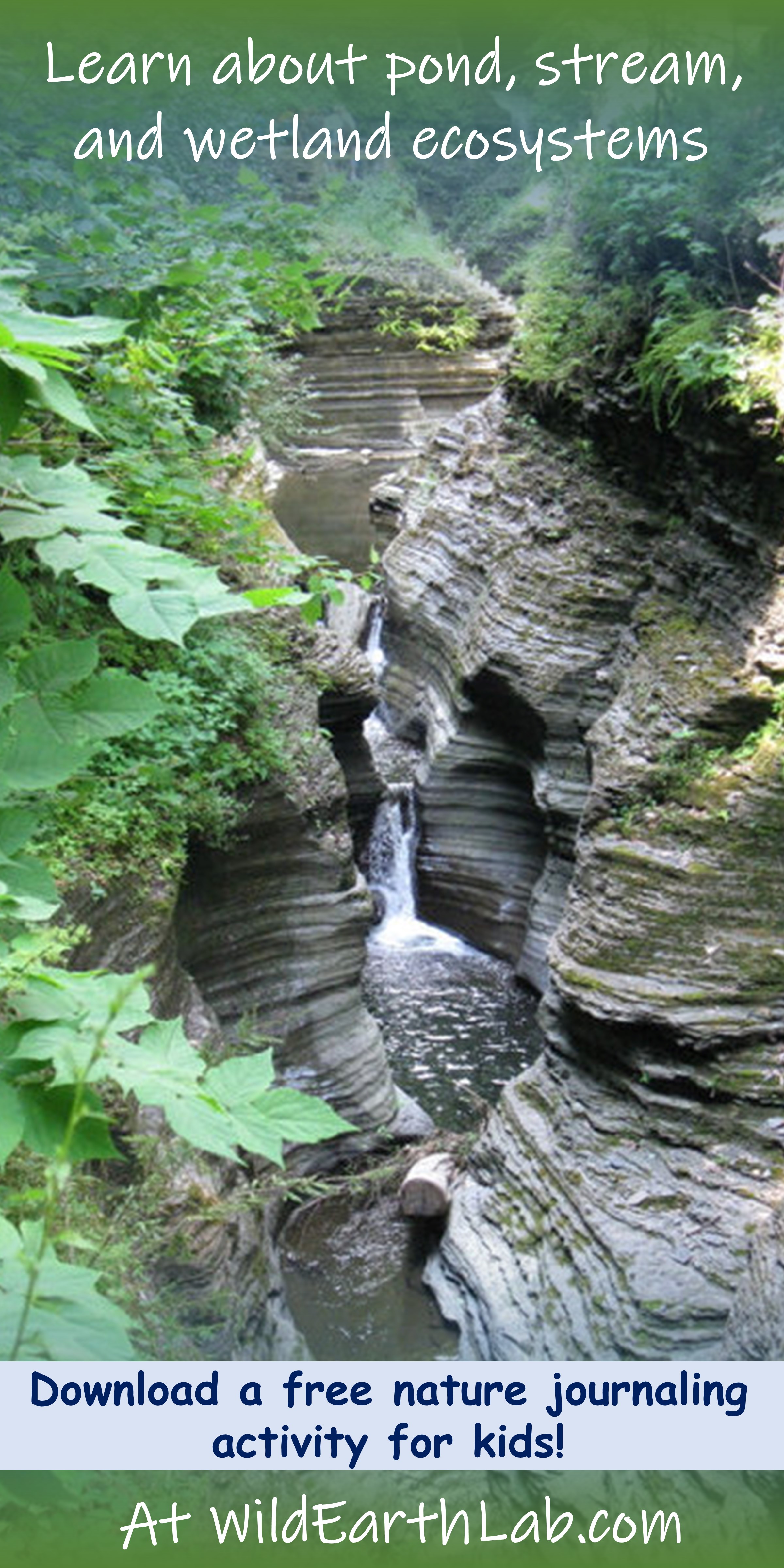
Watkin’s Glen in New York state is home to some incredible water features and lush vegetation
Free of Trash
This one seems obvious, but it is worth including first because of how important it is, and because it is something we can all help prevent and fix. Litter and trash can be harmful to wildlife and plants. Lots of trash floating on the surface of water can impact the amount of light and oxygen in a pond or stream. Below the water’s surface, aquatic plants need sunlight and oxygen for photosynthesis, the process through which plants make their own food. Furthermore, our trash, especially plastics, contains harmful chemicals that may harm aquatic animals. Animals like fish, birds, and turtles confuse trash for food and eat it, which can be very toxic to them. Healthy aquatic ecosystems should be free of human trash.
Any time you see an area dominated by just one plant, that might be a clue that something is wrong. Unhealthy ecosystems are more susceptible to invasive plant species. When an invasive plant species is introduced to an ecosystem, it can outcompete native plant species. Where there were once many diverse plant species, a single invasive plant may take over. This will send ripple effects through the whole local food chain. Examples of invasive plants species in North America include cheat grass, kudzu, garlic mustard, and buckthorn trees.
The Poudre River in Northern Colorado is an example of an ecosystem impacted by an invasive plant. Invasive cheat grass is found along its floodplain in some areas.
Some Algae, but not Too Much
It is natural for stagnant bodies of water (non moving bodies of water like ponds and wetlands), and slower moving streams to have a good bit of algae. Fish, aquatic insects, and other invertebrates need algae as a source of food. But how much is too much? When ponds are near farm fields, the runoff into them may contain too much of the nutrients phosphorous and nitrogen, which is found in many fertilizers. After rain, water flowing off of farm fields and lawns will wash fertilizers containing phosphorous, nitrogen, and other chemicals into low-lying ponds and wetlands. This can cause massive, unnatural plumes of algae to form, which block out sunlight, deplete oxygen, and make it difficult for any other life forms to survive in the pond. When one species takes over, such as a massive plume of algae, it is often a sign that something is out of balance in an ecosystem.
A remote pond below Vestal and Arrow Peaks near Silverton, Colorado, in the San Juan Mountains contains clear water with a small amount of algae.
Abundant and Diverse Aquatic Macroinvertebrates
Have you ever flipped over a rock in a pond or stream? Chances are you saw tons of wriggling little creatures underneath! These creatures are aquatic insect larvae, such as mayflies, dragonflies, and caddisflies (“case-makers”) and other aquatic macroinvertebrates! “Aquatic macroinvertebrates” is a general word for tiny creatures with no backbones that live in water. They include insect larvae, worms, snails, crayfish, and more. Many aquatic macroinvertebrates are herbivores of algae and provide an important food source for many fish species. A healthy ecosystem should have a variety of different aquatic macroinvertebrates!
Many macroinvertebrate species are sensitive to disturbances and contaminants in an ecosystem, so their populations will reflect an ecosystem’s health. The aquatic macroinvertebrates in a pond or stream are actually such an excellent indicator of ecosystem health that scientists routinely use studies of the aquatic macroinvertebrates in a stream or pond as a holistic measure of aquatic ecosystem health! A healthy aquatic community will have abundant and diverse macroinvertebrates.
This is me, collecting aquatic insects from a lake while I was an undergraduate in college. Using a mesh net and a pan, I found all sorts of benthic macroinvertebrates, including stonefly larvae, caddisfly larvae, and mayfly larvae.
Multiple Trophic Levels
A healthy ecosystem should also contain a variety of different living things including plants, herbivores, predators, and decomposers. These life forms represent different trophic levels, or positions in the food chain, and all play different roles in the ecosystem to maintain balance. A classic example is the relationship between wolves, elk, and riparian plants. When an ecosystem is healthy, all three thrive. However, if wolves (or other top predators) are driven out of an area, the elk population will increase since no one is eating them any more. That will cause the plant populations to suffer, because more elk eat more plants. Additionally, without fear of predation, herbivores like elk will be emboldened to graze out in the open near wetlands and streams, rather than hiding in the woods. This leads to greater stress on the plants around aquatic ecosystems.
Scientists study this effect by building fences around small areas of an ecosystem, to keep out elk, and to see what an area would look like without exaggerated grazing. This same sort of imbalance between plants, herbivores, and predators can happen on a smaller scale too. In some pond ecosystems, the top predators (predators that are not prey to any other animals) might be herons, hawks, or otters, rather than wolves. See if you can identify a top predator in a local pond or stream ecosystem near you. In a healthy ecosystem, look for a variety of insects, fish, birds, amphibians, and other animals.
A bald eagle, a top predator, perches overlooking the Wisconsin river
Many turtles are omnivores that eat a variety of both plant and animal foods
Free of Chemicals
Chemicals can get washed into water from surrounding human settlements and agriculture. Some chemicals might be noticeable, and appear as a white or yellow froth on top of water, an oily sheen floating on the surface, or an unnatural metallic or rusty color. Some chemical pollutants are invisible, but their impact on wildlife is not! For example, road salts, when dissolved in water might be invisible, but it can impact the number of female frogs that are born in a pond – which can impact a frog species’ ability to reproduce.
Another example of a harmful but nearly invisible chemical is a mosquito pesticide called DDT. When DDT gets into pond and stream water, it accumulates in the tissues of plants. These contaminated plants are eaten by macroinvertebrates and small fish, which are in turn eaten by larger fish, which are eaten by raptors like bald eagles. On each step up the food chain, the amount of the DDT chemical would build up in the organisms, in an effect called biomagnification. The bioaccumulated DDT in the eagles caused the shells of the eggs they laid to be too weak, which caused an enormous threat to this species. Luckily a biologist named Rachel Carson figured out the cause of the problem and DDT was later banned in the United States. DDT is still legal in some countries.
We love visiting streams and wetlands, but too many human or livestock visitors traveling over fragile surfaces can have a big impact. Human visitors and livestock that are not natural to an area can cause soil compaction by repeatedly walking over the same area, this can make it very difficult for plants to grow. Plants are an important part of a pond or stream ecosystem because their roots help stabilize the banks or shores, preventing erosion. Signs of excessive erosion like undercut banks and over compacted, plant-less soil can be signs that an ecosystem isn’t doing so well. Water also cannot infiltrate into soils as easily when they are too compacted – which may cause floodwaters to pool rather than seep back into the ground. To help prevent impacts to soils, you can stay on designated trails and recreation areas when visiting a local stream, pond, or wetland.
Spring Creek in Fort Collins, Colorado. A corridor of grassy, natural areas along the creek’s floodplain provide an area to accommodate floodwaters and promote water infiltration into the soils.
Ways we can all help promote healthy aquatic ecosystems!
Stay on trails, boardwalks, and already-impacted surfaces when visiting local streams, ponds, and wetlands.
Pack out your trash or dispose of it properly in a trash can or dumpster.
Consider bringing an extra baggie or container on hikes to pick up litter.
Help prevent the spread of invasive plant species by checking your shoes and clothing for burs, seeds, or other plant materials.
Help prevent the spread of invasive animal species by not releasing aquatic pets into local ecosystems.
Consider reducing the amount of chemicals you use in your lawn or garden to prevent chemical run-off into nearby wetlands, ponds, or streams. More about this in my post on improving you backyard wildlife habitat, if you haven’t read it yet!
Consider joining a volunteer group in your area that helps pull up invasive plant species in parks and on public lands.
Teach your family about healthy aquatic ecosystems. I’ve made a free aquatic ecosystem scavenger hunt for you to download, shown at the bottom of this page! Or purchase my Pond Ecology Unit – which includes activities, flashcards, and posters for learning about ecosystems!
Boardwalks provide a route for visitors to cross fragile riparian areas while minimizing impacts to plants and soils
Are you interested in learning more about ecosystems and conservation? Subscribe at the bottom of this page, or follow Wild Earth Lab using the links below!
This week, my students and I took a field trip to a local creek. Getting outside to make observations in nature is one of my favorite hands-on ways to learn about science and the natural world! Ponds, creeks, and wetlands are some of the best places to do this. These aquatic areas are teaming with life and activity – there is so much to watch, listen to, and wonder about. Like most living creatures, we humans are naturally drawn to water sources. Being outside with my students at the creek this week got me thinking more about ponds, streams, and wetlands, and their important role in all kinds of ecosystems...
A stream in Northern Wisconsin is home to a variety of plant and animal species
Perhaps you have noticed that some of the best places in your area to see birds, plants, and other wildlife are near water! Where you find water you usually find an abundance of life! All plants need water to perform photosynthesis, the process plants use to make their own food. A healthy ecosystem will have a healthy food web! An ecosystem with many different plants will attract herbivores or animals that eat plants. You might have seen some herbivores around ponds or streams in your area, such as plant-eating species of fish, birds, and insects. A thriving herbivore population will, in turn, attract predators, or animals that hunt and eat other animals. You may notice predators such as larger fish species like pike and walleye, as well as otters, herons, kingfishers, spiders, and dragonflies. Decomposers, like mushrooms and earthworms, also thrive in moist environments. It is no surprise that water featureslike streams, ponds, and wetlands are the lively, bustling centers of many ecosystems!
Loons are predators of fishMushrooms are decomposers found in many ecosystems
I became very familiar with aquatic ecosystemhealthwhile collecting field samples for an aquatic ecology laboratory several years ago. While going out and collecting samples from streams, ponds, and rivers all over Colorado, I quickly learned that not all aquatic ecosystems are equal. I saw and studied all kinds of aquatic ecosystems – from streams that were little more than stagnant ditches on the sides of roads, to roaring mountain rivers overflowing with spring snowmelt. I visited remote beaver meadows miles from the nearest dirt road, and also popular lakes in national parks that host thousands of hikers, fishers, and sight-seers every year. I studied mountain springs that bubbled out of the ground looking as clean and clear as tap water and also streams where the water flowed bright orange, polluted with runoff from mining sites. It didn’t take long for me to start noticing some other big differences between these contrasting aquatic ecosystems…
As I visited these places, I would listen, touch, smell, and look – and notice the differences. I heard the sounds of many songbirds or the sounds of nearby highways. I felt the squishy, moss-covered river banks between my toes as I waded bare-foot in remote streams, or I felt the hardened plant-less dirt under my wader boots on riverbanks where too many boots from too many visitors had over-compacted the soil. I smelled the earthy scents of decaying leaves and wildflowers, or the stench of manure from a nearby herd of cattle grazing on the sweet riparian vegetation. I counted the number of native plants or the number of invasive species.
A pond near Buena Vista, ColoradoMaking observations of an ecosystem
Ponds, streams, and wetlands are the heart of many ecosystems. If these water features are unhealthy, the whole ecosystem will decline. Take away a clean and plentiful source of water, and the vegetation will suffer, sending ripple effects through the local populations of herbivores, predators, and decomposers.
Consequently, these vital water features are also a great indicator of ecosystem health. If something is not right in an ecosystem, you can often observe signs of poor health in the streams, ponds, and wetlands. An unhealthy ecosystem cannot support a diverse community of plants, herbivores, predators, and decomposers. Scientists monitor ponds, streams, and wetlands due to their importance to animals and plants (and humans) in a variety of environments, and also because the symptoms of ecosystem imbalance are often quite visible there.
A variety of animal and plant species that are found around healthy ponds and wetlands
Continue to part 2 to learn how to recognize the signs of healthy aquatic ecosystems wherever you go!
If you are looking for ways to teach kids or young students about aquatic ecosystem health, you can download and print the free nature journal page for kids, about pond ecosystems or purchase the Pond Ecology Bundle on Etsy!
If you enjoyed this post, please share it with a friend and subscribe to Wild Earth Lab’s blog to get new posts about science, sustainability, and nature sent to your inbox!
Wild Earth Lab is new to blogging as of March 2021 and is dedicated to telling engaging stories about the natural world and creating unique learning resources to spark curiosity about nature. You can also visit Wild Earth Lab on social media to preview new learning resourcesin the making, using the links below: