Posted on — Leave a comment

Alphabet of North American Animals

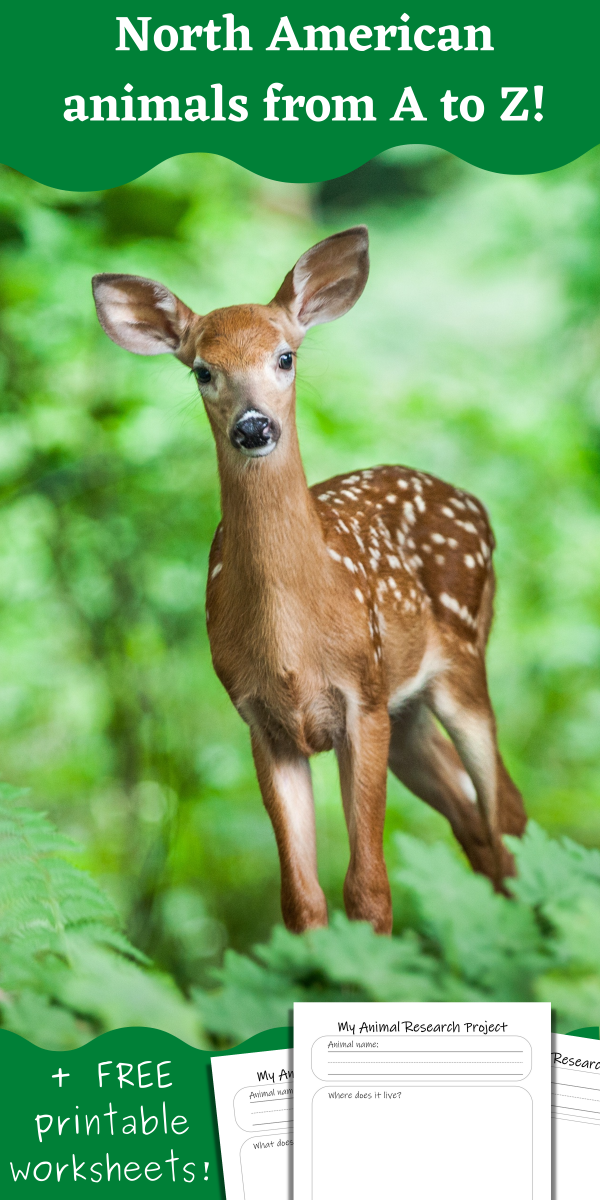
young deer

There’s a whole alphabet of animals out there in nature for you to discover!

For a recent project, I illustrated North American Animals from A to Z (you can find those illustrations here)! During this project, I reviewed many incredible critters that I studied while earning my degree in Wildlife Biology! I wanted to share more about these cool creatures with you! You may already know and love some of these animals, many of which have wide ranges in North America (and beyond) – like ants, crows, and frogs! Others are small, rare, or hard to spot – and might even be creatures you’ve never seen before! Which ones can you spot in your local habitats?

In this post, you’ll find a little more information about the featured alphabet animals (which you can also learn more about from my Alphabet in Nature Unit)! You’ll also find links to outside websites with more information about each animal! There’s also a free PDF worksheet for younger children or students to do a research project on their favorite animal from this unit!

I created this Alphabet Animals post to go along with one of my latest educational resource packs, the Alphabet in Nature Unit! It comes with flashcards, a poster, and indoor and outdoor activities for practicing the alphabet with an nature-themed twist! You can also find it in my Nature Preschool Bundle! If you haven’t already, be sure to check it out ๐Ÿ™‚

How to use this page:

  1. Use the links on this page to learn about the alphabet animals of North America.
  2. Download and print these free animal research project worksheets for your students.
  3. Students can pick their favorite animal from the Alphabet in Nature Unit to learn more about!
  4. Help your student research their favorite animal using the online resources linked below or other resources, such as books from your local library.
  5. Students may use the worksheets to draw and write about what they learned!

Ant

Photo by Egor Kamelev on Pexels.com

Ants are common insects! They can be spotted on every continent except Antarctica. They live in colonies where there are workers and a queen! There are many species of ants. These are some of the different types of ants:

  • Leafcutter Ants
  • Fire Ants
  • Carpenter Ants

Check out these websites to learn more about ants!

Bat

Photo by Surendra Singh Shekhawat on Pexels.com

Bats are unusual because they’re a mammal but they can fly! Depending on the species of bat, they will eat a variety of foods, such as insects, flower nectar, and fruit! Some common North American bats include:

  • Little brown bats
  • Mexican Free-tailed bats
  • Fruit bats
  • Long-nosed bats

Check out these websites to learn more about bats!

Crow

Photo by Pixabay on Pexels.com

Crows are incredibly intelligent birds found world wide. They’ve been observed using tools, and can recognize human faces! Check out these web resources about crows:

Duck

Photo by Billel Moula on Pexels.com

Ducks are waterfowl. There are many types of ducks in North America including dabbling ducks and diving ducks. Some common North American ducks are:

  • Mallard
  • Wood ducks
  • Ring-neck ducks
  • Teals
  • Wigeons
  • Mexican Duck

Check out these websites to learn more about ducks!

Earthworm

Earthworm photographed in the backyard of Valerie from Wild Earth Lab, in Northern Colorado!

Earthworms are annelids, the phylum of segmented and ring worms. Earthworms are beloved for their importance to agriculture. They are decomposers that move nutrients through soil by consuming and digesting waste and decaying matter. They also create large pores as they move through soil, which provide paths for water, gases, and plant roots to move through soil. You can see earthworms come to the surface of the soil to breathe during rainstorms in many habitats. Learn more about earthworms using these websites:

Fox

Photo by Steffi Wacker on Pexels.com

Foxes are omnivorous mammals. Grey foxes and kit foxes are found in the southern parts of North America. Red foxes are common in northern parts of North America. Arctic foxes are found near the arctic circle, in Canada and Alaska. Visit these web resources to learn more about foxes!

Goose

Photo by Ellie Burgin on Pexels.com

There are many species of geese world wide. Canada geese are commonly found in North America from northern Canada around the arctic circle to the the northern parts of Mexico. Many are migratory, spending their winters in warmer southern climates and their summers in far-north breeding grounds. Learn about Canada geese on these websites!

Hawk

A red-tailed hawk in the care of a raptor center. Photo by Valerie (Wild Earth Lab) in Northern Colorado

Hawks are raptors, or “birds of prey”. They are carnivores and top predators found across a wide range of habitats. Here are some of the different types of hawks found in North America:

  • Red-tailed Hawk
  • Northern Goshawk
  • Cooper’s Hawk
  • Ferguson Hawk
  • Sharp-shinned Hawk

Check out these websites to learn more about hawks!

Inchworm

Caterpillars devour a green leaf
Inchworms devour leaves in West Virginia, photo by Valerie from Wild Earth Lab.

Inchworms or cankerworms are the larval stage of the geometer moth. They are known and named for the way they move, inching forward with the front of their body then their rear. Inchworms undergo complete metamorphosis, in which they have a pupa stage before becoming adult moths. Learn more about inchworms and geometer moths here:

Jellyfish

Photo by Oday Hazeem on Pexels.com

There are many species of jellyfish found in multiple oceans and seas. There is also one unique species of freshwater jellyfish in North America. Jellyfish are not really fish at all! They are invertebrates in the phylum Cnidaria. There are different types of jellyfish found off the coast of North America:

  • Moon Jelly
  • Lion’s Mane Jelly
  • Bay Nettle
  • Portuguese Man-of-War

Check out these websites to learn more about jellyfish!

Kingfisher

Photo by Frank Cone on Pexels.com

Kingfishers are small birds that can be spotted near estuaries, wetlands, lakes, and other bodies of water. There are a few species of kingfishers found in North America, including:

  • Belted Kingfisher
  • Great Kiskadee
  • Green Kingfisher
  • Ringed Kingfisher

Check out these websites to learn more about bats!

Lady Beetle

Photo by Skyler Ewing on Pexels.com

Lady beetles, also known as ladybugs, are not really bugs! Bugs are a specific type of insects that belong to the order Hemiptera, like box elder bugs and leaf hoppers. Lady beetles belong to the beetle order of insects, Coleoptera. Amusingly, while ladybugs are not bugs themselves, they do eat bugs – one of their favorite foods is aphids, a member of the order Hemiptera (true bugs). Learn more about lady beetles using the links below:

Minnow

A sketch of a fathead minnow by Valerie from Wild Earth Lab

Minnow is a general term for many different species of small freshwater fish including chubs, shiners, and daces. Minnows provide an important food source for larger fish species higher up on the food chain and for waterfowl. Check out these websites to learn more about minnows!

Newt

Eastern spotted newt photographed by Valerie (Wild Earth Lab) in the eastern United States along the Appalachian Trail.

Newts are amphibians and a type of salamander. It’s never a good idea to pick up a newt because they have very delicate and absorbent skin – chemicals and oils on our hands can be very harmful to them! They come in many different colors – from green, to brown, to bright orange. Learn about newts on these websites:

Otter

Photo by Flickr on Pexels.com

Otters are mammals that love the water! River otters live in freshwater, and sea otters live along coasts. Learn more about otters on these websites:

Preying Mantis

Preying mantis photo in Northern Colorado by Valerie (Wild Earth Lab)

Preying mantises are insects that are voracious predators of other insects! Gardeners love them because they help keep away pesky crop-eating insects such as grasshoppers. Learn more about preying mantises on these websites:

Quail

Photo by Brett Sayles on Pexels.com

Quail are small game birds found in a variety of habitats. There are several different types of quail, such as:

  • California quail
  • Scaled quail
  • Montezuma quail
  • Bobwhite quail

Learn more about quail:

Rabbit

Photo by Pixabay on Pexels.com

Rabbits are common herbivorous mammals in the lagomorph order, which also includes hares and pika. They are sometimes mistaken as rodents. Humans have domesticated rabbits and they are beloved pets. Learn more about wild rabbits with these internet resources:

Snail

Photo by Laura Reed on Pexels.com

Snails are common shelled gastropods found world wide! They live on land and in water. Check out these websites about snails:

Turtle

A box turtle hiding in its shell by Valerie (Wild Earth Lab), along the Appalachian Trail in the eastern United States.

Turtles are common shelled reptiles found world wide! They are found in many types of habitats, including ponds, salt water, islands, and even the desert! There are many species of turtles. Some common North American turtles include:

  • box turtles
  • sea turtles
  • snapping turtles

Check out these websites to learn more about turtles!

Urchin

Photo by Ish Sookun on Pexels.com

Sea urchins are found in salt water. If you live near a coast, you may spot them in tide pools! Although they might not seem like it, sea urchins are in fact animals, belonging to the phylum Echinodermata. Learn about sea urchins here:

Vole

Photo by DSD on Pexels.com

Voles are rodents, like mice and rats. They are prey for a variety of predators, such as hawks, owls, and foxes. Check out these websites to learn more about voles!

Water Strider

Photo by Tanguy Sauvin on Pexels.com

Water striders are amazing insects that harness the power of surface tension to walk across water. They are common insects that can be seen at many lakes, ponds, wetlands, and even in the slow-flowing pools and eddies of streams and rivers. Learn more about water striders:

Xeme

A sketch of a xeme (sabrine’s gull) by Valerie at Wild Earth Lab

Xemes, also called Sabrine’s gulls, are a migratory gulls. In the summer, they are found in their summer breeding range near the arctic circle in northern Canada and Alaska. They may be seen passing through off the west coasts of Canada and the United States as they make the long journey to their winter range in the Pacific Ocean off the coast of South America. Check out these websites to learn more about xemes!

Yellow Jacket

Photo by Pixabay on Pexels.com

Yellow jackets are a common type of wasp. They are omnivores and feed on a variety of foods including other insects and flower nectar. They can be pollinators – animals which move pollen between flowers, transferring plants’ genetic material which allows for the production of seeds and new plants. Learn more about yellow jackets:

Zebra Swallowtail Butterfly

Photo by Erik Karits on Pexels.com

Zebra swallowtail butterflies are a butterfly species found in the southeastern part of the United States. They undergo complete metamorphosis like all butterflies and moths. Learn about zebra swallowtail butterflies here:

Are you interested in reading more posts like this? Subscribe or follow Wild Earth Lab using the links below!


Sharing options and discussion for this post:

Posted on — 6 Comments

Food Chains vs Food Webs: definitions, differences explained, and examples

art of a food web

Maybe you’ve studied a little ecology and come across the terms “food chain” and “food web.” Both help ecologists explain the ways that energy from food travels through an ecosystem. In this post, we will dive into the differences between food chains and food webs, and look at some examples of both!

Before we dive in:ย If youโ€™re an educator planning toย teach food webs, great activities are key to deepening understanding! I think you and your students will love my Food Webs Unit (plus youโ€™ll support my blog with your purchase! โค๏ธ)

Food Chains

In an ecosystem, organisms are connected through feeding relationships: basically, who eats whom. There are feeding relationships between plants and plant-eating animals and feeding relationships between prey and predators. A food chain is an ordered list of who eats whom in an ecosystem. It is just one of the many paths that allow energy to move through an ecosystem, from organism to organism.

Food chains will always start with a producer: a plant or microorganism that can make its food through photosynthesis, creating sugar and oxygen from water, carbon dioxide gas, and sunlight. The next organism on every food chain will be the primary consumer – a plant-eating animal, also known as an herbivore. Following the primary consumers are one or more additional consumers, called the secondary (2nd) consumer, tertiary (3rd) consumer, quaternary (4th) consumer, etc… Secondary and higher consumers will always be omnivores or carnivores. The final consumer on any food chain is also known as a top predator because it has no predators of its own.

An example of a food chain

Food Chain Diagrams:

We visually represent food chains with a list of organisms connected by arrows to show the movement of energy through food (see above). Food chains are also sometimes represented as pyramids (see below) because it takes many producers to feed each primary consumer, many primary consumers to feed each secondary consumer, and so on. This is why ecosystems have many plants but few top predators. Each layer on the pyramid represents a position in the food chain, called a trophic level.

A food chain pyramid diagram with labels
A pyramid food chain diagram reminds us how it takes many organisms in lower trophic levels to support just a few organisms in higher trophic levels.

Food chains vary in length. Some may be short, with as few as two trophic levels. Others have more trophic levels due to many different producers eating one another. Below, you will find a few examples of food chains.

Food Chain Examples:

Clover -> Rabbit -> Fox

Willow -> Elk -> Wolf

Leaf-> Grasshopper -> Songbird -> Owl

Flower nectar -> Butterfly -> Frog -> Heron

Phytoplankton -> Bivalve -> Walrus -> Orca

Algae -> Caddisfly larva -> Minnow -> Salmon-> Bear

Food Webs

A food chain is just one of the many paths that allow energy to flow through an ecosystem. However, ecosystems are more complicated than a single food chain: every ecosystem includes many overlapping and interconnected food chains. For example, several different herbivores might all graze on one large field of grass. One predator might eat several types of prey to get enough food. The result is a complex network of feeding relationships between organisms in an ecosystem, called a food web. Food webs map the many paths for the movement of energy between all the organisms in an ecosystem.

In addition to the producers and consumers, decomposers are an important part of any food web. Decomposers are ecosystem members who have an important role in recycling organic matter back into the soil. They consume waste and decaying plant and animal matter. Usually, decomposers are fungi, microorganisms, or invertebrate animals like worms. Thanks to decomposers, nutrients are returned to the soil to help plants grow.

The difference between food chains and food webs? In summary, food chains are a single path showing how energy moves from organism to organism through an ecosystem, while a food web is a more complex network that maps the multiple feeding relationships of each organism in an ecosystem.

Food Web Example:
An example diagram of a food web including decomposers, producers, consumers, primary, secondary consumers, and tertiary consumers!

Build Your Own Food Webs:

For a fun, hands-on way to teach students about food webs, try creating models of food webs in your classroom! Read my post about building your own food web models for step-by-step activity directions! Or, you can find all the printable materials, directions, and worksheets for this activity in my complete Food Webs Unit:

Free Food Web Learning Materials:

I’ve created a few free food web learning materials that you can download and print! My email newsletter subscribers can access and download my full collection of free worksheets, handouts, and diagrams, including these:

Download this Free Printable Food Web Poster!
Download some free wildlife research project worksheets! Click here for a list of reference websites for researching wildlife.

Access the free resources: my newsletter email subscribers can access my ENTIRE collection of free resources!

Support Wild Earth Lab with your purchase:

If you haven’t already, try out one of my ecology units!


Are you interested in reading more posts like this? Subscribe or follow Wild Earth Lab using the links below!


References and Further Reading

  1. EPA (n.d.). EPA EcoBox Tools by Exposure Pathways – Food Chains. Available: https://www.epa.gov/ecobox/epa-ecobox-tools-exposure-pathways-food-chains
  2. National Geographic (n.d.). Food Web. Available: https://www.nationalgeographic.org/encyclopedia/food-web/
  3. National Oceanic and Atmospheric Administration (2019). Aquatic Food Webs. Available: https://www.noaa.gov/education/resource-collections/marine-life/aquatic-food-webs

Sharing options and discussion for this post:

Posted on — 7 Comments

Aquatic Insects: identification, examples, and use as bioindicators

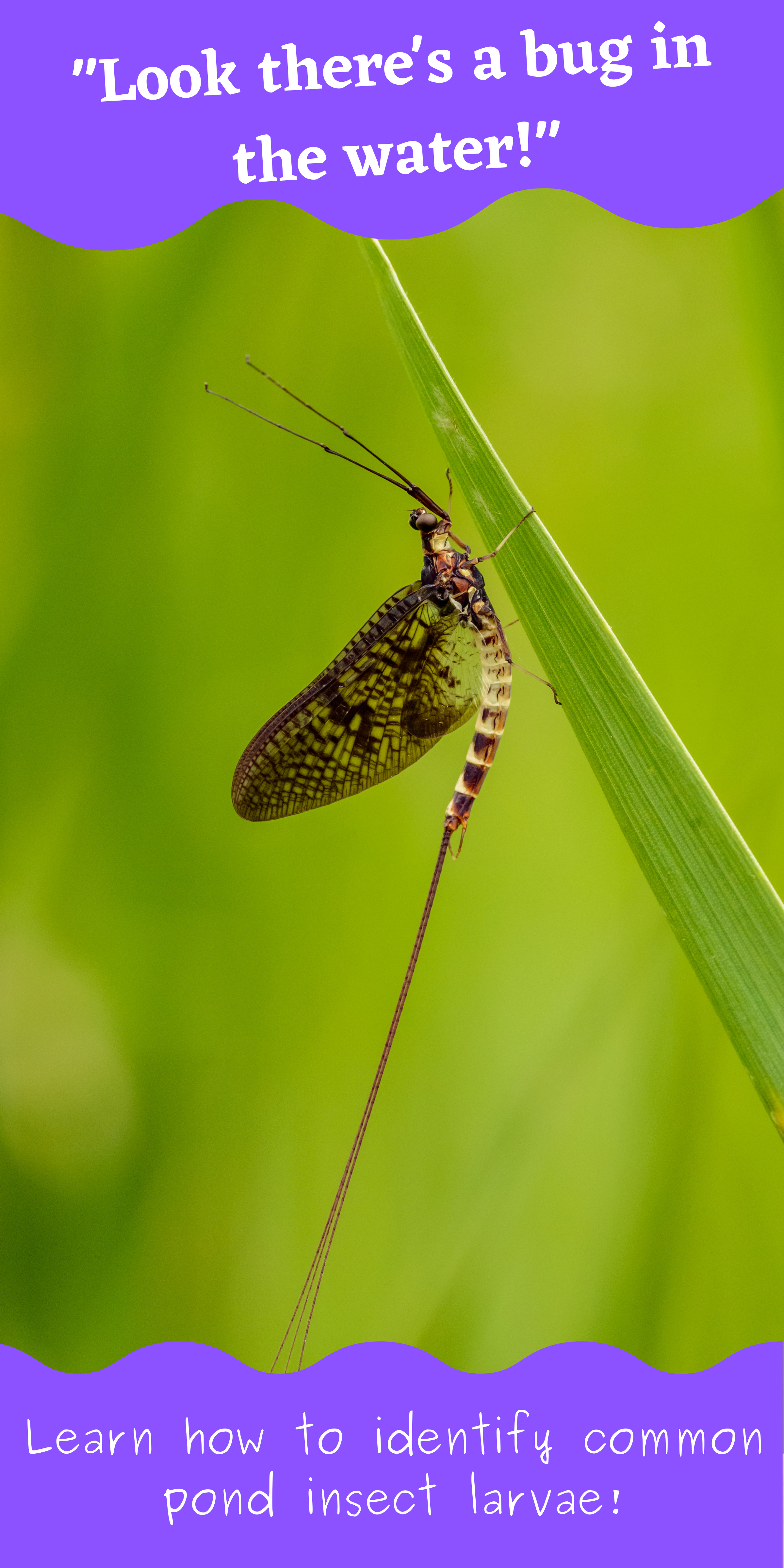
mayfly on grass

In this post, you’ll read about the different types of aquatic insects. You’ll learn how to identify the different types and see example images. This post also discusses aquatic insects’ important use as bioindicators in ecosystems.

A Note For Teachers: If youโ€™re an educator planning to teach aquatic insects, great learning resources are key to deepening understanding! I think you and your students will love my aquatic insects mini study, which you can also find within my huge Macroinvertebrates Unit (plus youโ€™ll support my blog with your purchase! โค๏ธ )

If you flip over a few rocks in the shallow water at any healthy pond or stream, youโ€™re sure to see a few aquatic insects! Many aquatic insects are the larvae or nymphs of well-known flying insects, like dragonflies and mayflies! They begin their lives in the water, then emerge from the surface of the pond or stream as flying adults.

These little creatures play an important role in pond and stream food webs. Aquatic insects help recycle nutrients from the pondโ€™s bottom back into the food web! The juvenile life stages, called either larvae or nymphs, eat algae and waste that settles to the bottom of the water. Many other animals eat aquatic insects. Fish feed on aquatic insect larvae and nymphs living along the pond or stream bed. Some fish will snatch the emerging adult insects from the waterโ€™s surface or leap from the water to eat flying adult insects. Birds and amphibians may eat the aquatic insect adults as well.

Aquatic insects can teach us a lot about ecosystems – in other words, they are bioindicators. Some aquatic insects are very sensitive to water pollution. An unhealthy pond or stream ecosystem cannot support a large and diverse population of aquatic insects. Healthy ecosystems should have lots of different aquatic insect species. Scientists use aquatic insects to check in on pond and stream ecosystem health. They will use nets to scoop up samples of aquatic insects from the water. Then, back in a lab, they use microscopes to figure out the different species of aquatic insects that were living there. If you are a teacher or parent, you can try catching aquatic insects with your students/kids too, by following these directions. Usually, more different species means a healthier ecosystem. Here are some examples of aquatic insects and a few tips on how to identify them!

Mayflies

Order: Ephemeroptera

Nymph Identification: Aquatic mayfly nymphs have bodies with distinct head, thorax, and abdomen. They have three pairs of segmented legs, two antennae on their heads, and either two or three long strand-like tails on the ends of their abdomens. There will appear to be two miniature wings on the thorax – these are non-functional “wing pads”. Mayflies and stoneflies look quite similar. Mayflies, however, have claws on the end of each of their legs with a single hook, while stoneflies have claws with two hooks. Of course, you might need a magnifying glass or even a microscope to count the number of hooks on these insects’ tiny claws!

About: Mayflies thrive in standing (lentic) and flowing (lotic) water habitats. As nymphs, they live underneath rocks along the bottoms of streams, ponds, and lakes. There are many mayfly species, which feed in different ways: gathering debris, scraping algae from rocks, and even hunting smaller aquatic creatures. After incomplete metamorphosis (no pupa stage), the winged adults emerge from the waterโ€™s surface. They molt their exoskeletons once during adulthood. Adulthood lasts, at most, a few days because adults donโ€™t have mouths and cannot feed.

A mayfly nymph, Drunella grandis, or western green drake.

Stoneflies

Order: Plecoptera

Nymph Identification: Aquatic stonefly nymphs look very similar to mayflies (see above), with distinct heads, thoraxes, and abdomens. Like mayflies, they also have wing pads, three pairs of segmented legs, and two antennae. However, stoneflies will always have just two long, thin tails, and they always have two hooks on the end of each claw.

About: Stonefly nymphs live in clean, flowing (lotic) water like streams and rivers. Nymphs live along the streambeds gathering debris and plant matter as food, or in some cases eating smaller aquatic insects. After their incomplete metamorphosis (no pupa stage), the winged adult stoneflies emerge from the water. Most species reach adulthood and emerge between late winter and early summer.

A stonefly nymph, Pteronarcys californica, or giant salmonfly

Caddisflies

Order: Trichoptera

Larvae Identification: Many aquatic caddisfly larvae are easily recognizable by their distinct cases. These larvae construct tiny cases out of little pieces of plant matter or rock, which they live inside of, with only their heads, thoraxes, and legs exposed. Hidden within the case, the abdomen of the caddisfly is relatively soft and ends in two anal claws instead of tails. There are some species of “free-living” caddisfly larvae that do not make cases. In all caddisfly larvae, the classic head, thorax, and abdomen body sections can seem less easily recognizable compared to mayflies and stoneflies. Caddisflies may have a more maggot-like appearance, especially the free-living caseless ones.

About: Caddisflies live in flowing (lotic) water and sometimes in standing (lentic)water. Caddisfly larvae produce silk. The larvae will use the silk to fasten bits of plant matter or sand together into a case (looks like a shell). Some larvae donโ€™t make shells and instead use silk to tether themselves to streambeds or build tiny nets to catch prey (like a spiderโ€™s web). Before adulthood, caddisflies transition through a pupa stage, during a process called complete metamorphosis. Many caddisfly pupae seal themselves in their cases for safety during this stage. The winged adults emerge from the water.

A caddisfly larva in the family Brachyceridae

Dragonflies and Damselflies

Order: Odonata

Nymph Identification: One of the best characteristics for identifying dragonfly and damselfly nymphs is their specialized labium or lower jaw. The labium is designed to extend in front of the body and retract as it grasps prey. Like all insects, members of the family Odonata have a head, thorax, abdomen, and three pairs of segmented legs. You may also notice their wing pads. You can tell damselflies and dragonflies apart by the endings of their abdomens. Damselflies have three long but flat tails on the ends of their abdomens, while dragonflies have no tails, but instead short triangular features, creating a pyramid-like shape on the rear tip of their abdomen.

About: The order Odonata includes dragonflies and damselflies. Nymphs are often found in ponds. Dragonflies are predators of other insects during both the nymph and adult life stages. Dragonflies have a modified labium (lower jaw) that rapidly extends and pulls in prey. After incomplete metamorphosis (no pupa phase), the winged dragonfly adults emerge from the water. Female dragonflies have specialized ovipositors on the tips of their tails, an organ that allows them to dip their tails below the surface of the water to safely lay their eggs in aquatic plants.

A dragonfly nymph, Ophiogomphus severus, or pale snaketail

Fly larvae

Order: Diptera

There are numerous species of aquatic fly larvae. Horseflies, mosquitoes, black flies, and midges are just a few examples. As larvae, flies have an elongated body that looks almost like a segmented worm. They have three pairs of legs, which may be small and hard to see. Aquatic flies undergo complete metamorphosis (i.e., with the pupa stage) before emerging from the water as flying adults.

Water beetles

Order: Coleoptera

There are several families of beetles that live in water during their larval, pupal, and adult stages. Beetle larvae may look somewhat similar to fly larvae, with long and segmented bodies. Adult water beetles will have a rounded, hardened forewing that covers most of their bodies.

Water striders and water scorpions

Order: Hemiptera

Water striders and water scorpions are two common aquatic insects in the order Hemiptera (“true bugs“). Water striders have elongated bodies and thin, widely spread-out legs, which allow them to stay on the surface of the water. Similarly, water scorpions have elongated and sometimes flat bodies. Water scorpions use their front pair of legs to capture prey; the front pair of legs is noticeably bulkier than the other legs.

Scientist sits on the shore of a lake while sorting through a pan containing a lake benthic sample, looking for aquatic insects.
Looking through a lake sample for aquatic insects.

Study Aquatic Insects & Ecology with Wild Earth Lab

Are you interested in teaching your students about aquatic insects? Check out my complete aquatic macroinvertebrates unit:


Are you interested in reading more posts about animals and insects you can spot in your local area? Subscribe or follow Wild Earth Lab using the links below!


References and Further Reading

  1. Merritt, R. W., Cummins, K. W., & Berg, M. B. (2008). Aquatic insects of North America (4th edition). Kendall Hunt, Dubuque.
  2. Neuswanger, J. (n.d.). Mayfly species Drunella grandis (Western Green Drake). Troutnut.com. Retrieved from: http://www.troutnut.com/hatch/446/Mayfly-Drunella-grandis-Western-Green-Drake
  3. Ward, J. V., Kondratieff, B. C., & Zuellig, R. E. (2002). Mountain stream insects of Colorado (2nd edition). University Press of Colorado.

Sharing options and discussion for this post:

Posted on — Leave a comment

An Invitation

A banner of a student using forceps to collect insect samples from a tray of pond material, overlaid with text: "unique learning resources to spark curiosity about the natural world" and "visit Wildearthlab.com"

Welcome fellow nature lovers and outdoor adventurers. Welcome backyard naturalists, kitchen table scientists, life-long learners. Welcome fellow wonderers and wanderers. I’m glad to see you here.

My name is Valerie and I’m a scientist, artist, and avid outdoors woman currently in Colorado, USA. My curiosity about the natural world started at a young age, exploring the prairies and woods of Wisconsin where I grew up. This curiosity blossomed into a love of backpacking and hiking as a teenager, which inspired me to embark on what I saw as the ultimate outdoor adventure – a thru-hike of the 2,180-mile Appalachian Trail. This journey took me to places I had never been, where I experienced things I had only dreamt of: I saw my first-ever black bear, as well as moose, baby deer, copperhead snakes, songbirds, foxes, owls, turtles, and red-spotted newts. I marveled at wildflowers that grew above tree line in the White Mountains of New Hampshire. I witnessed seemingly tropical rhododendron plants comfortably survive two feet of snow in the Great Smoky Mountains. I forded rivers where no bridges had been built, bathed in lakes that had never seen a motorboat. I satiated my hiker hunger with wild blueberries.

I also saw many things I hadn’t expected to see, such as when the trail crossed through a superfund site in Pennsylvania. The area’s history of zinc smelting noticeably impacted the landscape, which abruptly changed from dense forest to barren hillslopes, eerily devoid of birdsong and inhabited by only a scattering of dying trees, invasive grasses, and more deer ticks than I care to remember. I saw firsthand the immense efforts of trail crews to remove litter at overrun shelters and privies. I experienced a mass emergence of invasive caterpillars along a section of trail in West Virginia. I encountered wild animals that were so desensitized by repeated human interaction and feeding that they approached hikers without fear. I witnessed restoration efforts to prevent the encroachment of lower-elevation species onto the mystical bald mountaintops of the southern Appalachians. I learned that the “100-mile wilderness” in Maine, known for being one of the most remote and wild areas on the east coast, is also the site of several logging operations, providing the necessary resource for our wood and paper products. Through this experience I learned there was a lot I didn’t know about our natural world, the resources we extract from it, and the ways that we impact it.

In part, my experiences along the trail inspired me to pursue a degree in Fish, Wildlife, and Conservation Biology. I felt motivated to better understand the natural world and our relationships with it. Through the eyes of a scientist, I learned. I learned about the big, seemingly-unstoppable cycles of nature – of water, carbon, tides, and seasons – so powerful and yet delicately balanced, to allow for the diversity of life on this planet. And I learned about the small, unlikely relationships existing between pairs of species – between flower and pollinator, bird and fruit-bearing tree, plant and mycorrhizal fungus – allowing both to thrive. I learned about the unseen connections of all beings within an ecosystem, and about how we humans are connected to this world too, even when our lives make it difficult to see the places we are attached.

In the past few years, I have worked as a scientist in both the field and in the laboratory. I’ve measured the flows of headwater streams, counted new seedlings in beetle kill forests, evaluated the health of insect communities in a national park, and studied soils following forest fires and chemical spills. As a scientist, I’ve had the opportunity to intimately understand our relationship as humans with nature: what we are doing right, what we are doing wrong, and how we can do better.

Throughout my education and career, I have wondered how things would be different if education about nature and our relationship with Earth started earlier. My childhood education barely scratched the surface of ecosystem science, and it wasn’t until college that I was introduced to sustainability and conservation. What could our world be like if we all started out with a better understanding of this Earth and all its wild, remarkable, intricate beauty? How could things change if we all carried with us an understanding of the things we can do – big and small – to improve our relationship with Earth? I believe one of the most natural things we can do as humans is to wonder at nature. It’s never too early – or too late – to start learning about the natural world, the diversity of life on this planet, and what we can do as individuals to help protect it.

My goal in creating Wild Earth Lab is to create resources for you, your family, and your students to learn about the Earth and our relationship with it. Through combining my passions for nature, science, and art, I hope to use this space to create unique and beautiful educational resources and engaging, informative articles covering a range of topics related to science, sustainability, and the natural world.

Are you still with me? Perhaps this sounds like something you’re interested in too. I hope you will join me on this journey by subscribing to Wild Earth Lab, or by following Wild Earth Lab using the links below:


Sharing options and discussion for this post: