During their life cycles, monarch butterflies go through several distinct steps – known as metamorphosis. In this post, read all about the steps of monarch butterfly metamorphosis. I’ve also included links to download learning activities for teaching the monarch butterfly life cycle in your classroom.
Before we dive in: If you’re an educator planning to teach butterfly or insect life cycles, great learning resources are key to deepening understanding! I think you and your students will love my monarch life cycle diagram, which you can also find within my complete Insects Unit (plus you’ll support my blog with your purchase! ❤️)
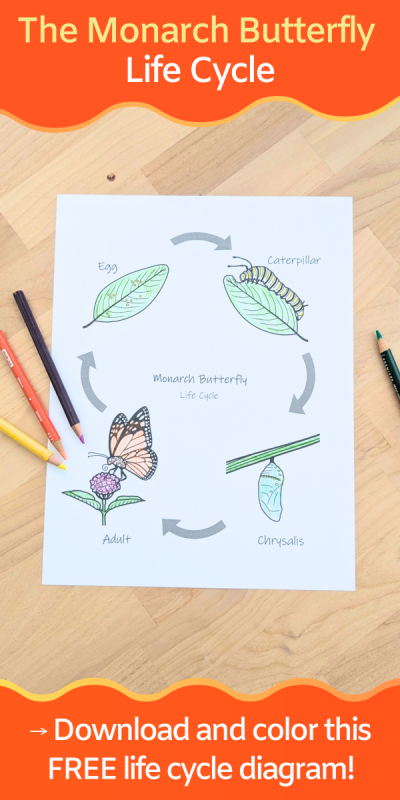
The adult female butterfly lays her tiny eggs on the underside of a leaf. After a few days, the eggs hatch and the butterfly larvae, called caterpillars, are born.
2: Caterpillar (Larva)
The caterpillar cannot fly because its wings have not formed yet. The caterpillar eats leaves and grows quickly. As it grows, it sheds and regrows its exoskeleton several times.
3: Chrysalis (Pupa)
The caterpillar hangs upside down and becomes a pupa, called a chrysalis. The chrysalis cannot move for a week or two. Even though it stays still, big changes are happening on the inside.
4: Butterfly (Adult)
The new adult butterfly breaks free from its chrysalis. It has wings now, but they are soft and look crumpled at first. Soon, the wings grow strong, and the butterfly is ready to fly. The adult butterfly sips nectar from flowers. It migrates south to its winter home in Mexico to stay warm.
Monarch Butterfly Life Cycle Activities:
Try these activities for teaching the life cycle of a monarch butterfly!
1.) Color your own monarch life cycle diagram (FREE resource)
You can find the monarch life cycle coloring worksheet on my free resources page. You can access this free resource and all the other free resources when you join my email newsletter.
2.) Monarch Life Cycle Diagram Printables (Paid resource)
There’s no need to scramble to put together the perfect insects lesson – I’ve already created it for you! This set includes all the printable materials you need for studying insects.
In this post, we’ll discuss the parts of an insect and an insect’s three main body segments. At the end, download my free insect anatomy coloring worksheet and find links to more insect anatomy activities and materials – perfect for reviewing the parts of an insect in your classroom.
A note for educators: If you’re an educator planning to teach insects, great learning resources are key to deepening understanding! I think you and your students will love my complete Insects Unit. It includes tons of insect anatomy activities and much, much more (plus you’ll support my blog with your purchase! ❤️)
1.The head is the front insect body segment. The head holds the eyes and antennae, which help the insect see, touch, and smell. Insects’ mouthparts are also on the head. Different insects have different-shaped mouthparts depending on what foods they eat.
Thorax
1.The thorax is the middle body segment. The legs are attached to the thorax. If the insect has wings, the wings are also attached to the thorax.
Abdomen
1.The abdomen is the rear insect body segment. Many of an insect’s organs are inside the abdomen.
The legs are attached to the insect’s thorax. Insects always have 6 legs. Animals with a different number of legs are not insects, like spiders with 8 legs.
Wings (sometimes)
The wings allow some insects to fly. Not all insects have wings. If an insect has wings, they are attached to the thorax. Insects may have two or four wings.
Insects have two antennae attached to their heads. The antennae help the insect sense the world around it. They are used for touching, smelling, and sometimes even tasting.
Specialized Mouthpart
Insects do not have teeth like you or me. Instead, they have a specialized mouthpart. This mouthpart is designed for the type of food each insect eats. It might be used for chewing, scraping, or even sipping. A great example is a proboscis, which is a long tube-like mouthpart of butterflies and moths. It lets butterflies and moths sip nectar from flowers the way you drink a milkshake through a straw.
I’ve Created this Insect Anatomy Worksheet (FREE)
You can find the insect anatomy coloring worksheet on my free resources page. You can access this free resource and all the other free resources when you join my email newsletter.
For more insect anatomy and insect lessons, try one of these…
You can find lots more insect teaching materials in the Wild Earth Lab shop. For the most complete and in-depth set of materials, I recommend my Insects Unit. Otherwise, find a la carte insect lessons below…
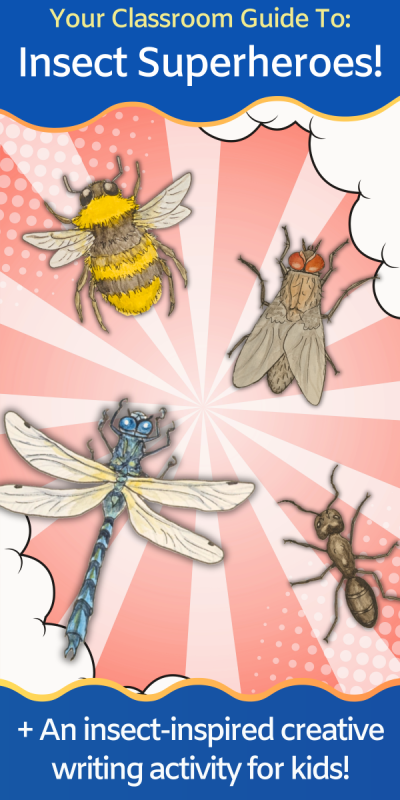
In this post, you’ll read about 9 amazing and real superpowers of insects that you might not have known about. Plus, scroll to the bottom for a classroom writing prompt inspired by insects’ incredible abilities.
A note for educators: If you’re an educator planning to teach insects, great learning resources are key to deepening understanding! I think you and your students will love my complete Insects Unit (plus you’ll support my blog with your purchase! ❤️)
Insects may be small, but they make up for it with incredible superpowers. Just look at what these cool critters can do—you’ll see that insects are like tiny superheroes living all around us!
1. Super Strength
An ant can carry 50x its own weight. A dung beetle can drag over 1,000x its own weight!
Leaf cutter ants. Photo by Kirsten C. Staring on Pexels.com
2. Super Vision
Some insects can see types of light that humans cannot see. These include ultraviolet and infrared light, which are invisible to our eyes. Butterflies and bees can see ultraviolet light, while mosquitoes can see infrared light.
Mosquitoes’ infrared-sensitive vision helps them detect body heat and find someone to bite! Photo by Anuj on Pexels.com
3. Super Tasters
Houseflies and butterflies can taste with the bottoms of their feet. Housefly feet are even more sensitive to sugar than the taste buds on your tongue!
4. Super Builders
Some types of termites build giant homes called mounds that can be twice as tall as an adult man. They are built to last too – some termite mounds are about 4,000 years old and are still in use. That’s nearly as old as the Great Pyramids of Egypt!
Through teamwork, tiny termites build giant homes.
5. Super Jumpers
A grasshopper can jump up to 20x its own body length!
6. Super Fliers
Every year, monarch butterflies fly up to 3,000 miles from their summer homes in the United States to their winter homes in Mexico. This long, yearly trip is called a migration.
This monarch has a long migration ahead of it. Photo by Pixabay on Pexels.com
7. Super Pollinators
Bees help pollinate 80% of the flowering plants on Earth! About one third of all our food comes from plants pollinated by bees – including almonds, squash, and apples!
8. Space Explorers
Fruit flies were the first animals to be sent into space!
Dragonflies have been on Earth for about 300 million years. In contrast, humans have only been around for about 300 thousand years. That means dragonflies have been around 1,000x longer than humans!
Classroom Writing Activity
After you read about the superpowers of insects, try your hand at some insect-inspired creative writing:
Writing Prompt: Write a story about a superhero insect. What insect-inspired superpower does your hero have? How do they use it? Who or what do they help?
Find this activity and more in my complete Insects Unit
There’s no need to scramble to put together the perfect insects lesson – I’ve already created it for you! This set includes all the printable materials you need for studying insects.
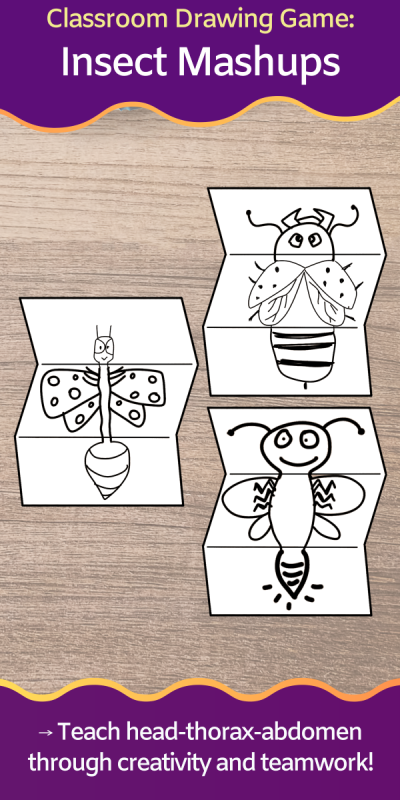
Insect Mashups is similar to the activity “Three Part Monster”. This is a playful insect drawing activity that reviews the three insect body segments (head, thorax, and abdomen) through drawing and teamwork.
Before we dive in: If you’re an educator planning to use this game to teach head-thorax-abdomen, I’ve got something you will love. Printable directions for this activity are included in my Insects Unit– a complete set of activities and printables for teaching insects (plus you’ll support my blog with your purchase! ❤️)
This is a simple activity that can be done with minimal supplies. All you need is:
Paper
Drawing supplies
Creativity!
Directions
Insect mashups drawing activity
Here’s how to play Insect Mashups:
Students will play this game in groups of three.
Before starting, instructors should introduce insect anatomy, emphasizing the three main body segments: head, thorax, and abdomen.
Fold a paper to divide it into 3 equal sections.
On the top section, the first student draws an insect’s head. Remember to include the antennae, mouthpart, and eyes!
The first student will fold the top section back, so that the head is hidden.
Tip: Leave the bottom of the neck visible below the crease, so that the next student knows where to start drawing the thorax.
Without looking at the head, the second student draws an insect’s thorax. Remember, the six legs and wings (if any) attach to the thorax – so draw those here too!
The second student will fold the middle section back, so that the head and thorax are hidden.
Tip: Leave the bottom of the thorax visible below the crease, so that the next student knows where to start drawing the abdomen.
The third student draws an insect’s abdomen. Does it have a stinger? Stripes? Does the abdomen light up like a firefly? Be creative!
Each group should unfold their paper together to reveal the unique insect they created as a team.
Find this activity and more in my complete Insects Unit
There’s no need to scramble to put together the perfect insects lesson – I’ve already created it for you! This set includes all the printable materials you need for studying insects.
In this post, you will learn about pollination: the process of pollen transfer between flower parts. Then, you will read about the important role that insect pollinators like honeybees play in this process.
Before we dive in: If you’re an educator planning to teach pollinators and pollination, great learning resources are key to deepening understanding! You can download a printable handout version of this article with a vocab list and review activity! Or, you can also find these materials within my complete Insects Unit (plus you’ll support my blog with your purchase! ❤️)
You can download this article as a printable classroom handout – complete with a vocab list and reading comprehension activity
Pollination is the movement of pollen from one flower part to another. Specifically, pollen is moved from the stamen (male flower part) to the carpel (female flower part) of a flower. After a flower is pollinated, a fruit begins to grow. Fruits contain seeds, which will grow into new plants.
The stamen and carpel of a flower. Pollen moves from the stamen to the carpel during pollination.
What are Pollinators?
Plants cannot move. So how do they get their pollen from the stamen of one flower to the carpel of another? Many plants rely on animals called pollinators to help with pollination. Pollinators are animals that carry pollen from flower to flower. Many pollinators are insects, such as bees. However, birds, mammals, and other animals can also be pollinators!
Pollinators visit flowers to feed on flower nectar or pollen. When they do this, they help carry pollen from one plant to another. Pollen from the stamen attaches to the body of a pollinator. As the pollinator visits other flowers, some of the pollen rubs off onto their carpels.
When this butterfly drinks nectar, it brushes against flowers’ stamens and carpels. As it flies from flower to flower, it carries pollen from one plant to another.
Working Together: Pollinators and Plants
Plants and pollinators have a symbiotic relationship– a close relationship between two living things. Both the plant and pollinator benefit from this close relationship. The pollinator gets a tasty meal of nectar. The plant gets pollinated so it can make seeds and reproduce. It’s a win-win!
Pollinators are very important in their ecosystems because they help plants make fruits and reproduce. Many pollinated plants produce fruits, seeds, and leaves that other animals eat. Pollinators also help humans because they pollinate many of our food crops. For example, a tomato could not form from a tomato plant’s flower without being pollinated by a bee!
Download this Article As a Printable Handout
Includes a vocab list and review activity worksheets – ideal for classroom use!
You can download this article as a printable classroom handout – complete with a vocab list and reading comprehension activity
Or: Find these materials within my complete Insects Unit
There’s no need to scramble to put together the perfect insects lesson – I’ve already created it for you! This set includes all the printable materials you need for studying insects.
In this post, you will read about some of the key traits of insects. Then, you will learn how to tell insects apart from similar animals like spiders. Scroll to the bottom for a vocab list for this article.
Before we dive in: If you’re an educator planning to teach insects, great learning resources are key to deepening understanding! You can download a printable handout version of this article with reading comprehension activities and a vocab list! Or, you can also find these materials within my complete Insects Unit (plus you’ll support my blog with your purchase! ❤️)
You can download this article as a printable classroom handout – complete with a vocab list and reading comprehension activity
Insects are all around us! For every person on Earth, there are about 1.4 billion insects. There are many different kinds of insects, too. Scientists have discovered more than 1 million species, and they continue to find new ones. Insects live in all kinds of places. You can find ants building tunnels underground. You might spot a water strider walking across the surface of a pond. There is even a flightless midge that survives in frozen Antarctica.
The water strider, which uses surface tension to walk across the surface of water, is a great example of an insect that lives in a pond or other aquatic habitat. Photo by Tanguy Sauvin.
Traits of Insects
Want to know if an animal is an insect? All insects share a few important traits. Here’s what to look for:
Exoskeleton – insects have a hard outer shell called an exoskeleton. It protects their bodies and supports them, much like your bones support you.
Three main body segments – insects have three main body segments. The three body segments are the head, thorax, and abdomen. They can be different shapes and sizes, but every insect has all three.
Six legs – insects have six legs. Animals with a different number of legs, like spiders with eight, are not insects.
These are not an insect’s only traits. Insects also have two antennae on their heads. Antennae help insects touch, smell, and sometimes taste the world around them. Instead of teeth, insects have special mouthparts for eating. Many adult insects have wings for flying. Insects hatch from eggs, and most go through a special change called metamorphosis as they grow. This means they change from one body form to another, like a caterpillar turning into a butterfly.
Can you spot the three main body segments of these insects (head, thorax, and abdomen)? Count their legs. How many do they have?
Arthropods: Insects and their Cousins
You can tell if an animal is an insect by counting its legs and body segments and looking for an exoskeleton. However, many animals look a lot like insects but are not. Insects belong to a bigger group of animals called arthropods. All arthropods have exoskeletons, segmented bodies, and jointed legs.
Different arthropods have different numbers of legs and body segments. Insects are arthropods with 6 legs and 3 body segments. Arachnids, such as spiders, ticks, and scorpions, have 8 legs. Crustaceans, such as crabs and shrimp, usually have 10 legs. However, arachnids and crustaceans are not insects. You can think of these animals as insect cousins.
What are the differences between the insects and the non-insects? (Hint: count the legs and body segments!)
Download this Article As a Printable Handout
Includes a vocab list and reading comprehension worksheets – ideal for classroom use!
Or: Find these materials within my complete Insects Unit
There’s no need to scramble to put together the perfect insects lesson – I’ve already created it for you! This set includes all the printable materials you need for studying insects.
Abdomen – The back section of an insect’s body. It contains many of the insect’s organs.
Antennae – Two feelers on an insect’s head that help it touch, smell, and sometimes taste.
Arachnid – An arthropod with eight legs, such as a spider, tick, or scorpion.
Arthropod – An animal with an exoskeleton, a segmented body, and jointed legs. Insects, arachnids like spiders, and crustaceans like crabs are all arthropods.
Crustacean – An arthropod that usually has ten legs, such as a crab or shrimp.
Exoskeleton – A hard outer covering that protects and supports an animal’s body.
Head – The front body segment of an insect. It holds the eyes, mouthparts, and antennae.
Metamorphosis – The process of changing from one body form to another as an animal grows, like a caterpillar turning into a butterfly.
Species – A group of living things that are alike and can have young together.
Thorax – The middle body segment of an insect. It is where the legs and wings are attached.
Explore more lessons from Wild Earth Lab:
If you enjoyed this post, I know you will love trying my other printable science and nature units in your classroom too!
From tadpoles turning into frogs to caterpillars transforming into butterflies, metamorphosis is one of nature’s most incredible processes. Understanding metamorphosis helps students see how organisms grow, adapt, and survive in their environments. Whether you’re exploring amphibians, insects, or life cycles in general, this fascinating transformation is a perfect way to bring nature and science to life in your classroom.
📚A Note for Teachers 🍎: If you’re an educator planning to teach metamorphosis and animal life cycles in your classroom, great learning resources are key to deepening understanding! You can find materials for teaching metamorphosis in my Amphibians Unit and Insects Unit, as well as my Aquatic Macroinvertebrates Unit – plus tons of other materials and activities for these fun topics! (And you’ll support this blog with your purchase! ❤️)
Metamorphosis is a process where an animal’s body changes form at different stages of its life cycle. Many insects and amphibians go through metamorphosis, developing in two or more distinct stages, like a legless tadpole becoming a frog or a wingless caterpillar transforming into a butterfly.
In contrast, reptiles, birds, and mammals (including humans) do not undergo metamorphosis. Consider human babies—as we grow, we get bigger and taller, but our basic body shape stays the same. We don’t develop wings, extra limbs, or entirely new body parts like a butterfly or frog.
Amphibians and Metamorphosis
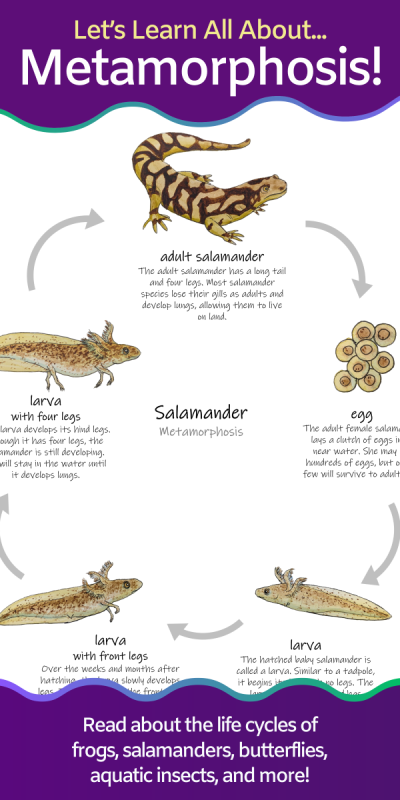
The word “amphibian” means “double life”, referring to how most amphibians begin their lives in water before transitioning to land. This transformation happens through metamorphosis. Take frogs, for example – tadpoles swim using their tails and breathe underwater through gills. During metamorphosis, they grow limbs and lungs, allowing them to live on land as adults. Just like tadpoles transform into frogs, most salamanders start as aquatic, legless larvae before developing their adult forms.
Salamander Life Cycle Diagram
Most amphibians go through metamorphosis, but there are a few exceptions. Some species of caecilians, a group of legless amphibians, develop differently and don’t go through metamorphosis the way frogs and salamanders do.
Insects and Metamorphosis
Amphibians are not the only animals that go through metamorphosis. Many (though not all) insects go through metamorphosis too. One of the most classic examples is a butterfly. A butterfly starts life as a wingless larva called a caterpillar, a life stage in which the main goal is to eat and grow! After some time, the caterpillar stops munching and forms a chrysalis. During this stage, called the pupa stage, it doesn’t eat, but continues to develop. Finally, the winged butterfly emerges from its chrysalis – now it is an adult.
However, butterflies are far from the only insect to go through metamorphosis. Caddisflies, ladybugs, beetles, and ants are a few other examples of insects whose lives take place in three stages: larva, pupa, and adult. Insects like these with three distinct life stages go through what scientists call “complete metamorphosis“. In contrast, some other insects, like dragonflies and mayflies, go through “incomplete metamorphosis“. These insects only have two life stages: nymph and adult.
Why Metamorphosis?
Why change forms at all? Metamorphosis helps animals use different habitats and resources at each stage of life. For example, tadpoles live in aquatic habitats like ponds and eat plants, so they have gills, a small mouth, and a tail for swimming. But as they grow into adult frogs that hunt insects on land, they develop lungs, strong legs, and a wide mouth with a sticky tongue for catching prey.
Similarly, caddisflies, mayflies, dragonflies, and other aquatic insects begin their lives in water as larvae or nymphs. This allows them to feed on aquatic plant matter, detritus, or small organisms found in habitats at the bottoms of streams and ponds. As they go through metamorphosis, these insects emerge from the surface of the water as winged adults. After this, they use their wings to take advantage of a new habitat above the surface. For example, adult dragonflies are ferocious aerial predators of other insects. Contrastingly, adult mayflies do not eat at all, but simply use their short adult life stage to fly around and find a mate.
Finally, consider butterflies. Unlike frogs and aquatic insects, a butterfly lives on land for its whole life. However, butterflies use different food sources at different stages. For example, the monarch butterfly is in a close symbiotic relationship with the milkweed plant. As a caterpillar, the monarch eats the milkweed leaves. After metamorphosis, the adult butterfly eats a different part of the milkweed plant – the nectar of the milkweed flowers. As an added benefit, when the adult butterfly drinks flower nectar, it pollinates milkweed plants, which helps the plants reproduce. Thanks to the butterfly’s pollination services, a new generation of milkweed plants will grow, providing leaves for future caterpillars to eat!
A monarch butterfly caterpillar munches on milkweed.
Study Metamorphosis with Wild Earth Lab!
Whether you’re teaching your students about the metamorphosis of amphibians or insects, I’ve got the perfect learning resources for you! These sets include all the printable materials you need for studying amphibians and aquatic insects – including life cycle diagrams and much, much more!