Posted on — 1 Comment

The Saguaro Cactus Life Cycle: step-by-step guide with pictures!

A picture of the saguaro cactus life cycle with the text "saguaro cactus life cycle: a step-by-step guide"
text that says share this post

Some saguaro cacti live for 200 years or longer! Saguaro cacti grow very slowly. The speed of growth depends on many factors such as precipitation, temperature, and soil quality. Let’s explore the saguaro cactus life cycle in five steps! Notice that desert animals play a key role in two of these steps.

For Teachers and Parents:ย If youโ€™re an educator planning toย teach kids about cacti in your classroom or at home, great activities and visuals are key to deepening understanding! I think you and your students will love my complete Cactus Unit (plus youโ€™ll support my blog with your purchase! โค๏ธ)

1. Germination

Saguaro cactus seedling

A seed germinates. The two cotyledons open to form a tiny plant. Seeds that germinate in shady areas such as beneath palo verde trees are most likely to survive through the fragile young stages and reach maturity.

The seedling cactus grows through its first summer and develops more areoles and spines. At just a few millimeters in height, the seedling is so small that it can be difficult to spot.

2. Maturity

It may take ~35 years for a saguaro cactus to reach maturity and produce its first flowers.

The rate of growth depends on environmental conditions such as precipitation, temperature, soil quality, and the type of cactus. For saguaro cacti, growth happens very slowly over many years.

When a cactus reaches reproductive maturity, it can produce its own flowers. Time to reach maturity depends on the cactus species. For example, the saguaro cactus takes several decades to reach maturity.

3. Flowering & Pollination

The lesser long-nosed bat is a nighttime pollinator of the saguaro cactus

The cactus flowers bloom. Cactus flowers make tasty nectar to attract pollinators like bats, bees, and doves. Pollen is transferred between plants by the pollinators. This is a type of symbiotic relationship called mutualism because both the pollinator and the plant benefit. The pollinator gets a tasty meal of nectar, and the plant gets pollinated.

4. Fruiting

Saguaro fruits are a food source for many animals in the Sonoran desert. People sometimes eat the fruit too.

Once pollinated, the cactus fruit begins forming from the ovary of the flower. Cacti can produce huge amounts of fruit. For example, a single saguaro cactus may produce upwards of 100 fruits each year. Thatโ€™s a lot of fruit! The ripened fruit splits open, revealing sweet flesh and seeds.ย  This sends the signal to animals that the fruit is ready to eat!

5. Seed Dispersal

When an animal eats the saguaro fruit, it ingests some seeds. The seeds are then dispersed in the animal’s scat.

Desert animals like birds, coyotes, and tortoises eat cactus fruit and disperse seeds in their scat. This is another example of a mutualistic relationship between an animal and a cactus. The animal gets a meal of fruit, and the cactus gets its seeds dispersed. If the cactus is lucky, some of its seeds will be deposited in locations with good growing conditions. Over its lifespan, a single saguaro may produce millions of seeds. However, only a few of those seeds will germinate, grow, and reach maturity.

Classroom cactus materials:

Explore units from Wild Earth Lab:

If you enjoyed this post, I know you will love using my environmental science materials in your classroom!


Are you interested in reading more posts like this? Subscribe or follow Wild Earth Lab using the links below!


References and Further Reading

  1. Ceotto, E. (2009). Cultivation of Carnegiea gigantea from seeds: a journey in desert ecology. Desert Plants, 25(1), 10. Available: https://repository.arizona.edu/bitstream/handle/10150/556548/dp_25_01-010-015.pdf?sequence=1
  2. Dimmitt, M. (n.d.). Cactaceae (cactus family). Arizona-Sonora Desert Museum. Available: https://www.desertmuseum.org/books/nhsd_cactus_.php
  3. Helmy, Olga. 2021. Carnegiea gigantea, saguaro. In: Fire Effects Information System, (Online). U.S. Department of Agriculture, Forest Service, Rocky Mountain Research Station, Missoula Fire Sciences Laboratory (Producer). Available: www.fs.usda.gov/database/feis/plants/cactus/cargig/all.html
  4. National Park Service (n.d.). The Saguaro Cactus (Carnegiea gigantea). Organ Pipe Cactus National Monument. Available: https://www.nps.gov/orpi/learn/nature/saguaro-cactus.htm
  5. National Park Service (2017). How Saguaros Grow. Saguaro National Park. Available: https://www.nps.gov/sagu/learn/nature/how-saguaros-grow.htm
Sharing options and discussion for this post:

Posted on — 1 Comment

Types of Cacti: explore the diversity of cactus species – with pictures!

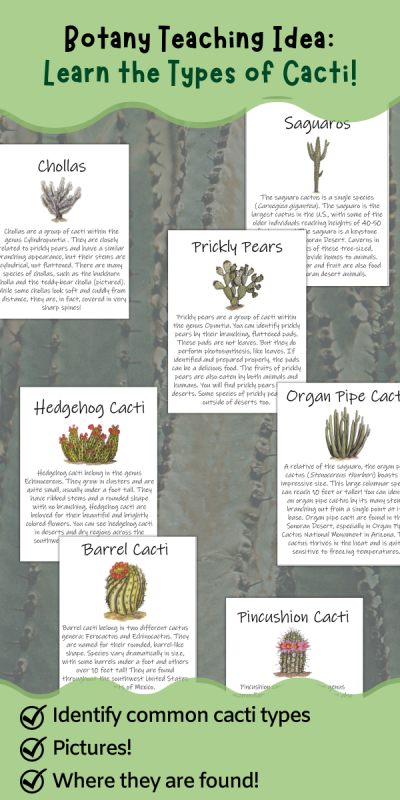
banner with the text "Botany teaching idea: learn the types of cacti"

There are many types of cacti, which are found in dry places and deserts. Cacti are succulent plants. Succulent plants are thick and fleshy for storing water. While all cacti are succulents, not all succulents are cacti. Cacti are unique because they have areoles โ€“ cushion-like bumps that cover the outside of a cactus. One or more sharp, pointy spines are attached to each areole. Spines are a type of modified leaf. Most cacti species have no true leaves. They do, however, produce flowers and fruit, which provide an important food source to desert animals.

A note for teachers and parents: Are you teaching your students or children about cacti? I think you will love my complete set of printable cactus learning materials. Plus, you’ll support this blog with your purchase! โค๏ธ

Cacti are a diverse group. There are more than one thousand different species of cacti. Some look like a single rounded shape (like a barrel cactus). Others have complex, branching arms or pads (like a prickly pear). They can be as tiny as a grape or grow taller than a house.

Without further ado, let’s explore some of the types and groups of cacti in the United States:

Saguaro Cactus

The saguaro is the largest cactus in the U.S., with some of the older individuals reaching heights of 40-50 feet or more! While it is probably the best-known cactus in the United States, the mighty saguaro actually has a fairly small range and is native to the Sonoran Desert only. The saguaro is actually a keystone species of the Sonoran Desert. Cavities in the large trunks of these tree-sized, columnar cacti provide homes to animals. Their flower nectar and fruit are also food for many Sonoran desert animals. The saguaro cactus is a single species (Carnegiea gigantea).

close up photo of prickly cactus plant
Photo by Nicole Ashley Rahayu Densmoor on Pexels.com

Organ Pipe Cactus

A relative of the saguaro, the organ pipe cactus (Stenocereusthurberi) boasts an impressive size. This large columnar species can reach 10 feet or taller! You can identify an organ pipe cactus by its many stems branching out from a single point at its base. Organ pipe cacti are found in the Sonoran Desert, especially in Organ Pipe Cactus National Monument in Arizona. This cactus thrives in the heat and is quite sensitive to freezing temperatures.

Prickly Pears

Prickly pears are a group of cacti within the genus Opuntia. You can identify prickly pears by their branching, flattened pads. These pads are not leaves. But they do perform photosynthesis, like leaves. If identified and prepared properly, the pads can be a delicious food. The fruits of prickly pears are also eaten by both animals and humans. You will find prickly pears in many deserts. Some species of prickly pears grow outside of deserts too.

selective focus photography of prickly pear cactus
Photo by mali maeder on Pexels.com

Chollas

Chollas are a group of cacti within the genus Cylindropuntia . They are closely related to prickly pears and have a similar branching appearance, but their stems are cylindrical, not flattened. There are many species of chollas, such as the buckhorn cholla and the teddy-bear cholla (pictured). While some chollas look soft and cuddly from a distance, they are, in fact, covered in very sharp spines!

Hedgehog Cacti

Hedgehog cacti belong in the genus Echinocereus. They grow in clusters and are quite small, usually under a foot tall. They have ribbed stems and a rounded shape with no branching. Hedgehog cacti are beloved for their beautiful and brightly colored flowers. You can see hedgehog cacti in deserts and dry regions across the southwest United States and Mexico.

Barrel Cacti

Barrel cacti belong in two different cactus genera: Ferocactus and Echinocactus. They are named for their rounded, barrel-like shape. Species vary dramatically in size, with some barrels under a foot and others over 10 feet tall! They are found throughout the southwest United States and parts of Mexico.

Pincushion Cacti

Pincushion cacti belong in the genus Mammillaria. Types of cacti in this genus are also sometimes called nipple cacti. Pincushion cacti are characterized by hooked spines and a very small size. Often, they are just a few inches tall. There are many species of pincushion cacti. You will find pincushions across Central America and Mexico. A handful of pincushion species have ranges extending into the southwest United States.

Study types of cacti with Wild Earth Lab!

Want to learn about cacti with your students or children? Look no further than my cactus unit study. It includes posters featuring my watercolor cactus artwork and all the worksheets, flashcards, and lessons you need!

Explore more units from Wild Earth Lab:

If you enjoyed this post, I know you will love using my environmental science materials in your classroom!


Are you interested in reading more posts like this? Subscribe or follow Wild Earth Lab using the links below!


References and Further Reading

  1. The American Southwest (n.d.). Cacti of West and Southwest USA. Available: https://www.americansouthwest.net/plants/cacti/index.html
  2. CactiGuide.com (n.d.). Notes for the Genus: Mammillaria. Available: https://cactiguide.com/cactus/?genus=Mammillaria
  3. DesertUSA (n.d.). Barrel Cactus. Available: https://www.desertusa.com/cactus/barrel-cactus.html
  4. Dimmitt, M. (n.d.). Cactaceae (cactus family). Arizona-Sonora Desert Museum. Available: https://www.desertmuseum.org/books/nhsd_cactus_.php
  5. Gauna, F. J. (n.d.). Prickly Pear (Opuntia basilaris P. Mill.). Plant of the Week. U.S. Forest Service. Available: https://www.fs.usda.gov/wildflowers/plant-of-the-week/opuntia_basilaris.shtml
  6. Gauna, F. J. (n.d.). Barrel Cactus (Ferocactus sp., Britt. & Rose). Plant of the Week. U.S. Forest Service. Available: https://www.fs.usda.gov/wildflowers/plant-of-the-week/ferocactus_sp.shtml
  7. National Park Service (2005). Ecology of the Saguaro: II. NPS Scientific Monograph No. 8. Chapter 5. Available: https://www.nps.gov/parkhistory/online_books/science/8/chap5.htm
  8. National Park Service (n.d.). The Organ Pipe Cactus (Stenocereus thurberi). Organ Pipe Cactus National Monument. Available: https://www.nps.gov/orpi/learn/nature/organ-pipe-cactus.htm
  9. North Carolina State University (n.d.). Echinocactus. Extension Gardener Plant Toolbox. Available: https://plants.ces.ncsu.edu/plants/echinocactus/
  10. Notes from the Road (2022). Types of Cactus in the Desert Southwest. Available: https://www.notesfromtheroad.com/desertsouthwest/cactus-species.html

Sharing options and discussion for this post:

Posted on — 4 Comments

Desert Adaptations: 8 strategies plants and animals use to survive in the desert!

banner with cacti and the text "life with less water... desert adaptations!"
text that says share this post

A desert is a place that is very dry. Deserts typically get only about 25 centimeters (10 inches) of precipitation or less each year. That’s not very much water! But life is still possible in these dry conditions, thanks to desert adaptations!

Desert plants and animals have adapted to survive in dry conditions over many, many generations. An adaptation is a trait or behavior that helps an organism survive in its environment. Adaptations evolve through a process called natural selection.

To understand natural selection, take the following example. Imagine that some individual plants in a plant species develop a mutation in their genes that causes their roots to grow longer and reach deeper into the soil. The deeper-rooted plants are better at getting water from deep underground during droughts. Consequently, the deep-rooted individuals survive through droughts, reproduce, and pass on their genes to the next generation of plantsโ€“including the gene responsible for the deeper roots. Repeat this over many generations, and you will see more and more of the deep-rooted version of the plant in the habitat. That’s natural selection at work!

Now, let’s take a look at 8 amazing strategies that plants and animals use to survive in the desert!

Before we dive in: If youโ€™re an educator planning to teach desert adaptations, great activities and visuals are key to deepening understanding! I think you and your students will love my Desert Ecology Unit and my Cacti Unit (plus youโ€™ll support my blog with your purchase! โค๏ธ)

1. Store water

close up shot of an african desert turtle
Desert tortoise. Photo by Rutpratheep Nilpechr on Pexels.com

A desert tortoise survives dry spells by storing extra water within its bladder. This can sustain it through times without rainfall and during periods of inactivity.

2. Escape the heat

close up photo of prickly cactus plant
An owl in a cavity nest within a saguaro cactus. Photo by Nicole Ashley Rahayu Densmoor on Pexels.com

Animals escape the desert sun inside a den or cavity. For example, elf owls will hide inside cavity nests in cacti during the heat of the day. Jackrabbits and prairie dogs find shade inside dens underground when it is hot out.

3. Get water from food

feral pigeon on stone in nature
A dove. Photo by Ellie Burgin on Pexels.com

Kangaroo rats are known for getting all the water they need through their food. They do not need to drink liquid water because the juices in the insects and plants they eat will sustain them. Kangaroo rats are not the only desert animals using this strategy. Some birds such as white-winged doves get water through food too.

4. Rest when it is hot

photo of a cougar near a log
A mountain lion resting during the day. Photo by Nicky Pe on Pexels.com

Crepuscular and nocturnal animals rest during the daytime when it is hottest. These animals hunt and forage in the evenings and at night to reduce the amount of energy they spend keeping their bodies cool. Examples of nocturnal animals include owls, bats, and kangaroo rats. Examples of crepuscular animals include mountain lions, deer, and jackrabbits.

5. Reduce water loss through thick skin

close up shot of a scorpion
Scorpions have thick exoskeletons. Photo by Annalise Tingler on Pexels.com

Both animals and plants try to avoid water loss in the desert. Animals such as scorpions have thick exoskeletons to avoid losing water. Many desert plants have thick, waxy skin or bark for this same purpose.

6. Reach deeper water

American Ginseng root, Panax quinquefolius

Many desert trees and plants have deep taproots to reach down to deep groundwater sources. A great example of this is a mesquite tree. Trees like mesquites have such deep taproots that they try to tap into the water table. Plants like this are known as phreatophytes.

7. Lose your leaves

Ocotillo without leaves. Photo taken by the author, near Tuscon, AZ.

Big leaves are great for performing lots of photosynthesis, but big leaves also lose lots of water through transpiration. And in the desert, that’s no good! Desert plants have developed ways to live with fewer (or no) leaves. The ocotillo plant only briefly grows leaves when conditions are moist. Palo verde trees just have tiny leaves, but make up for this by also doing photosynthesis through their green bark. Most cacti have done away with leaves altogether and perform photosynthesis through their green skin instead.

8. Defend your water

Desert plants must live on very little water. And to make things even harder, desert animals want to eat plants for both nutrients and water. Desert plants like cacti defend themselves from hungry, thirsty animals with sharp spines.

Nature Journaling Prompts

Desert Adaptations

close up of woman writing in a journal outdoors

Ask your students to reflect on the following questions in their nature journals:

  1. Humans use a lot more water than animals. How can you live life using less water?
  2. Humans grow non-native plants in many places, for food, livestock feed, and landscaping. What problems might arise from growing non-desert plants in a desert?

New to nature journaling? There are many wonderful options for guided nature journals and hand-made notebooks on Etsy. Here are a few popular options to help get you started with nature journaling:

Teaching Desert Ecology & Adaptations!

If you enjoyed this post, I know you will love my Desert Ecology Unit! Plus, your purchase in my shop supports Wild Earth Lab to create more environmental science content!

Explore more units from Wild Earth Lab

If you enjoyed this post, I know you will love using my environmental science materials in your classroom!


Are you interested in reading more posts like this? Subscribe or follow Wild Earth Lab using the links below!


References and Further Reading

  1. Arizona-Sonora Desert Museum (n.d.). Sonoran Desert Fact Sheets. Available: https://www.desertmuseum.org/kids/oz/long-fact-sheets/
  2. National Park Service (n.d.). Animals. Organ Pipe Cactus National Monument Arizona. Available: https://www.nps.gov/orpi/learn/nature/animals.htm
  3. Nevada Dept. of Wildlife (n.d.). Desert Kangaroo Rat. Available: https://www.ndow.org/species/desert-kangaroo-rat/
  4. National Park Service (n.d.). Animals. Saguaro National Park. Available: https://www.nps.gov/sagu/learn/nature/animals.htm
  5. San Diego Zoo Wildlife Alliance (n.d.). Desert. Available: https://animals.sandiegozoo.org/habitats/desert
  6. Texas Parks and Wildlife (n.d.). Black-tailed Jackrabbit (Lepus californicus). Available: https://tpwd.texas.gov/huntwild/wild/species/rabbit/
  7. U.S. Fish and Wildlife Service (n.d.). Desert Tortoise. Available: https://www.fws.gov/species/desert-tortoise-gopherus-agassizii

Sharing options and discussion for this post: