
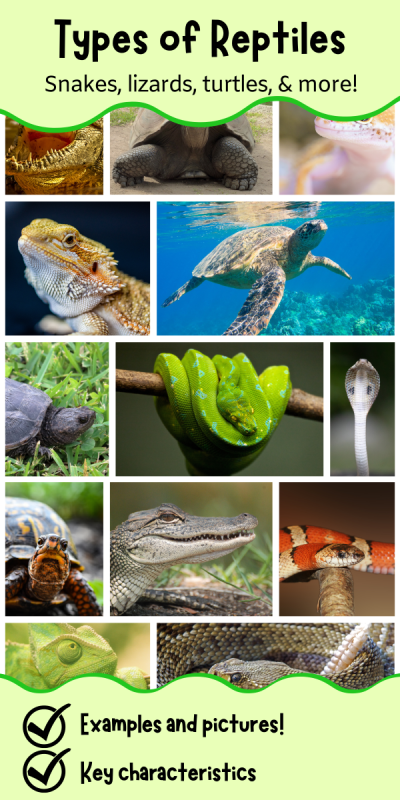
Reptiles are a cool group of critters – and not just because they are cold-blooded! In this post, you will read about the different types of reptiles: snakes, lizards, turtles, tuataras, and crocodilians. Each of these groups has its own unique characteristics but also has several key traits shared with all reptiles.
A note for teachers: Are you an educator planning a reptiles lesson? I think you’ll love my Reptiles Unit, which can also be found within my even more comprehensive Vertebrates Bundle. The information and some of the artwork in this post come from the reptile unit. The unit also includes hands-on activities, thoughtfully crafted diagrams and visuals, handouts, worksheets, and everything you need to teach reptiles–plus you will support this blog with your purchase! 💚
Recommended products
-

Reptiles: a science unit exploring reptile adaptations, traits, & biodiversity
$12.00 -
Vertebrates Bundle: 5 units on amphibians, birds, fish, mammals, reptiles
Original price was: $54.00.$43.20Current price is: $43.20.

Reptiles are part of a bigger category of animals called vertebrates, which means they all have a backbone. There are seven different groups, or classes, of vertebrates on Earth. These include amphibians, birds, mammals, reptiles, and three kinds of fish.

Reptiles are not always the easiest group to define. There is a lot of diversity within this group. From legless snakes to shelled turtles and armored crocodiles, the reptile group has some incredible creatures. Unlike other classes of vertebrates, scientists now know that the group we call reptiles is not an isolated evolutionary lineage. This means that some members of the reptile group are not quite as closely related as we once thought they were.
What counts as a reptile?
Some reptiles might seem very different from one another, but all types of reptiles share a few special traits. You can use these traits to help you identify reptiles:
- A backbone
- Breathe air with at least 1 functional lung
- Scales or scutes
- Ectothermic


From the cute gecko to the venomous rattlesnake, and everything in between, there are so many unique creatures to discover in the world of reptiles! The main types of reptiles covered in this post are: lizards & snakes, tuataras, turtles, and crocodilians.
1. Lizards

Order:
- Squamata
- Note: snakes and lizards belong to the same order
Key traits:
- Usually (but not always) four limbs
- Long tail
- External ear holes
- Scales
Fun Facts:
Some species of lizards can drop their own tails when they feel threatened. This is a great defense because a predator will be distracted by the tail while the lizard escapes. The tail later regrows.
Examples:
Skink, gecko, iguana, chameleon, anole
2. Snakes

Order:
- Squamata
- Snakes belong to the suborder Serpentes
Key traits:
- No limbs
- Long, slender body
- Forked tongue
- No ear holes
- Scales
Fun Facts:
Snakes have nostrils for breathing but smell using their tongues.
There are about 600 venomous snake species in the world, but only a few poisonous snake species.
Examples:
Cobra, python, rattlesnake, boa, garter snake
3. Tuatara

Order:
- Rhynchocephalia
Key traits:
- Four limbs
- Long tails
- Spiny back
- No ear holes
- Scales
Fun Facts:
The tuatara is only found in New Zealand. Despite its lizard-like looks, the tuatara is not a lizard. Lizards and snakes are in the order Squamata, but the tuatara belongs in its own order, Rhynchocephalia. All animals in this order except for the tuatara are extinct today.
4. Turtles

Order:
- Testudines
Key traits:
- Four limbs
- Short tail
- Bony shell with scutes
- No ear holes
- Scales
Fun Facts:
Turtles and tortoises can live to be very old. The Galapagos giant tortoise can live for over 150 years. Even small turtles can live for decades. Many people do not realize a pet turtle can be a lifelong responsibility!
Examples:
Snapping turtle, sea turtle, desert tortoise, box turtle
5. Crocodilians

Order:
- Crocodilia
Key traits:
- Four limbs
- Long tails
- Semi-aquatic
- Covered in scutes
- Large predators with powerful jaws
Fun Facts:
Crocodilians are some of the closest living relatives of the dinosaurs.
The saltwater crocodile, the largest crocodilian, can reach a length of over 20 feet (6 meters)!
Examples:
Alligator, crocodile, caiman
Study Reptiles in Your Classroom:
Are you teaching about reptiles in your classroom or homeschool? There’s no need to scramble to create the perfect set of materials for a reptile unit – I’ve already done it for you! You and your students will love studying reptiles with my complete Reptiles Unit!
-
 $12.00
Explore more units from Wild Earth Lab:
If you enjoyed this post, I know you will love using my environmental science learning materials in your classroom!


Are you interested in reading more posts like this? Subscribe or follow Wild Earth Lab using the links below!
References and Further Reading
- Discovery UK (2019). What On Earth Is A Tuatara? | Modern Dinosaurs (YouTube Video). Available: https://www.youtube.com/watch?v=44JUXPzEI2U
- Greater Cleveland Aquarium (2019). EXPLORING SIMILARITIES, CELEBRATING DIFFERENCES: AMPHIBIANS AND REPTILES. Available: https://www.greaterclevelandaquarium.com/exploring-similarities-celebrating-differences-amphibians-and-reptiles/
- Uetz, P. (1996). General Information (and “FAQ”). The Reptile Database. Available: http://www.reptile-database.org/db-info/introduction.html