
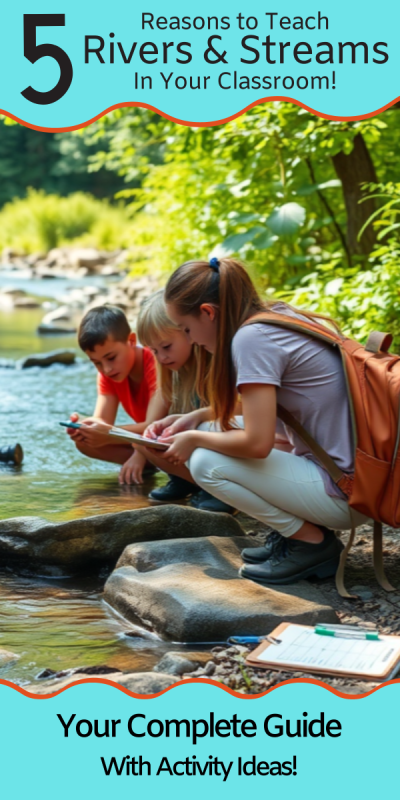

Rivers and streams provide endless opportunities for scientific exploration and discovery – and chances are you can find one right in your community! From their chemistry and physics to their role in ecosystems and human communities, rivers and streams offer excellent opportunities to teach critical concepts in science and math in an applied way. Across many grade levels, incorporating rivers and streams into your curriculum is a fantastic way to spark curiosity and make learning meaningful. Here are five compelling reasons to study rivers and streams in your classroom this year.
Before we dive in: If you’re an educator planning to teach rivers and streams, great learning resources are key to deepening understanding! I think you and your students will love my complete Science on the River Unit (plus you’ll support my blog with your purchase! ❤️)

1. Rivers and Streams Are an Interdisciplinary Subject
One of the most exciting aspects of studying rivers and streams is their interdisciplinary nature. Studying natural waterways relates to many fields of science, allowing students to apply knowledge across disciplines:
- Chemistry: Investigate water quality by measuring pH levels, electrical conductivity, or analyzing dissolved oxygen.
- Physics: Study fluid mechanics, such as how a stream’s velocity varies with depth, width, and around river bends.
- Ecology: Explore river ecosystems, food webs, and macroinvertebrate populations that indicate water quality and river health.
- Geology: Discuss rivers’ role in shaping landscapes and carving out canyons over time.
- Environmental Science: discuss the challenges facing rivers today, including water conservation, changes in flow due to climate change, pollution from urban and agricultural runoff, and flooding.
By approaching rivers and streams as an interdisciplinary subject, you can help students see how different scientific fields work together to solve real-world problems.
2. Opportunities for Hands-On Learning Activities
Rivers and streams offer a wealth of hands-on learning opportunities that engage students in scientific investigation. Measuring stream flow is a simple yet effective activity that brings science concepts to life. By timing how long it takes for an object to travel a set distance downstream, students can calculate the velocity of a stream.
Other hands-on activities include collecting water samples, catching and identifying aquatic insect larvae, and identifying floodplains and high-water lines. Many of these activities can be conducted with minimal equipment, making them accessible even for classrooms with limited resources. Hands-on learning not only reinforces concepts but also encourages students to ask questions, explore their surroundings, and develop critical thinking skills.

3. A Perfect Example of Applied Math
Studying rivers and streams is an excellent way to integrate applied math into your science curriculum. Hydrologists and engineers rely on mathematics to analyze water flow, predict floods, and manage water resources. By engaging in similar calculations, students can see how math is used to solve real-world problems. Here are a few ways to apply math when studying rivers:
- Geometry: students can estimate the cross-sectional area of a river using width and depth data.
- Arithmetic: students can calculate river discharge using the formula Q=A×V, where Q is discharge, A is the cross-sectional area of the stream, and V is the velocity of the flowing water.
- Probability: students can determine the likelihood of floods based on historical data.
- Calculus: For more advanced learners, you can introduce calculus concepts like rating curves. Hydrologists use rating curves to estimate stream discharge based on water height.
These activities reinforce math skills and show students how math is a valuable tool for understanding the natural world.

4. A Great Excuse to Take Learning Outside
Studying rivers and streams provides an opportunity to step outside the classroom and into nature. Field trips to local rivers, streams, or creeks allow students to apply textbook knowledge and observe concepts they’ve studied first-hand. They can look for signs of ecosystem health, observe different river features like goosenecks or riffles, and identify types of river channels.
Outdoor activities not only make lessons more memorable but also help students connect with their local environment. A river field trip can foster an appreciation for rivers and nature in general. Connecting with their local rivers on a field trip may even inspire your students to become involved in local conservation and habitat restoration efforts. If you visit a river with your class, spend 15 minutes picking up trash to leave it nicer than you found it.

5. Rivers and Streams Are Vital to Our Communities
Rivers and streams play a critical role in human communities, providing drinking water, supporting agriculture, and offering recreational opportunities. By studying these waterways, students can gain a deeper understanding of how rivers impact their daily lives.
Lessons can focus on the challenges of managing rivers sustainably or the impact of pollution and climate change on streams. For example, you can discuss how urban development affects stormwater runoff or how conservation efforts have improved water quality in a local river. Understanding the role of rivers and streams in our communities helps students see the relevance of their studies and fosters a sense of responsibility for protecting these vital resources.
Study this topic with Wild Earth Lab!
There’s no need to scramble to put together the perfect rivers lesson – I’ve already created it for you! This set includes all the worksheets, project guides, and printable materials you need for studying rivers and streams.
Explore more lessons from Wild Earth Lab:
If you enjoyed this post, I know you will love trying my other printable science and nature units!


Are you interested in reading more posts about fascinating science topics? Subscribe or follow Wild Earth Lab using the links below!