
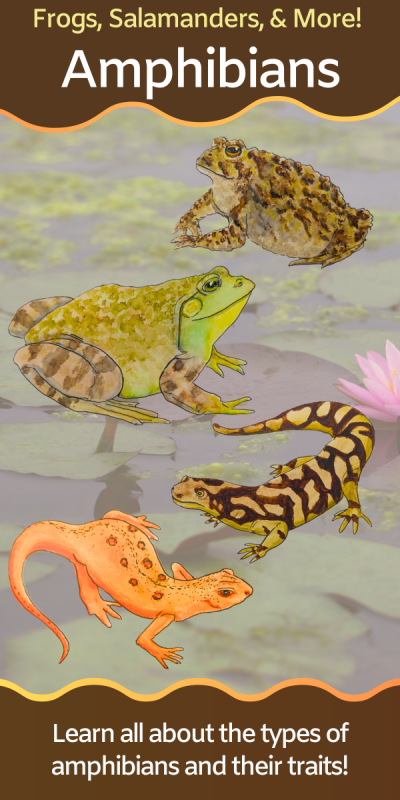

Amphibians are a diverse group of vertebrate animals. They come in many shapes and sizes—from long-tailed salamanders to tailless frogs and even legless caecilians! Some are huge, like giant salamanders that grow to nearly six feet (two meters) long, while others are so tiny they could sit on your pinky finger. Amphibians also display striking colors, like the brightly patterned fire salamander or the brilliantly hued—but toxic—poison dart frog. In this post, we’ll explore the different types of amphibians – some you’ve probably seen before, and perhaps a few you’ve never heard of!
📚A Note for Teachers 🍎: If you’re an educator planning to teach amphibians, great learning resources are key to deepening understanding! I think you and your students will love my complete Amphibian Unit (plus you’ll support my blog with your purchase! ❤️)

There are 3 main types of amphibians: frogs, salamanders, and caecilians. Each has its own unique characteristics, described below.
Frogs and Toads


- Class: Amphibia
- Order: Anura
Key traits
Frogs and toads are amphibians with four limbs and no tails as adults. They also have powerful hind legs and vocal sacs for croaking. Frogs and toads start their lives in water as aquatic larvae called tadpoles. As tadpoles, they have gills and a tail for swimming. As frogs develop, they grow lungs and most species can come onto land. There are, however, some frogs that are aquatic as adults, such as African clawed frogs.
But even adult frogs like to live in damp habitats to help keep their moist skin from drying out. Frogs, like all amphibians, have moist skin rather than scales – one of the differences between reptiles and amphibians. Their skin is permeable, allowing them to drink water and breathe air through their skin.
Examples of Frogs and Toads
- Bullfrog
- Grass frog
- Tree frog
- Poison dart frog
- Common toad
- African clawed frog
Fun Fact
There are about 5,000 different species of frog worldwide! They are found on 6 of 7 continents (everywhere but Antarctica).
Salamanders


- Class: Amphibia
- Order: Urodela
Key traits
Salamanders are amphibians with long, thin tails and usually four limbs. Like all amphibians, they have moist skin that they can breathe through. Most salamanders also have gills, lungs, or even both at different stages of their life cycle. Like frogs, most salamanders go through metamorphosis. The larvae are often aquatic, with no limbs, tails for swimming, and frilly-looking external gills around their necks. Adults may live in water, on land, or both, depending on the species. Like all amphibians, adult salamanders are carnivores – often they eat small invertebrates.
Perhaps you’re wondering, what is the difference between a salamander and a newt? A newt is one type of salamander. So while all newts are salamanders, not all salamanders are newts.
Examples of Salamanders
- Tiger salamander
- Giant Salamander
- Newt
- Axolotl
- Amphiuma
Fun Facts
Salamanders struggle to lift their bodies off the ground due to the position of their limbs on the sides of their bodies. To walk on land, they must wiggle from side to side while dragging their bodies across the ground.
The axolotl is a species of salamander that never grows up (sort of)! Even as an adult, it lives in water and has gills like a larva.
Caecilians

- Class: Amphibia
- Order: Gymnophiona
Key traits
The third type of amphibian is caecilians. If you’ve never heard of them or seen one, don’t worry! They are only found in the tropics, and they live underground, burrowing in the soil.
Caecilians are different from other amphibians in several ways. They have no legs, and long, worm-like bodies with grooves or rings that look like segments. Furthermore, caecilians don’t go through metamorphosis like frogs and salamanders.
Fun Facts
Though they have no legs, caecilians evolved from a legged ancestor. Over many generations, they lost their legs since they didn’t need them to survive in their habitat.
What’s Next?
Continue reading about the different types of reptiles or the different types of mammals. Or learn about the differences between reptiles and amphibians.
Study this topic with Wild Earth Lab!
There’s no need to scramble to put together the perfect lesson for teaching amphibians – I’ve already created it for you! This set includes all the printable materials you need for studying amphibians.

Explore more lessons from Wild Earth Lab:
If you enjoyed this post, I know you will love trying my other printable science and nature units in your classroom too!


Are you interested in reading more posts like this? Subscribe or follow Wild Earth Lab using the links below!
References and Further Reading
- Black, R. (2012). World’s Smallest Frog Discovered. BBC News. Available: https://www.bbc.com/news/science-environment-16491477
- Clark, M.A., Douglas, M., and Choi, J. (2018). Biology. Open Stax. Ch 29.3. Available: https://openstax.org/books/biology-2e/pages/29-3-amphibians
- Fowler, S., et al. (2013). Concepts in Biology. OpenStax. Ch 15.6. Available: https://openstax.org/books/concepts-biology/pages/15-6-vertebrates
- San Diego Zoo (n.d.). Chinese Giant Salamander. Available: https://animals.sandiegozoo.org/animals/chinese-giant-salamander
- San Diego Zoo (n.d.). Goliath Frog. Available: https://animals.sandiegozoo.org/animals/goliath-frog
- San Diego Zoo (n.d.). Salamander and Newt. Available: https://animals.sandiegozoo.org/animals/salamander-and-newt
- Wake, DB and Koo, MS. 2018. Primer: Amphibians. Current Biology 28(21): R1237-R1241. https://doi.org/10.1016/j.cub.2018.09.028