
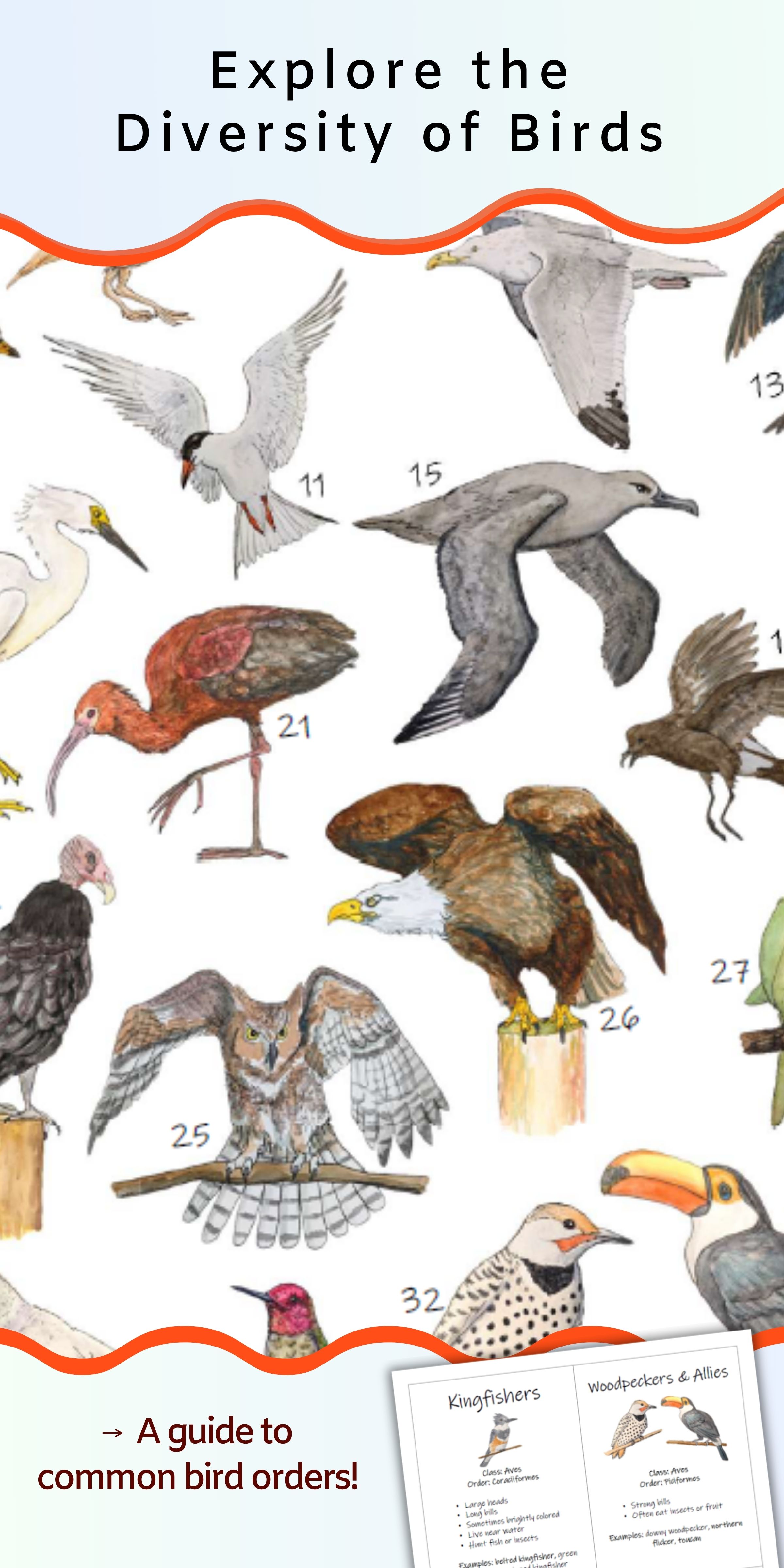

While all birds share some common traits, like feathers, a beak, and wings, birds are also a diverse group with a lot of variety. There are over 10,000 species of birds, and they range in size from tiny hummingbirds to towering ostriches. Birds also show remarkable diversity in behavior. Birds live on every continent, including Antarctica, and can be found in nearly every habitat—from forests and deserts to wetlands and open oceans. Some migrate thousands of miles each year, while others stay in the same place their entire lives. Their colors, calls, and nesting styles vary just as much as their sizes and shapes. If you’ve ever wondered “what are the main types of birds” or “how are birds grouped”, this post is here to help!
Birds are one of the main vertebrate classes, meaning they are a group of animals with a backbone. Other vertebrate classes include amphibians, mammals, fish, and reptiles. Within the class of birds, there are different subgroups called orders. Each order contains birds that share an evolutionary history – meaning they are like relatives. Because of this, birds in the same order often share traits, like size, body shape, or nesting style. Let’s take a look at a few well-known orders of birds.
For Teachers: If you’re an educator planning to teach your students about birds, I think you and your students will love my educational Birds Unit or the larger Bird Bundle. Plus, if you love the artwork in this post, you can find the same artwork and more in my units (and you’ll support my artistic work and blog with your purchase! ❤️)
Recommended products
-
Bird Bundle: 4 Complete Units for Ornithology with Kids
Original price was: $44.00.$35.20Current price is: $35.20. -

Birds: an ornithology unit with animal adaptations
$12.00

Gamebirds

Order: Galliformes
Gamebirds belong to the order Galliformes. They typically have rounded bodies and short wings. Consequently, it can take a lot of effort to get their bodies off the ground, and they often fly in short bursts. You may have seen a flock of turkeys or a pheasant take flight when startled, rapidly flapping their wings. Male gamebirds sometimes have elaborate plumage (feathers) that are large, showy, and/or colorful.
Examples: chicken, peacock, pheasant, turkey, quail
Waterfowl

Order: Anseriformes
Waterfowl are a group of water-dwelling birds including ducks, geese, and swans. However, not all birds that swim or live around water are waterfowl. For example, loons, grebes, and cormorants are not waterfowl.
Waterfowl make a special oil that repels water. They preen their feathers with this oil, which helps keep their feathers from soaking through with water when they swim. Waterfowl also have webbed feet for swimming. They often have rounded bodies and flat bills.
Examples: mallard, bufflehead, northern pintail, Canada goose, snow goose, tundra swan
Shorebirds

Order: Charadriiformes
Shorebirds are a special order of birds found along shores and mudflats. Shorebirds have some special adaptations that help them thrive in coastal habitats. They have long legs for moving fast on the ground. You may see them walking, running, or wading along beaches or in shallow water.
Many shorebirds build their nests directly on the ground, such as along dunes on the beach. Their nests are called “scrapes” because they carve out a nest in the sand or dirt, rather than piling up materials to make a nest. Many shorebirds are migratory, meaning they live in different habitats in different seasons, traveling back and forth each year by flight.
Examples: avocet, plover, sandpiper, stilt
Pigeons and Doves

Order: Columbiformes
Birds in the order Columbiformes have short bills and rounded bodies and heads. Birds in this order have shown great skills for adapting to live near humans. You’ve probably seen pigeons or doves in your neighborhood.
Examples: mourning dove, rock pigeon
Parrots

Order: Psittaciformes
Parrots are distinct, often brightly colored birds found in tropical places. They come in many sizes, from tiny parakeets to large macaws. They have strong, curved bills. Their feet are specially designed for climbing, with two toes facing forward and two toes facing back. This arrangement is called a “zygodactyl foot”, and it is great for clinging and climbing. Other birds with zygodactyl feet include woodpeckers and some owls. Parrots are known for being especially intelligent, and in some cases, mimicking human speech.
Examples: cockatoo, macaw, parakeet
Perching Birds

Order: Passeriformes
Passeriformes is the largest order of birds. It includes the birds commonly referred to as “songbirds”. These birds have feet designed for perching on branches, with one toe facing back and three toes facing forward. Perching birds are found across many different habitats and come in many colors. Most are relatively small birds and they are often the birds that visit backyard bird feeders.
Examples: blackbird, crow, finch, jay, sparrow, swallow, warbler, wren
Owls

Order: Strigiformes
Owls are a group of birds with rounded bodies, disc-like faces, and short necks. They are raptors, also called “birds of prey,” that are predators of smaller animals and insects. Owls are nocturnal, meaning they are active at night. Owls detect their prey using the sounds they make. Their disc-like faces actually help them hear by acting like a satellite dish for sound waves. Owls have sharp talons and beaks for grasping prey. When they swallow their prey whole, they regurgitate an “owl pellet” containing the prey’s bones, fur, and other undigestible parts.
Examples: barn owl, great horned owl, snowy owl
Penguins

Order: Sphenisciformes
Penguins are flightless seabirds found in the Southern Hemisphere. Some, but not all, types of penguins live in Antarctica. Though they cannot fly, they are excellent swimmers. Their webbed feet and fin-like wings help them “fly” underwater and hunt for fish.
Examples: Adélie penguin, emperor penguin, rockhopper penguin
Even more birds…
These are far from the only orders of birds. In fact, there are 41 different orders of birds in total! One of the best ways to explore the diversity of birds is to get outside and look for birds in an area near you. There are many great tools out there for identifying birds. Great resources include:
- The Merlin App – identify birds by snapping photos or recording birdsong
- The All About Birds website from Cornell Lab – with species profiles and maps
- Audubon.org – with a guide to North American birds
- Wild Earth Lab’s bird units – great for teaching kids about birds. (see below)
Study birds with Wild Earth Lab!
Are you learning about birds with kids? Whether you’re a parent, educator, or an environmental outreach group, my units will help you and your little learners explore the amazing world of birds together.
Recommended products
-
Bird Bundle: 4 Complete Units for Ornithology with Kids
Original price was: $44.00.$35.20Current price is: $35.20. -

Birds of Prey: a raptor unit for kids
$8.00 -
Birds: an ornithology unit with animal adaptations
$12.00 -

Sea & Shorebirds: a wildlife unit for the coast!
$12.00 -

Waterfowl & Waterbirds: a wildlife unit with animal adaptation activities!
$12.00
Find your next science topic, from Wild Earth Lab…
If you enjoyed this post, I know you will love trying my other printable science and nature units in your classroom too!


Are you interested in reading more posts about wildlife? Subscribe or follow Wild Earth Lab using the links below!
References and Further Reading
- Clark, M., Douglas, M., Choi, J. (2018). Biology 2e. Open Stax. Ch. 29. Available: https://openstax.org/books/biology-2e/pages/29-5-birds
- Dahle, L. (n.d.). 20 TYPES OF SHOREBIRDS IN THE UNITED STATES! (ID GUIDE). Bird Watching HQ. Available: https://birdwatchinghq.com/shorebirds-in-the-united-states/
- Golden Gate Bird Alliance (n.d.). Types of Bird Nests. Available: https://goldengatebirdalliance.org/conservation/make-the-city-safe-for-wildlife/tree-care-and-bird-safety/types-of-bird-nests/
- Jaramillo, A. (2017). Shorebirds 101: What to Look for When You Hit the Water. Audubon. Available: https://www.audubon.org/news/shorebirds-101-what-look-when-you-hit-water
- Penguins International (n.d.). Penguin Species. Available: https://www.penguinsinternational.org/penguin-species
- Reeves, N., et al. (2013). Concepts in Biology. Open Stax. Ch. 15.6. Available: https://openstax.org/books/concepts-biology/pages/15-6-vertebrates