


A stream or river is a natural, flowing waterway on the land’s surface. Stream channels are long, narrow depressions in the land where water flows. There are several common river channel types, also known as the major plan forms.
Before we dive in: If you’re an educator planning to teach about rivers, having great visuals to deepen understanding is key! You can find materials for teaching channel types/plan forms within my comprehensive Science on the River Unit. It also includes activities for measuring stream discharge, lessons on drainage patterns, and stream diagrams (plus you’ll support my blog with your purchase! ❤️)


As a river flows from its headwaters out to the sea, it usually transitions between several different plan forms. The river channel is shaped by the surrounding landscape, underlying rock type(s), sediment availability, and flow regime (i.e., variation in the amount of water flowing through a river, including the magnitude and frequency of different-sized floods).
Different rivers naturally have different plan forms – and that’s a good thing! You will find healthy streams and rivers with various natural planforms – no one planform is necessarily better than the others. It is best for a river to be as close to its natural state as reasonably possible.
The major planforms are straight, meandering, braided, and anastomosing. Next, let’s take a look at the different types of river channels you may see:
Straight River Channels
Straight channels are seen in areas where the landscape is steep, such as on the side of mountains or in straight, narrow valleys. The stream or river’s channel appears mostly straight with few curves or bends.


Meandering River Channels
A meander is a curve in a stream. Subsequently, a meandering river is curving with many noticeable bends or turns. Meandering channels are seen in areas where the topography is gentle or nearly flat, such as plains and wide valley bottoms. Even subtle changes in the land’s surface can shape the river’s path since water always flows downhill in the path of least resistance. Flow is fastest on the outside of a curve, causing erosion. In contrast, flow is the slowest on the inside of a curve. Sediments settle out of the water and accumulate on the insides of curves, where water flows slowest, forming point bars.

Notably, some meanders are curvy and nearly double back on themselves, forming a loop. These extra curvy meanders are called goosenecks. Over time, the fast waters on the outside curves of a gooseneck wear down the banks. Eventually, the curves erode all the way through so that the flowing river water bypasses the gooseneck, cutting off the loop. Then, the former gooseneck becomes a water feature known as an oxbow lake.


Braided River Channels
Braided channels are seen in many locations, including deserts, plains, glacial outwash, and coastal areas. The river channel contains sediment bars, giving it a braided appearance. For a braided channel to form, there must be plenty of sediment available in the channel to build up bars. Bars can be made of a variety of sediments: silts and sands, gravels, or larger stones.
The locations and shapes of sediment bars change over time. Although the bars in a braided channel may look permanent, the sediment is slowly making its way downstream toward the ocean. The powerful, flowing water carries each grain of sediment a short distance at a time. In fact, a single piece of sediment may travel a short distance rapidly, then settle onto a bar or the riverbed for days, months, or even years before it moves again. Even so, large floods can cause rapid changes in the locations and appearances of the bars in a braided river.

Anastomosing River Channels
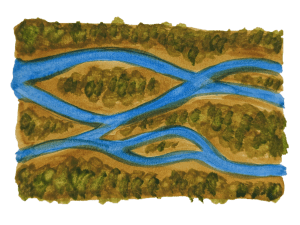
In an anastomosing channel, multiple river channels are separated by large, vegetated bars or islands. This gives the appearance of a few separate stream channels rather than one main channel. Braided rivers and anastomosing rivers are similar because they both have multiple channels that intertwine. The main difference between anastomosing rivers and braided rivers is that the channels of an anastomosing river are separated by semi-permanent islands, while the sediment bars of a braided river are more ephemeral (short-lived).
Teaching Rivers in Your Classroom
Are you an educator planning to teach about rivers? You can save time preparing lessons by using my complete Science on the River Unit below. Plus, you’ll support Wild Earth Lab with your purchase!


Keep reading about rivers, streams, and freshwater…
Recommended Posts:
5 Reasons to Teach Rivers and Streams in Your Classroom
Rivers and streams provide endless opportunities for scientific exploration and discovery – and chances are you can find one right in your community! From their chemistry and physics to their role in ecosystems and human communities, rivers and streams offer excellent opportunities to teach critical concepts in science and math in an applied way. Across…


Freshwater Visualization: Learning Activity With Kitchen Measurements
It’s hard to imagine just how little freshwater exists on Earth compared to saltwater. If you’re teaching the water cycle, your students might be amazed to learn that less than 3% of the Earth’s water is freshwater—the rest is saltwater. In this post, I’ll show you a hands-on freshwater learning activity that uses simple kitchen…
Explaining The Water Cycle in 10 Stages
The water cycle is the process that keeps our planet’s water in constant motion. From evaporation to groundwater flow, each step plays a vital role in shaping our environment and life on our planet. In this post, we’ll explore 10 key processes in the water cycle, breaking down how each one works. For teachers: If you’re…
Measuring Soil Infiltration Rates: A Science Classroom Activity
Are you teaching the water cycle or studying soil in your classroom or homeschool? Measuring infiltration rates in different types of soils is a hands-on activity that helps students explore how water interacts with the ground. This soil infiltration activity also ties in perfectly with studies of porosity and permeability. This engaging experiment works as…
DIY Rain Gauge Activity for Teaching the Water Cycle
Teaching your students about the water cycle? Building a DIY rain gauge from a plastic bottle is a fun, hands-on activity to explore a key water cycle process: precipitation. This simple project is perfect for your classroom or homeschool and can be a stand-alone lesson or part of a larger study of water cycle processes.…
Find your next science topic from Wild Earth Lab…
Recommended products
-

Macroinvertebrates: a hands-on aquatic ecology unit!
$15.00 -

Rocks and Minerals: a geology unit with lab activities!
$15.00 -

Science in the Snow: an applied STEM unit with lab activities!
$10.00 -

Soil Science: STEM unit with 5 hands-on lab activities
$12.00 -

The Sun and Stars: an astronomy unit with hands-on STEM activities!
$12.00 -

The Water Cycle: a science unit + hands-on lab activities!
$8.00
Are you interested in reading more posts like this? Subscribe or follow Wild Earth Lab using the links below!
References and Further Reading
- National Park Service (n.d.). Fluvial Features: Meandering Streams. Available: https://www.nps.gov/articles/meandering-stream.htm
- National Park Service (n.d.). Fluvial Features: Braided Streams. Available: https://www.nps.gov/articles/braided-stream.htm
- Plummer, C. C., Carlson, D. H., & Hammersley L. (2019) Physical Geology. New York, NY: McGraw-Hill Education. (16th ed., ch. 10).