


Catching aquatic macroinvertebrates is an exciting, hands-on activity that makes for an unforgettable ecology field trip. This is an outdoor activity and is a great way to examine the diverse organisms of freshwater ecosystems with your homeschool or science class. This activity will enhance your classroom studies of biodiversity, bioindicators, entomology, or aquatic food webs. In this post, I’ll guide you through three different techniques to successfully catch and observe aquatic macroinvertebrates. Let’s begin!
Before we dive in: If you’re an educator planning to teach macroinvertebrates, great visuals and activities are key to deepening understanding! I think you and your students will love my complete Macroinvertebrates Unit (plus you’ll support my blog with your purchase! ❤️)


What are aquatic macroinvertebrates?


An aquatic macroinvertebrate is an animal with no backbone that lives in or on water and is big enough that you can see it with your naked eye. This includes animals like aquatic insects, other aquatic arthropods, aquatic mollusks, aquatic worms, and more.
Macroinvertebrates play an important role in aquatic ecosystems. Many macroinvertebrates help recycle nutrients back into the food web by consuming detritus (decaying matter) that settles to the bottom of the water. They may also eat algae or even other macroinvertebrates. These tiny creatures are an important food source for fish, birds, and other animals that live in and around ponds, streams, and wetlands.
Furthermore, aquatic macroinvertebrates are used by scientists as bioindicators – basically, they help tell us if a stream, pond, or wetland is healthy. You can read more about macroinvertebrates and their use as bioindicators in this blog post.
Catching Aquatic Macroinvertebrates Activity
Materials
Each group will need the following materials.
- Fine-mesh net such as a pool net for collecting aquatic macroinvertebrates
- Tweezers
- Large, deep-sided pans (e.g., foil roast pans, pie tins)
- Small jars or containers with holes in the lids
- Footwear and clothing for shallow wading
- Student handouts & worksheets (part of my macroinvertebrates unit, in my shop)


Set-Up & Directions
Safety Note: Only attempt activities in extremely shallow, easily wadable streams and water bodies. Do not enter deep or swiftly moving water. Adult supervision is required at all times while in and around water.
- Assign groups of 2-4 students.
- Introduce and demonstrate the three methods for collecting aquatic macroinvertebrates (details below).
- Pass out the materials.
- Allow students to try out the three methods for collecting aquatic macroinvertebrates (details below).
- Aquatic macroinvertebrates like to be in water and cannot survive for long out of water. While examining your aquatic macroinvertebrate catches, be sure to always keep them in a pan or jar of water.
- At the end of the activity, instruct students to gently pour the aquatic macroinvertebrates back into the pond or stream.
Method 1: Flipping over rocks


Works best in: shallow flowing or standing water
In shallow water such as near the edge of a pond or stream, flip over submerged rocks and logs. Benthic (bottom-dwelling) macroinvertebrates such as insect larvae are often clinging to the underside of rocks or logs. Use tweezers or fingers to gently remove the macroinvertebrates from the rock/log and place them in a pan filled with water.
Method 2: Net in flowing water


Works best in: shallow flowing water only
Have one person hold a net touching the bottom of a shallow stream, facing upstream. This should allow water to flow through the net. A second person will use their hands to gently move and scrub the rocks and sediments directly upstream of the net. As you scrub, macroinvertebrates will let go of the rocks and the flowing water will sweep them directly into the net. Empty the net’s contents into a pan filled with water.
Method 3: Net in standing water


Works best in: shallow standing water
You may be familiar with this technique as pond dipping. Use a net to scoop up sediments and plant matter from the bottom of a pond and empty it into a pan of water. Use tweezers to pick through the sample to find the aquatic macroinvertebrates that were hiding in the sediments and plant matter. You can place the macroinvertebrates you pick out into a separate small jar filled with water.
Identifying Aquatic Macroinvertebrates
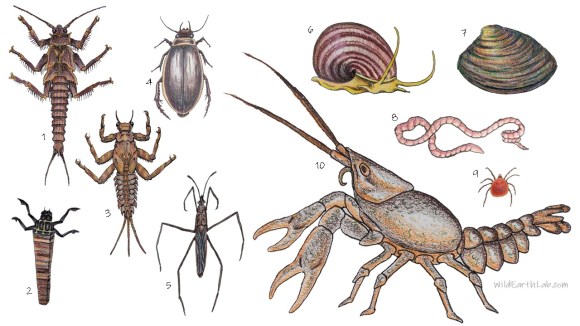
There are many types of aquatic macroinvertebrates. Once you catch some macroinvertebrates, you will probably want to sort them into a few basic categories to begin with.
Aquatic macroinvertebrates include:
- Aquatic insects:
- Larvae/nymphs (e.g., EPT, dragonflies, dipterans)
- Insects that are aquatic for their whole life cycle (e.g., water scorpions, water beetles)
- Crayfish
- Aquatic snails
- Aquatic worms
- Bivalves
- Water mites

Resources for Macroinvertebrate ID:
You have options when it comes to identifying macroinvertebrates. For beginners and younger learners, you may wish to sort macroinvertebrates into just a few basic categories (e.g., insects, worms, bivalves, etc.). Middle and high school classes often identify aquatic insects by order (e.g., mayflies, stoneflies, caddisflies, dipterans, etc.).
University-level classes and researchers sort macroinvertebrates down to the family, genus, or even species level. This level of ID typically requires a dissection microscope and a dichotomous key.
There are many resources for identifying aquatic macroinvertebrates and aquatic insects. Here are a few:
- Troutnut is a fly fishing website with some wonderful photos of aquatic insects. It’s a great resource if you’re already pretty familiar with aquatic insects and ID at the genus/species level
- This webpage from the University of New Hampshire has many aquatic insect photos and a stream key for advanced ID (genus/species level)
- My Macroinvertebrates Unit has beginner-friendly materials for studying aquatic macroinvertebrates and identifying aquatic insects at the order level
- My macroinvertebrates flashcards (these are found in the unit, but you can also purchase them separately here)


Expanding on this Activity
Once you’ve learned how to catch aquatic macroinvertebrates, there are many ways that you can expand on this activity. Here are just a few ideas:
- Compare two locations: compare the macroinvertebrates captured in flowing and standing water. Are they the same or different?
- Life stages: bring a butterfly net and also capture flying insects in the area. Many aquatic insects like mayflies, stoneflies, caddisflies, dragonflies, and more are only aquatic until they reach maturity. Can you capture the flying adult forms of any aquatic macroinvertebrates around your pond or stream?
- Sorting & counting: in ecology, “richness” refers to the number of different taxa (e.g., species, orders) found in a community. This is an important measure of biodiversity and one of many metrics that ecologists use to assess the health of an ecosystem. Introduce this concept to your students by having them create a list of the different types aquatic macroinvertebrates that they find during the field trip activity.
Teach Macroinvertebrates with Wild Earth Lab
Planning to teach this activity? Save time and support my blog when you purchase my Macroinvertebrates Unit, referenced throughout this post.
The unit includes everything you need to complete this activity: student handouts, worksheets, and readings, plus tons of other materials for learning all about macroinvertebrates!
Explore other units from Wild Earth Lab’s shop:
If you enjoyed this post, I know you will love using my environmental science materials in your classroom!


Are you interested in reading more posts like this? Subscribe or follow Wild Earth Lab using the links below!